AQA · A-Level · Physical Education
Course version: 7582 · Version from Sept 2016
Baddeley and Hitch, working memory model memory system.
Full specification wording
General information processing model, to include:: Baddeley and Hitch, working memory model memory system.
Baddeley and Hitch proposed the working memory model as a system for temporarily holding and manipulating information during cognitive tasks.
Checked against the AQA 7582 specification (opens in a new tab) on .
- Point 10 of 13
- 4 key terms
Study notes
From the checked teaching notes for this specification point.
The idea
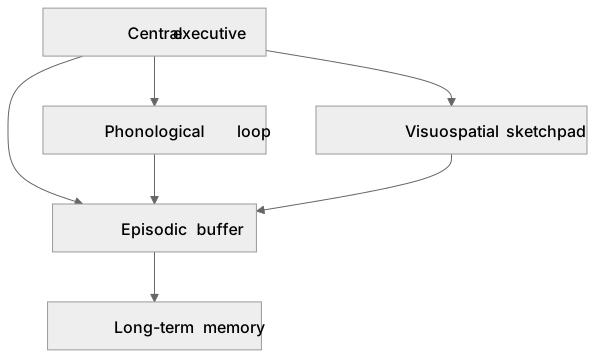
Baddeley and Hitch proposed the working memory model as a system for temporarily holding and manipulating information during cognitive tasks. It contains a central executive that controls attention and coordinates three slave systems: the phonological loop, which holds verbal and acoustic information; the visuospatial sketchpad, which holds visual and spatial information; and the episodic buffer, which integrates information from the other components and links it to long-term memory. In sport, a footballer may use the phonological loop to remember a coach's verbal instruction, the visuospatial sketchpad to track player positions, and the central executive to decide the next pass. The model explains how several pieces of information can be processed at once during performance.
What earns the marks
- The working memory model was proposed by Baddeley and Hitch.
- The central executive controls attention and coordinates the slave systems.
- The phonological loop processes verbal and acoustic information.
- The visuospatial sketchpad processes visual and spatial information.
- The episodic buffer integrates information across components and links it to long-term memory.
- The model explains simultaneous temporary storage and manipulation of information during tasks.
Common mistakes and how to put them right
Misunderstanding: the central executive stores information itself.
Put it right: It controls attention and coordinates the slave systems rather than acting as a store.
Misunderstanding: the phonological loop handles visual information.
Put it right: It handles verbal and acoustic information, while the visuospatial sketchpad handles visual and spatial information.
Misunderstanding: the episodic buffer is the same as long-term memory.
Put it right: It is a temporary store that integrates information and links it to long-term memory.
Misunderstanding: working memory is the same as short-term memory.
Put it right: Working memory includes active manipulation and coordination, not just passive storage.
Exam tips
- Match each component to its function before selecting an option, especially central executive versus slave systems.
- Reject options that give a slave system a function belonging to another component.
- Use a sporting scenario to test each option, such as remembering a verbal cue while tracking opponents.
Try the lesson
The start of the General information processing model, to include:: Baddeley and Hitch, working memory model memory system. lesson, made from checked teaching notes for this specification point.
Have a go first
In the working memory model proposed by Baddeley and Hitch, which component acts as the overall control system that allocates attention and decides which information is processed?
Listen
Baddeley and Hitch proposed the working memory model as a system for temporarily holding and manipulating information during cognitive tasks. It contains a central executive that controls attention and coordinates three slave systems: the phonological loop, which holds verbal and acoustic information; the visuospatial sketchpad, which holds visual and spatial information; and the episodic buffer, which integrates information from the other components and links it to long-term memory. In sport, a footballer may use the phonological loop to remember a coach's verbal instruction, the visuospatial sketchpad to track player positions, and the central executive to decide the next pass. The model explains how several pieces of information can be processed at once during performance. A strong answer earns marks for these points. The working memory model was proposed by Baddeley and Hitch. The central executive controls attention and coordinates the slave systems. The phonological loop processes verbal and acoustic information. The visuospatial sketchpad processes visual and spatial information. A common slip: Misunderstanding: the central executive stores information itself. Instead, it controls attention and coordinates the slave systems rather than acting as a store. Exam tip: Match each component to its function before selecting an option, especially central executive versus slave systems.
See it
Key words
Say what each word means before you turn the card.
Working memory components and functions
Try answering aloud or in your head before turning the card.
Attention and cognitive control
Try answering aloud or in your head before turning the card.
Verbal and visuospatial processing in sport
Try answering aloud or in your head before turning the card.
Integration of information for decision making
Try answering aloud or in your head before turning the card.
See every definition
- Working memory components and functions
- A system for temporarily holding and manipulating information during cognitive tasks, containing a central executive and three slave systems.
- Attention and cognitive control
- The central executive controls attention and coordinates the slave systems rather than acting as a store.
- Verbal and visuospatial processing in sport
- The phonological loop holds verbal and acoustic information, while the visuospatial sketchpad holds visual and spatial information.
- Integration of information for decision making
- The episodic buffer integrates information from the other components and links it to long-term memory.
Label the diagram
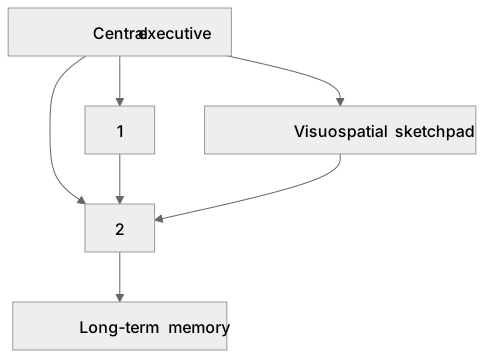
Some boxes have lost their names. Pick the right name for each number.
1Box 1
2Box 2
There is more to this lesson
The full lesson goes on to check your understanding and help you earn the marks. Create a free account to carry on, with your progress saved.
A week of Premium from your first lesson · Then the free plan continues · No card, no charge
Test your understanding of General information processing model, to include:: Baddeley and Hitch, working memory model memory system.
Active recall beats re-reading. Take an instant quiz now to test what you’ve learned and lock it into long-term memory.
A week of Premium from your first lesson · Then the free plan continues · No card, no charge