AQA · A-Level · Physical Education
Course version: 7582 · Version from Sept 2016
Short and long term memory
Full specification wording
General information processing model, to include:: Short and long term memory
Short-term memory (STM) is a limited-capacity, limited-duration store that holds information currently being attended to, whereas long-term memory (LTM) is a potentially unlimited store holding…
Checked against the AQA 7582 specification (opens in a new tab) on .
- Point 9 of 13
- 4 key terms
Study notes
From the checked teaching notes for this specification point.
The idea
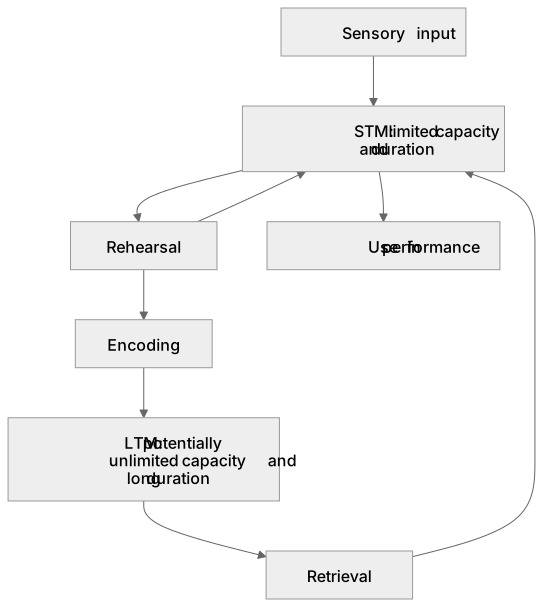
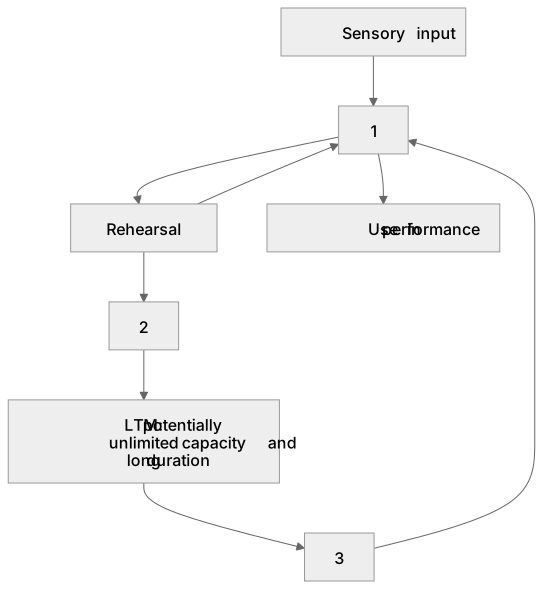
Short-term memory (STM) is a limited-capacity, limited-duration store that holds information currently being attended to, whereas long-term memory (LTM) is a potentially unlimited store holding information for long periods. In the general information processing model, sensory input enters STM, where it can be maintained by rehearsal; rehearsal and meaningful encoding transfer information into LTM, and retrieval brings it back into STM for use. For example, a gymnast rehearses a vault sequence in STM before it becomes an automatic LTM routine. Capacity and duration differ: STM holds a small number of items briefly, while LTM can retain vast amounts of motor and declarative knowledge. Understanding this distinction helps explain why skills need repeated practice to become permanent.
What earns the marks
- STM has limited capacity and limited duration, whereas LTM has potentially unlimited capacity and long duration.
- Information enters STM from sensory input and can be maintained by rehearsal.
- Rehearsal and encoding transfer information from STM into LTM.
- Retrieval brings stored information from LTM back into STM for use in performance.
- In physical activity, repeated practice moves a skill from conscious STM control towards automatic LTM storage.
Common mistakes and how to put them right
Misunderstanding: STM and LTM are the same store with different names.
Put it right: They are separate stores with different capacity and duration.
Misunderstanding: information passes directly from the environment into LTM.
Put it right: Sensory input first enters STM, and rehearsal or encoding is needed for transfer to LTM.
Misunderstanding: LTM is only for facts and never for movement skills.
Put it right: LTM stores motor programmes and procedural skills as well as declarative knowledge.
Misunderstanding: rehearsal is only repeating words silently.
Put it right: Rehearsal can be physical practice or mental rehearsal that strengthens the memory trace.
Exam tips
- Read the question carefully to identify whether it asks about capacity, duration, transfer or retrieval before choosing an option.
- Eliminate options that describe LTM as limited or STM as permanent, because these reverse the key features.
- Link each option to a sporting example, such as a tennis serve becoming automatic after many repetitions, to check it makes sense.
Try the lesson
The start of the General information processing model, to include:: Short and long term memory lesson, made from checked teaching notes for this specification point.
Have a go first
In the general information processing model, which store holds a limited amount of information for a brief period while a performer is actively using it?
Listen
Short-term memory (STM) is a limited-capacity, limited-duration store that holds information currently being attended to, whereas long-term memory (LTM) is a potentially unlimited store holding information for long periods. In the general information processing model, sensory input enters STM, where it can be maintained by rehearsal; rehearsal and meaningful encoding transfer information into LTM, and retrieval brings it back into STM for use. For example, a gymnast rehearses a vault sequence in STM before it becomes an automatic LTM routine. Capacity and duration differ: STM holds a small number of items briefly, while LTM can retain vast amounts of motor and declarative knowledge. Understanding this distinction helps explain why skills need repeated practice to become permanent. A strong answer earns marks for these points. STM has limited capacity and limited duration, whereas LTM has potentially unlimited capacity and long duration. Information enters STM from sensory input and can be maintained by rehearsal. Rehearsal and encoding transfer information from STM into LTM. Retrieval brings stored information from LTM back into STM for use in performance. A common slip: Misunderstanding: STM and LTM are the same store with different names. Instead, they are separate stores with different capacity and duration. Exam tip: Read the question carefully to identify whether it asks about capacity, duration, transfer or retrieval before choosing an option.
See it
Key words
Say what each word means before you turn the card.
Short-term memory (STM)
Try answering aloud or in your head before turning the card.
Long-term memory (LTM)
Try answering aloud or in your head before turning the card.
Rehearsal and encoding
Try answering aloud or in your head before turning the card.
Retrieval
Try answering aloud or in your head before turning the card.
See every definition
- Short-term memory (STM)
- A limited-capacity, limited-duration store that holds information currently being attended to.
- Long-term memory (LTM)
- A potentially unlimited store holding information for long periods.
- Rehearsal and encoding
- Processes that transfer information from STM into LTM, with rehearsal also maintaining information in STM.
- Retrieval
- The process that brings stored information from LTM back into STM for use.
Label the diagram
Some boxes have lost their names. Pick the right name for each number.
1Box 1
2Box 2
3Box 3
There is more to this lesson
The full lesson goes on to check your understanding and help you earn the marks. Create a free account to carry on, with your progress saved.
A week of Premium from your first lesson · Then the free plan continues · No card, no charge
Test your understanding of General information processing model, to include:: Short and long term memory
Active recall beats re-reading. Take an instant quiz now to test what you’ve learned and lock it into long-term memory.
A week of Premium from your first lesson · Then the free plan continues · No card, no charge