AQA · A-Level · Physical Education
Course version: 7582 · Version from Sept 2016
Group dynamics: Cohesion.
Cohesion is the strength of the bonds that hold a group together and keep its members working towards shared goals.
Checked against the AQA 7582 specification (opens in a new tab) on .
- Point 4 of 9
- 3 key terms
Study notes
From the checked teaching notes for this specification point.
The idea
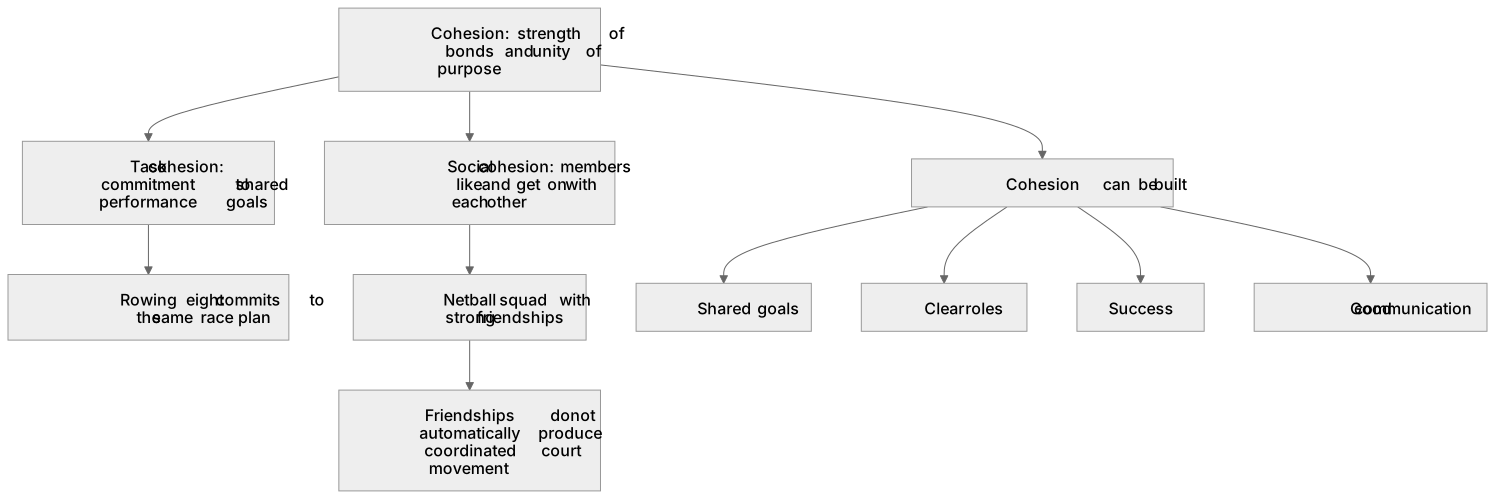
Cohesion is the strength of the bonds that hold a group together and keep its members working towards shared goals. In AQA A-level Physical Education, group dynamics distinguishes task cohesion, which concerns how united members are around achieving the performance goal, from social cohesion, which concerns how well members like and get on with each other. A rowing eight can show high task cohesion when all eight rowers commit to the same race plan even if they are not close friends; a netball squad may show high social cohesion through strong friendships that do not automatically produce coordinated court movement. Cohesion is therefore not simply friendship, and it is not fixed: it can be built through shared goals, clear roles, success and good communication.
What earns the marks
- Defines cohesion as the strength of bonds and unity of purpose within a group.
- Distinguishes task cohesion (commitment to shared performance goals) from social cohesion (interpersonal relationships and liking).
- Explains that high social cohesion does not guarantee high task cohesion, and vice versa.
- Applies cohesion to a sporting group, for example a rowing eight or netball squad, showing how it affects performance.
- Recognises that cohesion can be developed through shared goals, clear roles, communication and success.
Common mistakes and how to put them right
Treating cohesion as identical to friendship.
Put it right: Cohesion includes task cohesion, which is about shared performance goals, not only social liking.
Assuming a team with high social cohesion must perform well.
Put it right: Social cohesion and task cohesion are separate, and performance depends more directly on task cohesion.
Believing cohesion is fixed once a team is formed.
Put it right: Cohesion is dynamic and can be built or damaged by goals, roles, communication and results.
Exam tips
- Read the stem carefully to identify whether it describes shared goals (task) or interpersonal relationships (social).
- Use a named sporting example to test each option against the definition rather than relying on everyday use of the word 'cohesion'.
- Eliminate options that treat cohesion as a single fixed quality or as identical to friendship.
Try the lesson
The start of the Group dynamics: Cohesion. lesson, made from checked teaching notes for this specification point.
Have a go first
In the context of group dynamics in sport, what does cohesion describe?
Listen
Cohesion is the strength of the bonds that hold a group together and keep its members working towards shared goals. In AQA A-level Physical Education, group dynamics distinguishes task cohesion, which concerns how united members are around achieving the performance goal, from social cohesion, which concerns how well members like and get on with each other. A rowing eight can show high task cohesion when all eight rowers commit to the same race plan even if they are not close friends; a netball squad may show high social cohesion through strong friendships that do not automatically produce coordinated court movement. Cohesion is therefore not simply friendship, and it is not fixed: it can be built through shared goals, clear roles, success and good communication. A strong answer earns marks for these points. Defines cohesion as the strength of bonds and unity of purpose within a group. Distinguishes task cohesion (commitment to shared performance goals) from social cohesion (interpersonal relationships and liking). Explains that high social cohesion does not guarantee high task cohesion, and vice versa. Applies cohesion to a sporting group, for example a rowing eight or netball squad, showing how it affects performance. A common slip: Treating cohesion as identical to friendship. Instead, cohesion includes task cohesion, which is about shared performance goals, not only social liking. Exam tip: Read the stem carefully to identify whether it describes shared goals (task) or interpersonal relationships (social).
See it
Key words
Say what each word means before you turn the card.
Cohesion
Try answering aloud or in your head before turning the card.
Task cohesion
Try answering aloud or in your head before turning the card.
Social cohesion
Try answering aloud or in your head before turning the card.
See every definition
- Cohesion
- The strength of the bonds that hold a group together and keep its members working towards shared goals.
- Task cohesion
- How united members are around achieving the performance goal.
- Social cohesion
- How well members like and get on with each other.
Label the diagram
Some boxes have lost their names. Pick the right name for each number.
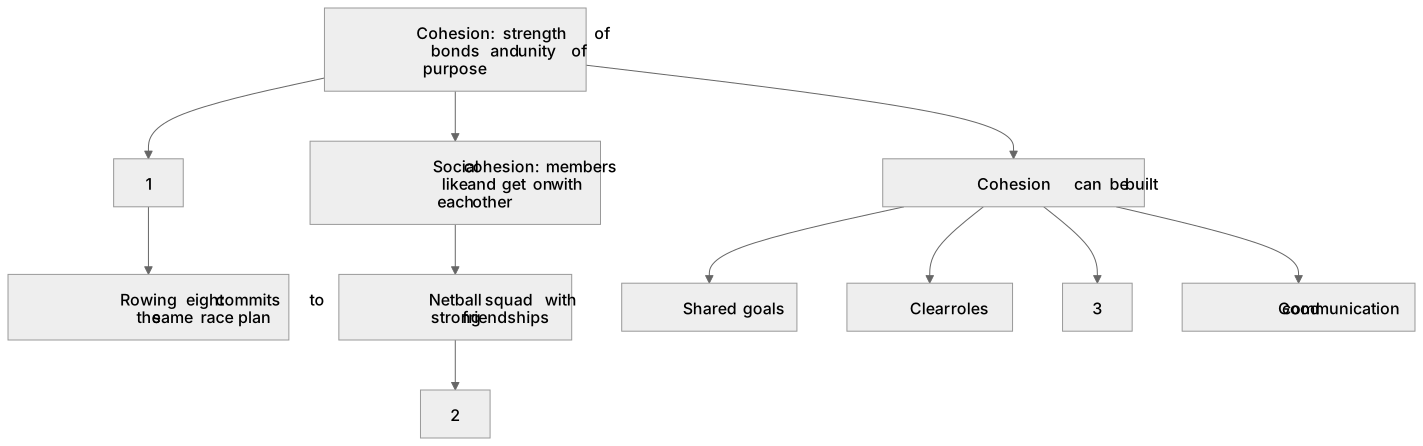
1Box 1
2Box 2
3Box 3
There is more to this lesson
The full lesson goes on to check your understanding and help you earn the marks. Create a free account to carry on, with your progress saved.
A week of Premium from your first lesson · Then the free plan continues · No card, no charge
Test your understanding of Group dynamics: Cohesion.
Active recall beats re-reading. Take an instant quiz now to test what you’ve learned and lock it into long-term memory.
A week of Premium from your first lesson · Then the free plan continues · No card, no charge