Group dynamics — AQA A-Level Physical Education
Verified courseTeaching note checked against the official specification.
Group dynamics in AQA A-Level PE examines how individuals interact within teams, focusing on Tuckman's stages of group formation (forming, storming, norming, performing), Steiner's model of group productivity, and the factors that influence cohesion such as group size, leadership, and shared goals. Understanding these concepts allows students to explain how effective teamwork and cohesion can be developed to enhance performance in physical activity.
Group dynamics explained
Group dynamics covers 9 specification points, including Students should understand how group dynamics… and Group formation..
Read the full explanation
Open a point below for its explanation and revision guidance.
Students should understand how group dynamics can influence the performance of an individual and/or team.
Group dynamics describes the forces, relationships and behaviours within a group that shape how it functions and performs. A team is not simply a collection of individuals: it develops through stages such as forming, storming, norming and performing, and its effectiveness depends on shared goals, clear roles, established norms, cohesion and effective leadership. These factors influence both the individual and the team. For example, a footballer who feels valued and clear about their role is more likely to work for teammates, whereas unresolved conflict or role ambiguity can lower motivation and cause coordination errors. Cohesion, the extent to which members stick together and share objectives, is often linked to improved communication and performance. Coaches can develop positive dynamics by setting team goals, clarifying roles, building trust and managing conflict early.
Group formation.
Group formation explains how separate individuals become a functioning team in physical activity. In AQA A-Level Physical Education, this is understood through Tuckman's four stages: forming, storming, norming and performing. In the forming stage, members get to know each other and rely on the coach for direction. Storming involves conflict and competition for roles as individuals establish their positions. Norming sees the group resolve conflicts, develop cohesion and agree on shared goals. Finally, in the performing stage, the team functions effectively as a unit, with players taking responsibility and working towards success. Understanding these stages helps explain why some teams gel quickly while others struggle with internal conflict.
Tuckman’s model.
Tuckman’s model describes stages a group may pass through as it develops: forming, storming, norming, performing and, later, adjourning. In forming, members orientate themselves and depend on the leader. Storming involves conflict over roles, power and ideas. Norming sees agreement on standards and cooperation. Performing is when the group works effectively towards shared goals. Adjourning is disbanding after the task. A rugby team may begin politely, argue about tactics, agree playing patterns, perform well, then disband at season’s end. The model is not strictly linear: groups can regress, and stages may overlap. It helps explain behaviour and guides leadership, but it is a framework rather than a fixed law.
Cohesion.
Cohesion is the strength of the bonds that hold a group together and keep its members working towards shared goals. In AQA A-level Physical Education, group dynamics distinguishes task cohesion, which concerns how united members are around achieving the performance goal, from social cohesion, which concerns how well members like and get on with each other. A rowing eight can show high task cohesion when all eight rowers commit to the same race plan even if they are not close friends; a netball squad may show high social cohesion through strong friendships that do not automatically produce coordinated court movement. Cohesion is therefore not simply friendship, and it is not fixed: it can be built through shared goals, clear roles, success and good communication.
Task and social.
Within group dynamics, cohesion is commonly separated into task cohesion and social cohesion. Task cohesion is the degree to which group members work together towards shared performance goals, such as a hockey team executing the same pressing system or a relay squad agreeing split times. Social cohesion is the degree to which members like each other and enjoy being together, shown through friendships and positive relationships within the squad. The two types can vary independently: a highly social team may lack task focus, while a task-focused team may have weaker personal bonds. Coaches can develop task cohesion through shared goals, clear roles and reviewing performance, and social cohesion through team-building, shared experiences and good communication.
Steiner’s model of potential and actual productivity, faulty group processes.
Steiner compares what a group could achieve with what it does achieve. Potential productivity is the best result possible from members' combined resources and the demands of the task. Actual productivity is what the group really produces. Steiner argues that actual productivity equals potential productivity minus losses caused by faulty group processes. Losses arise when members do not combine effort well: social loafing, where an individual reduces effort because contribution is hard to identify; coordination problems, where timing, spacing or roles clash; and motivational faults such as disagreement or low cohesion. Example: four rowers with strong individual power have high potential productivity, but if one eases off and strokes are mistimed, actual productivity falls below it.
Including cooperation and coordination.
Cooperation and coordination are group processes that help a team approach its potential productivity. Cooperation means members work together towards shared goals, accept their roles and support each other rather than pursuing individual aims. Coordination means organising movements, timing and roles so individual actions combine smoothly, for example a midfield press where players cover spaces in sequence. Both reduce faulty group processes: cooperation lowers motivational losses such as social loafing, while coordination lowers losses from mistimed or overlapping actions. A team can be highly cooperative yet poorly coordinated, or well coordinated yet uncooperative, so the two are distinct but linked. Improving either raises actual productivity towards potential productivity.
Ringelmann effect and social loafing.
The Ringelmann effect describes how an individual's average effort tends to fall as the size of a group pulling or working together increases. Social loafing is the related psychological explanation: a team member reduces effort because individual contribution becomes harder to identify, responsibility feels shared, or they assume others will cover the work. In a rowing eight, each rower may pull less hard than in a single scull because the coach cannot easily isolate one person's force. This differs from coordination loss, where effort is high but timing or technique breaks down. In physical education you apply both ideas to team games and group tasks, then judge which explanation fits the observed drop in performance.
Strategies to improve cohesion, group productivity and overcome social loafing to enhance team performance.
Cohesion is the strength of the bonds that hold a group together and keep members committed to shared goals. Task cohesion concerns working together on the job in hand, while social cohesion concerns interpersonal relationships. To raise group productivity and reduce social loafing, a coach can make individual contributions identifiable, for example by assigning specific roles, publishing individual statistics or using rotation. Setting clear, challenging group goals and individual targets builds commitment. Selecting players who fit the group, developing pride in the team and using positive reinforcement also help. Coaches can increase task cohesion through shared tactics and drills, and social cohesion through team-building activities. The chosen strategy should match the cause of the problem, because a cohesion problem needs a different remedy from a motivation problem.
Watch and listen
Listen: Group dynamics audio lesson
Read the full guide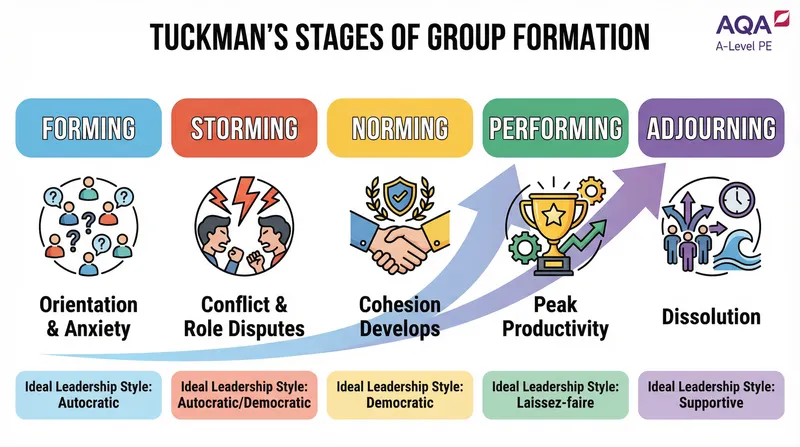
Interactive Diagrams
1 interactive diagram to visualise key concepts
Conceptual Flow Outline
A flowchart illustrating Steiner's Model of Group Effectiveness, showing how Potential Productivity is reduced by Faulty Processes (both Coordination and Motivational losses) to result in Actual Productivity.
Your focus
- Explain how factors such as cohesion, roles, norms and leadership influence individual and team performance.
- Apply models of group development to sporting teams and analyse their effect on performance.
- Evaluate strategies a coach can use to develop positive group dynamics and reduce negative influences.
Show all 27 objectives
- Describe the process by which individuals form a group using Tuckman's four stages.
- Explain the characteristics of forming, storming, norming and performing in a physical activity setting.
- Apply understanding of group formation stages to explain how a team develops cohesion and performance.
- Name and describe the stages of Tuckman’s model of group development.
- Explain the behaviours typical of each stage using sporting examples.
- Evaluate the model by explaining that development may not be linear and stages may overlap.
- Define cohesion in the context of a sporting group.
- Distinguish task cohesion from social cohesion using examples.
- Explain how cohesion can influence group performance and be developed over time.
- Define task cohesion and social cohesion accurately.
- Apply both types of cohesion to sporting group examples.
- Explain how coaches can develop task and social cohesion within a team.
- Define potential productivity and actual productivity using Steiner's model.
- Identify faulty group processes that cause productivity losses.
- Apply the model to explain why a group underperforms relative to its combined resources.
- Define cooperation and coordination in group dynamics.
- Distinguish cooperation from coordination with sporting examples.
- Explain how each process reduces faulty group processes and raises actual productivity.
- Define the Ringelmann effect and social loafing accurately.
- Distinguish social loafing from coordination loss in a team setting.
- Apply both concepts to explain reduced individual effort in a named group activity.
- Describe strategies that improve task and social cohesion in a team.
- Explain how increasing identifiability and setting individual targets reduce social loafing.
- Evaluate how improved cohesion and reduced loafing can enhance team performance.
Which command word is this?
Provide detailed reasons or mechanisms; show cause and effect. For example, explain how social loafing occurs and its impact on team performance.
Group dynamics exam tips
Topic Overview
Group dynamics explores how individuals behave and interact within teams, and how these interactions affect performance. It covers Tuckman's stages of group formation, Steiner's model of group productivity, and the concept of cohesion, including the factors that influence it such as group size, leadership, and shared goals. Understanding these theories helps explain why some teams succeed while others with equally talented individuals fail.
This topic is crucial for students aiming to analyse team performance in sports and physical activity. It links closely to other areas such as leadership, motivation, and social facilitation, and is frequently examined through application questions that require students to suggest strategies for improving team cohesion and performance.
Key Concepts
- →Tuckman's stages of group development: forming, storming, norming, performing (and adjourning).
- →Steiner's model: Actual productivity = Potential productivity - Faulty processes (coordination and motivational losses).
- →Cohesion: task cohesion (shared commitment to goals) and social cohesion (interpersonal attraction).
- →Factors affecting cohesion: group size, leadership style, shared goals, similarity of attitudes, and success.
- →Ringelmann effect: individual effort decreases as group size increases, leading to social loafing.
Marking Points
- Group dynamics refers to the forces, relationships and behaviours within a group that affect how it functions and performs.
- Tuckman's stages of group development (forming, storming, norming, performing) explain how a team evolves over time.
- Shared goals and clear individual roles reduce ambiguity and improve coordination between team members.
- Cohesion, including task and social cohesion, influences motivation, communication and team performance.
- Leadership style and the behaviour of the coach or captain can shape group norms and either support or undermine performance.
- Unresolved conflict, social loafing or role conflict can lower individual effort and harm team performance.
- Strategies such as team goal setting, role clarification, trust-building and early conflict management can improve group dynamics.
- Group formation is a dynamic process typically described by Tuckman's four stages: forming, storming, norming and performing.
- Forming involves members getting to know each other, assessing the group and relying heavily on the coach.
- Storming is characterised by conflict, rebellion against the leader and competition for roles or status.
- Norming occurs when conflicts are resolved, cohesion develops, and members agree on shared goals and expectations.
- Performing is the final stage where the team functions effectively, independently and collaboratively towards success.
- Tuckman’s model identifies forming, storming, norming, performing and adjourning as stages of group development.
- Forming involves orientation, dependence on the leader and uncertainty about roles and tasks.
- Storming involves conflict and disagreement about roles, power, ideas and leadership.
- Norming involves agreement on norms, cooperation and growing cohesion; performing involves effective work towards shared goals.
- Adjourning involves disbanding after the task, and the model is not strictly linear because groups may regress or overlap stages.
- Defines cohesion as the strength of bonds and unity of purpose within a group.
- Distinguishes task cohesion (commitment to shared performance goals) from social cohesion (interpersonal relationships and liking).
- Explains that high social cohesion does not guarantee high task cohesion, and vice versa.
- Applies cohesion to a sporting group, for example a rowing eight or netball squad, showing how it affects performance.
- Recognises that cohesion can be developed through shared goals, clear roles, communication and success.
- Defines task cohesion as unity around shared performance goals and coordinated effort.
- Defines social cohesion as the quality of interpersonal relationships and mutual liking within the group.
- Explains that task and social cohesion are separate dimensions that can vary independently.
- Applies both types to sporting examples, such as a hockey team's pressing system (task) and squad friendships (social).
- Describes strategies that develop each type, including shared goals and clear roles for task cohesion, and team-building for social cohesion.
- Potential productivity is the maximum output theoretically available from the group's combined resources and the task demands.
- Actual productivity is the real output the group achieves in performance.
- Steiner's relationship is actual productivity = potential productivity − losses from faulty group processes.
- Faulty group processes include social loafing, coordination breakdowns and motivational problems such as poor cohesion or conflict.
- Losses explain why a group of talented individuals can underperform compared with their combined individual capabilities.
- Reducing losses through clear roles, individual accountability and practised coordination raises actual productivity towards potential.
- Cooperation is members working together towards shared group goals and accepting their roles.
- Coordination is organising individual actions, timing and roles so they combine effectively.
- Cooperation mainly reduces motivational losses such as social loafing and conflict.
- Coordination mainly reduces losses from mistimed, overlapping or poorly sequenced actions.
- Cooperation and coordination are distinct but linked processes that both raise actual productivity towards potential.
- Strategies such as clear role allocation, shared goals and practised patterns develop both processes.
- Defines the Ringelmann effect as the tendency for average individual effort to decrease as group size increases.
- Defines social loafing as reduced individual effort caused by diffusion of responsibility or loss of identifiable contribution.
- Distinguishes social loafing from coordination losses, where effort is maintained but timing or technique fails.
- Applies both concepts to a team or group context, such as a rowing eight or a football team, explaining the drop in individual output.
- Recognises that the effect concerns individual effort within a group, not simply the group's total output.
- Defines cohesion as the strength of bonds and commitment within a group, distinguishing task cohesion from social cohesion.
- Explains that making individual contributions identifiable, such as through specific roles or individual feedback, reduces social loafing.
- Describes setting clear group goals and individual targets to raise commitment and productivity.
- Explains that team-building activities and shared success can improve social cohesion and interpersonal relationships.
- Explains that shared tactics, role clarity and coordinated practice can improve task cohesion.
- Links the chosen strategy to enhanced team performance, such as better communication, effort and results.
Examiner Tips
- 💡Use specific sporting examples to show how a dynamic such as role clarity or cohesion affects an individual and the team.
- 💡Structure extended answers around a clear chain of reasoning: identify the dynamic, explain its effect, then link it to performance.
- 💡Refer to named models such as Tuckman's stages only where they help explain the influence on performance, and apply them to the scenario.
- 💡Link each of Tuckman's stages to a specific sporting example, such as a netball squad competing for starting positions during the storming stage.
- 💡Use precise terminology such as forming, storming, norming and performing rather than vague phrases like getting on.
- 💡When a question asks about formation, explain the sequential process and how a team transitions from conflict to effective performance.
- 💡Name each stage accurately and give a brief behavioural indicator, such as conflict in storming.
- 💡Use a sporting example to show progression through the stages rather than listing them in isolation.
- 💡Comment on the model’s limitation, such as non-linearity, to show evaluative understanding.
- 💡Read the stem carefully to identify whether it describes shared goals (task) or interpersonal relationships (social).
- 💡Use a named sporting example to test each option against the definition rather than relying on everyday use of the word 'cohesion'.
- 💡Eliminate options that treat cohesion as a single fixed quality or as identical to friendship.
- 💡Match each option to the precise definition of task or social cohesion before choosing.
- 💡Use a quick sporting example for each type to check whether the option fits.
- 💡Reject options that merge the two types or claim one automatically produces the other.
- 💡Learn the relationship as a formula in words so you can apply it to a named team sport scenario.
- 💡When explaining a loss, name the faulty process and state how it lowers actual productivity.
- 💡Use a short example, such as a relay team with mistimed changeovers, to show the difference between potential and actual productivity.
- 💡Define both terms separately before explaining how each reduces productivity losses.
- 💡Use a team example to show cooperation and coordination working together, such as a defensive unit holding a line.
- 💡Link each process to a specific faulty group process it helps to reduce.
- 💡Anchor each definition to a concrete team example so the distinction between the Ringelmann effect and social loafing is visible.
- 💡When a question gives data on group size and effort, describe the trend in average individual effort rather than total output.
- 💡Check whether the scenario describes lost effort or lost coordination before choosing an explanation.
- 💡Use precise terms such as diffusion of responsibility and identifiability of contribution to raise the precision of your answer.
- 💡Name the specific strategy and state the mechanism by which it reduces social loafing or improves cohesion.
- 💡Link each strategy to a measurable outcome such as improved communication, effort or results.
- 💡Distinguish task cohesion strategies from social cohesion strategies when the question allows both.
- 💡Use a short applied example, such as assigning a specific marking role in football, to show understanding.
- 💡Always apply theoretical concepts to specific sporting examples; generic answers without context rarely gain full marks.
- 💡When explaining Steiner's model, explicitly define both coordination and motivational losses and give examples of each.
- 💡For questions on cohesion, ensure you discuss both task and social cohesion and link them to performance outcomes.
Common Mistakes
- Treating a group as automatically a team; the correction is that a team requires shared goals, interdependence and effective interaction, not just shared membership.
- Assuming cohesion always improves performance; the correction is that cohesion is generally linked to better performance but can become counterproductive if it creates complacency or hostility to outsiders.
- Ignoring the individual within the group; the correction is that group dynamics affect individual motivation, confidence and role performance as well as team outcomes.
- Believing conflict is always negative; the correction is that some conflict, such as task-focused disagreement during the storming stage, can be constructive if managed well.
- Confusing group formation with Carron's antecedents of cohesion: correction — formation refers to Tuckman's stages (forming, storming, norming, performing), while Carron's antecedents (environmental, personal, leadership, team) relate to cohesion.
- Thinking a group forms instantly: correction — formation is a developing process involving distinct stages of interaction and conflict resolution.
- Assuming storming is always negative: correction — storming is a necessary stage for establishing roles and resolving underlying issues before norming can occur.
- Treating the stages as strictly sequential: correction — groups can regress or experience overlapping stages.
- Believing storming is always negative: correction — managed conflict can clarify roles and improve later performance.
- Confusing norming with performing: correction — norming establishes agreed standards, while performing is effective goal-directed work.
- Forgetting adjourning: correction — disbanding is part of the model and matters for teams that end, such as a tournament squad.
- Treating cohesion as identical to friendship: correction — cohesion includes task cohesion, which is about shared performance goals, not only social liking.
- Assuming a team with high social cohesion must perform well: correction — social cohesion and task cohesion are separate, and performance depends more directly on task cohesion.
- Believing cohesion is fixed once a team is formed: correction — cohesion is dynamic and can be built or damaged by goals, roles, communication and results.
- Confusing the two types by labelling friendship as task cohesion: correction — friendship reflects social cohesion, while task cohesion concerns shared performance goals.
- Assuming one type always causes the other: correction — task and social cohesion can vary independently, so a socially close team may still lack task focus.
- Thinking only one type matters for performance: correction — both contribute to group dynamics, though task cohesion is more directly linked to coordinated performance.
- Thinking potential productivity is the same as actual productivity: potential is the theoretical best, while actual is what is really produced.
- Believing faulty group processes increase productivity: they cause losses that reduce actual productivity below potential.
- Treating social loafing as a lack of ability: it is reduced individual effort when personal contribution cannot be identified.
- Assuming a team of the best individual performers automatically has high actual productivity: coordination and motivation losses can still lower it.
- Treating cooperation and coordination as the same thing: cooperation is shared effort and goals, while coordination is the organisation of actions in time and space.
- Assuming a cooperative group is automatically well coordinated: goodwill does not guarantee smooth timing or role clarity.
- Thinking coordination only matters in individual sports: it is central to team and group performance.
- Believing cooperation means everyone doing the same job: it means shared commitment to complementary roles.
- Confusing the Ringelmann effect with social loafing: the Ringelmann effect is the observed decline in average individual effort as group size grows, whereas social loafing is one psychological explanation for that decline.
- Assuming the Ringelmann effect means total group output falls: total output usually still rises with more members, but average individual effort per person tends to fall.
- Treating all reduced effort as social loafing: a performer may be trying hard but suffering coordination loss, poor role clarity or fatigue, so the cause must be identified before labelling it loafing.
- Believing social loafing only affects weaker performers: highly capable athletes can also reduce effort when their contribution is not identifiable.
- Treating cohesion as a single idea: task cohesion is about working together on the shared task, while social cohesion is about interpersonal relationships, and strategies differ for each.
- Assuming any team-building activity automatically improves performance: the activity must address the actual cause, such as unclear roles or low identifiability, to affect productivity.
- Believing social loafing is solved only by punishment: increasing identifiability, clarifying roles and setting individual targets are usually more effective and sustainable.
- Confusing group productivity with individual effort: productivity depends on both effort and coordination, so improving cohesion alone may not raise output if tactics remain poor.
- Students often think that all groups automatically progress through Tuckman's stages in order; in reality, teams can regress or get stuck in a stage, and the stages may overlap.
- Many believe that high individual skill guarantees team success; Steiner's model shows that faulty processes can reduce actual productivity below potential.
- Some confuse task cohesion with social cohesion; task cohesion is about shared goals and objectives, while social cohesion is about interpersonal relationships and liking among members.
Revision Plan
- 1Day 1-2: Learn Tuckman's stages with sporting examples for each stage; create flashcards.
- 2Day 3-4: Study Steiner's model and faulty processes; practice applying to different team sports.
- 3Day 5-6: Understand cohesion, its types, and factors affecting it; make a mind map.
- 4Day 7-8: Complete past paper questions on group dynamics; focus on application and evaluation.
- 5Day 9-10: Review misconceptions and examiner tips; test yourself with active recall prompts.
Exam Question Types
- 📋Short answer questions (2-4 marks) defining key terms such as cohesion or faulty processes.
- 📋Application questions (4-6 marks) requiring analysis of a sporting scenario using Tuckman's or Steiner's model.
- 📋Extended response questions (8-10 marks) evaluating strategies to improve group cohesion and performance.
Command Word Expectations (AQA)
Provide detailed reasons or mechanisms; show cause and effect. For example, explain how social loafing occurs and its impact on team performance.
Break down the topic into components and show how they interrelate. For example, analyse how faulty processes can reduce actual productivity in a team sport.
Weigh up strengths and weaknesses, make a judgement, and justify it. For example, evaluate the effectiveness of Tuckman's model in explaining team development.
How Students Lose Marks (Examiner Pitfalls)
Step-by-Step Worked Solutions
Question: Explain how a coach could use Tuckman's stages of group development to improve a newly formed basketball team's performance. (6 marks)
- 1.Step 1: Identify the stages: forming, storming, norming, performing.
- 2.Step 2: Describe forming: coach should facilitate introductions, establish clear goals and roles to reduce uncertainty.
- 3.Step 3: Describe storming: coach should manage conflict, allow players to voice opinions, clarify roles to prevent role ambiguity.
- 4.Step 4: Describe norming: coach should reinforce team standards, develop cohesion through team-building activities.
- 5.Step 5: Describe performing: coach should maintain focus on tactics, provide feedback, and empower players to make decisions.
- 6.Step 6: Conclude: by guiding the team through each stage, the coach can accelerate development and enhance performance.
Question: Using Steiner's model, explain why a football team of highly skilled individuals might still lose a match. (4 marks)
- 1.Step 1: State Steiner's model: Actual productivity = Potential productivity - Faulty processes.
- 2.Step 2: Define potential productivity: the sum of individual abilities (high in this case).
- 3.Step 3: Identify faulty processes: coordination losses (e.g., poor passing timing, misunderstanding tactics) and motivational losses (e.g., social loafing, lack of effort).
- 4.Step 4: Explain how these losses reduce actual productivity below potential, leading to underperformance.