AQA · A-Level · Physical Education
Course version: 7582 · Version from Sept 2016
Group dynamics: Tuckman’s model.
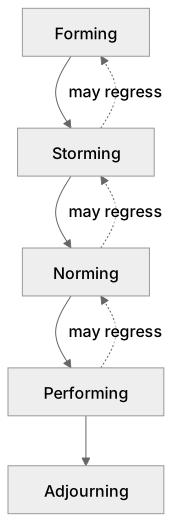
Tuckman’s model describes stages a group may pass through as it develops: forming, storming, norming, performing and, later, adjourning.
Checked against the AQA 7582 specification (opens in a new tab) on .
- Point 3 of 9
- 4 key terms
Study notes
From the checked teaching notes for this specification point.
The idea
Tuckman’s model describes stages a group may pass through as it develops: forming, storming, norming, performing and, later, adjourning. In forming, members orientate themselves and depend on the leader. Storming involves conflict over roles, power and ideas. Norming sees agreement on standards and cooperation. Performing is when the group works effectively towards shared goals. Adjourning is disbanding after the task. A rugby team may begin politely, argue about tactics, agree playing patterns, perform well, then disband at season’s end. The model is not strictly linear: groups can regress, and stages may overlap. It helps explain behaviour and guides leadership, but it is a framework rather than a fixed law.
What earns the marks
- Tuckman’s model identifies forming, storming, norming, performing and adjourning as stages of group development.
- Forming involves orientation, dependence on the leader and uncertainty about roles and tasks.
- Storming involves conflict and disagreement about roles, power, ideas and leadership.
- Norming involves agreement on norms, cooperation and growing cohesion; performing involves effective work towards shared goals.
- Adjourning involves disbanding after the task, and the model is not strictly linear because groups may regress or overlap stages.
Common mistakes and how to put them right
Treating the stages as strictly sequential.
Put it right: Groups can regress or experience overlapping stages.
Believing storming is always negative.
Put it right: Managed conflict can clarify roles and improve later performance.
Confusing norming with performing.
Put it right: Norming establishes agreed standards, while performing is effective goal-directed work.
Forgetting adjourning: correction — disbanding is part of the model and matters for teams that end, such as a tournament squad.
Exam tips
- Name each stage accurately and give a brief behavioural indicator, such as conflict in storming.
- Use a sporting example to show progression through the stages rather than listing them in isolation.
- Comment on the model’s limitation, such as non-linearity, to show evaluative understanding.
Try the lesson
The start of the Group dynamics: Tuckman’s model. lesson, made from checked teaching notes for this specification point.
Have a go first
In Tuckman’s model of group development, which stage is the first that a newly formed sports team passes through?
Listen
Tuckman’s model describes stages a group may pass through as it develops: forming, storming, norming, performing and, later, adjourning. In forming, members orientate themselves and depend on the leader. Storming involves conflict over roles, power and ideas. Norming sees agreement on standards and cooperation. Performing is when the group works effectively towards shared goals. Adjourning is disbanding after the task. A rugby team may begin politely, argue about tactics, agree playing patterns, perform well, then disband at season’s end. The model is not strictly linear: groups can regress, and stages may overlap. It helps explain behaviour and guides leadership, but it is a framework rather than a fixed law. A strong answer earns marks for these points. Tuckman’s model identifies forming, storming, norming, performing and adjourning as stages of group development. Forming involves orientation, dependence on the leader and uncertainty about roles and tasks. Storming involves conflict and disagreement about roles, power, ideas and leadership. Norming involves agreement on norms, cooperation and growing cohesion; performing involves effective work towards shared goals. A common slip: Treating the stages as strictly sequential. Instead, groups can regress or experience overlapping stages. Exam tip: Name each stage accurately and give a brief behavioural indicator, such as conflict in storming.
See it
Put it in order
Put these steps in the order they happen.
- 1. Storming
- 2. Norming
- 3. Forming
- 4. Adjourning
- 5. Performing
Key words
Say what each word means before you turn the card.
Stages of group development
Try answering aloud or in your head before turning the card.
Conflict and roles
Try answering aloud or in your head before turning the card.
Norms and cohesion
Try answering aloud or in your head before turning the card.
Leadership and performance
Try answering aloud or in your head before turning the card.
See every definition
- Stages of group development
- Forming, storming, norming, performing and, later, adjourning, which a group may pass through as it develops.
- Conflict and roles
- Storming involves conflict and disagreement about roles, power, ideas and leadership.
- Norms and cohesion
- Norming involves agreement on norms, cooperation and growing cohesion.
- Leadership and performance
- The model helps explain behaviour and guides leadership, but it is a framework rather than a fixed law.
Label the diagram
Some boxes have lost their names. Pick the right name for each number.
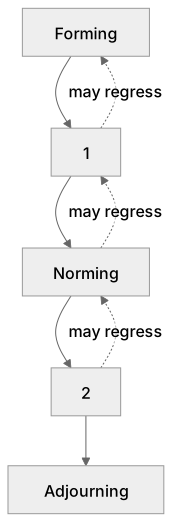
1Box 1
2Box 2
There is more to this lesson
The full lesson goes on to check your understanding and help you earn the marks. Create a free account to carry on, with your progress saved.
A week of Premium from your first lesson · Then the free plan continues · No card, no charge
Test your understanding of Group dynamics: Tuckman’s model.
Active recall beats re-reading. Take an instant quiz now to test what you’ve learned and lock it into long-term memory.
A week of Premium from your first lesson · Then the free plan continues · No card, no charge