AQA · A-Level · Physical Education
Course version: 7582 · Version from Sept 2016
Group dynamics: Including cooperation and coordination.
Cooperation and coordination are group processes that help a team approach its potential productivity.
Checked against the AQA 7582 specification (opens in a new tab) on .
- Point 7 of 9
- 3 key terms
Study notes
From the checked teaching notes for this specification point.
The idea
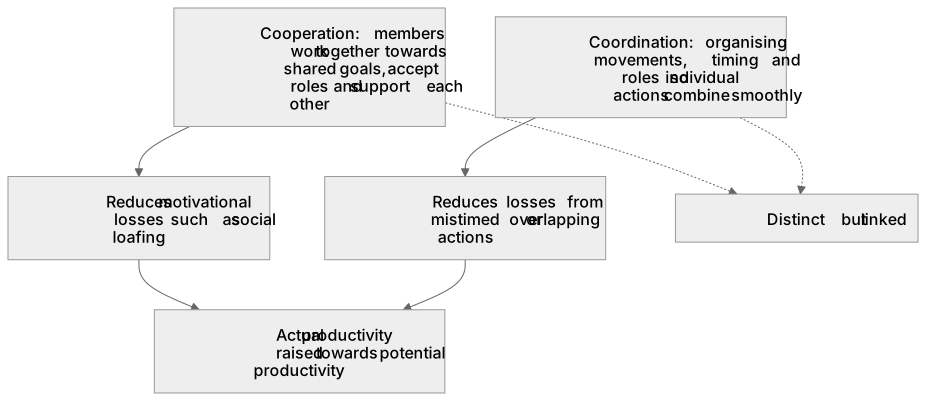
Cooperation and coordination are group processes that help a team approach its potential productivity. Cooperation means members work together towards shared goals, accept their roles and support each other rather than pursuing individual aims. Coordination means organising movements, timing and roles so individual actions combine smoothly, for example a midfield press where players cover spaces in sequence. Both reduce faulty group processes: cooperation lowers motivational losses such as social loafing, while coordination lowers losses from mistimed or overlapping actions. A team can be highly cooperative yet poorly coordinated, or well coordinated yet uncooperative, so the two are distinct but linked. Improving either raises actual productivity towards potential productivity.
What earns the marks
- Cooperation is members working together towards shared group goals and accepting their roles.
- Coordination is organising individual actions, timing and roles so they combine effectively.
- Cooperation mainly reduces motivational losses such as social loafing and conflict.
- Coordination mainly reduces losses from mistimed, overlapping or poorly sequenced actions.
- Cooperation and coordination are distinct but linked processes that both raise actual productivity towards potential.
- Strategies such as clear role allocation, shared goals and practised patterns develop both processes.
Common mistakes and how to put them right
Treating cooperation and coordination as the same thing.
Put it right: Cooperation is shared effort and goals, while coordination is the organisation of actions in time and space.
Assuming a cooperative group is automatically well coordinated.
Put it right: Goodwill does not guarantee smooth timing or role clarity.
Thinking coordination only matters in individual sports.
Put it right: It is central to team and group performance.
Believing cooperation means everyone doing the same job.
Put it right: It means shared commitment to complementary roles.
Exam tips
- Define both terms separately before explaining how each reduces productivity losses.
- Use a team example to show cooperation and coordination working together, such as a defensive unit holding a line.
- Link each process to a specific faulty group process it helps to reduce.
Try the lesson
The start of the Group dynamics: Including cooperation and coordination. lesson, made from checked teaching notes for this specification point.
Have a go first
In a doubles badminton pair, one player repeatedly calls for the shuttle while the other also moves to play it, and the two collide. Which term best describes the quality that was missing from their play?
Listen
Cooperation and coordination are group processes that help a team approach its potential productivity. Cooperation means members work together towards shared goals, accept their roles and support each other rather than pursuing individual aims. Coordination means organising movements, timing and roles so individual actions combine smoothly, for example a midfield press where players cover spaces in sequence. Both reduce faulty group processes: cooperation lowers motivational losses such as social loafing, while coordination lowers losses from mistimed or overlapping actions. A team can be highly cooperative yet poorly coordinated, or well coordinated yet uncooperative, so the two are distinct but linked. Improving either raises actual productivity towards potential productivity. A strong answer earns marks for these points. Cooperation is members working together towards shared group goals and accepting their roles. Coordination is organising individual actions, timing and roles so they combine effectively. Cooperation mainly reduces motivational losses such as social loafing and conflict. Coordination mainly reduces losses from mistimed, overlapping or poorly sequenced actions. Exam tip: Define both terms separately before explaining how each reduces productivity losses.
See it
Key words
Say what each word means before you turn the card.
Cooperation
Try answering aloud or in your head before turning the card.
Coordination
Try answering aloud or in your head before turning the card.
Productivity losses
Try answering aloud or in your head before turning the card.
See every definition
- Cooperation
- Members work together towards shared goals, accept their roles and support each other rather than pursuing individual aims.
- Coordination
- Organising movements, timing and roles so individual actions combine smoothly.
- Productivity losses
- Faulty group processes that reduce actual productivity, such as motivational losses including social loafing, and losses from mistimed or overlapping actions.
Label the diagram
Some boxes have lost their names. Pick the right name for each number.
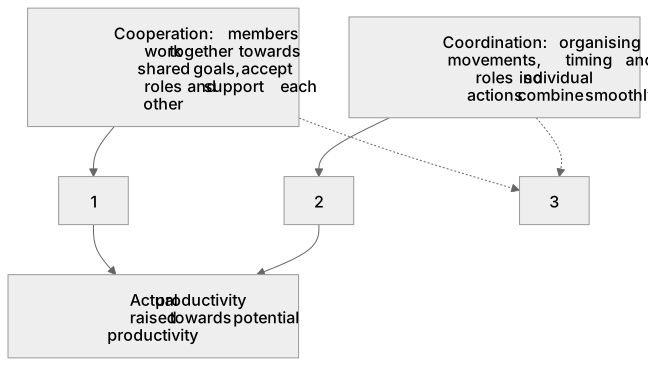
1Box 1
2Box 2
3Box 3
There is more to this lesson
The full lesson goes on to check your understanding and help you earn the marks. Create a free account to carry on, with your progress saved.
A week of Premium from your first lesson · Then the free plan continues · No card, no charge
Test your understanding of Group dynamics: Including cooperation and coordination.
Active recall beats re-reading. Take an instant quiz now to test what you’ve learned and lock it into long-term memory.
A week of Premium from your first lesson · Then the free plan continues · No card, no charge