AQA · A-Level · Physical Education
Course version: 7582 · Version from Sept 2016
Group dynamics: Ringelmann effect and social loafing.
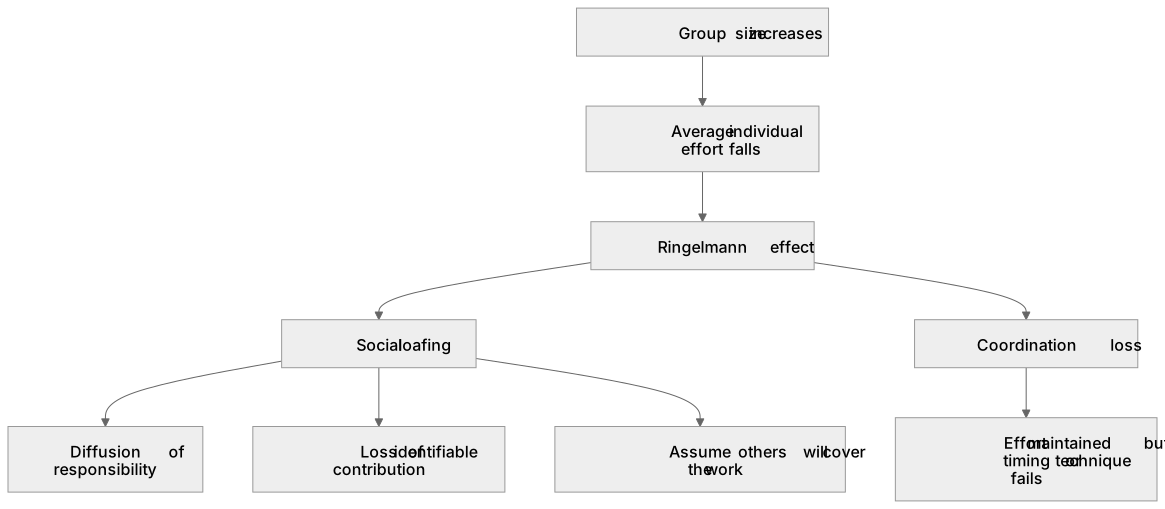
The Ringelmann effect describes how an individual's average effort tends to fall as the size of a group pulling or working together increases.
Checked against the AQA 7582 specification (opens in a new tab) on .
- Point 8 of 9
- 4 key terms
Study notes
From the checked teaching notes for this specification point.
The idea
The Ringelmann effect describes how an individual's average effort tends to fall as the size of a group pulling or working together increases. Social loafing is the related psychological explanation: a team member reduces effort because individual contribution becomes harder to identify, responsibility feels shared, or they assume others will cover the work. In a rowing eight, each rower may pull less hard than in a single scull because the coach cannot easily isolate one person's force. This differs from coordination loss, where effort is high but timing or technique breaks down. In physical education you apply both ideas to team games and group tasks, then judge which explanation fits the observed drop in performance.
What earns the marks
- Defines the Ringelmann effect as the tendency for average individual effort to decrease as group size increases.
- Defines social loafing as reduced individual effort caused by diffusion of responsibility or loss of identifiable contribution.
- Distinguishes social loafing from coordination losses, where effort is maintained but timing or technique fails.
- Applies both concepts to a team or group context, such as a rowing eight or a football team, explaining the drop in individual output.
- Recognises that the effect concerns individual effort within a group, not simply the group's total output.
Common mistakes and how to put them right
Confusing the Ringelmann effect with social loafing.
Put it right: The Ringelmann effect is the observed decline in average individual effort as group size grows, whereas social loafing is one psychological explanation for that decline.
Assuming the Ringelmann effect means total group output falls.
Put it right: Total output usually still rises with more members, but average individual effort per person tends to fall.
Treating all reduced effort as social loafing.
Put it right: A performer may be trying hard but suffering coordination loss, poor role clarity or fatigue, so the cause must be identified before labelling it loafing.
Believing social loafing only affects weaker performers.
Put it right: Highly capable athletes can also reduce effort when their contribution is not identifiable.
Exam tips
- Anchor each definition to a concrete team example so the distinction between the Ringelmann effect and social loafing is visible.
- When a question gives data on group size and effort, describe the trend in average individual effort rather than total output.
- Check whether the scenario describes lost effort or lost coordination before choosing an explanation.
- Use precise terms such as diffusion of responsibility and identifiability of contribution to raise the precision of your answer.
Try the lesson
The start of the Group dynamics: Ringelmann effect and social loafing. lesson, made from checked teaching notes for this specification point.
Have a go first
In a tug-of-war, each additional person pulling on a rope tends to add less force than the person before, so the group's total pull is smaller than the sum of the individuals' best efforts. Which term describes this reduction in individual effort as group size increases?
Listen
The Ringelmann effect describes how an individual's average effort tends to fall as the size of a group pulling or working together increases. Social loafing is the related psychological explanation: a team member reduces effort because individual contribution becomes harder to identify, responsibility feels shared, or they assume others will cover the work. In a rowing eight, each rower may pull less hard than in a single scull because the coach cannot easily isolate one person's force. This differs from coordination loss, where effort is high but timing or technique breaks down. In physical education you apply both ideas to team games and group tasks, then judge which explanation fits the observed drop in performance. A strong answer earns marks for these points. Defines the Ringelmann effect as the tendency for average individual effort to decrease as group size increases. Defines social loafing as reduced individual effort caused by diffusion of responsibility or loss of identifiable contribution. Distinguishes social loafing from coordination losses, where effort is maintained but timing or technique fails. Applies both concepts to a team or group context, such as a rowing eight or a football team, explaining the drop in individual output. Exam tip: Anchor each definition to a concrete team example so the distinction between the Ringelmann effect and social loafing is visible.
See it
Key words
Say what each word means before you turn the card.
Ringelmann effect
Try answering aloud or in your head before turning the card.
Social loafing
Try answering aloud or in your head before turning the card.
Diffusion of responsibility
Try answering aloud or in your head before turning the card.
Identifiability of contribution
Try answering aloud or in your head before turning the card.
See every definition
- Ringelmann effect
- The tendency for an individual's average effort to fall as the size of a group pulling or working together increases.
- Social loafing
- A team member reduces effort because individual contribution becomes harder to identify, responsibility feels shared, or they assume others will cover the work.
- Diffusion of responsibility
- A feeling that responsibility is shared, which can cause a team member to reduce effort.
- Identifiability of contribution
- The extent to which an individual's contribution can be identified, with effort reducing when it becomes harder to identify.
Label the diagram
Some boxes have lost their names. Pick the right name for each number.
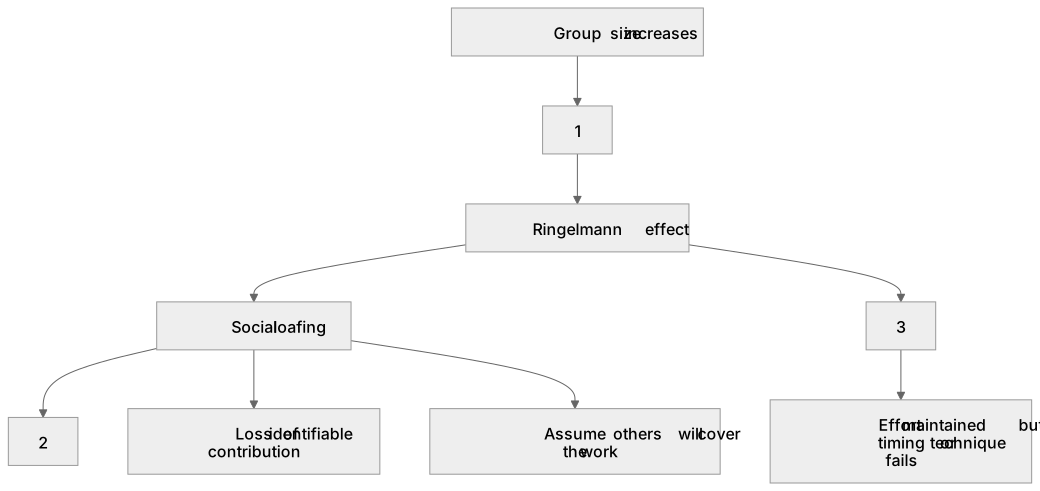
1Box 1
2Box 2
3Box 3
There is more to this lesson
The full lesson goes on to check your understanding and help you earn the marks. Create a free account to carry on, with your progress saved.
A week of Premium from your first lesson · Then the free plan continues · No card, no charge
Test your understanding of Group dynamics: Ringelmann effect and social loafing.
Active recall beats re-reading. Take an instant quiz now to test what you’ve learned and lock it into long-term memory.
A week of Premium from your first lesson · Then the free plan continues · No card, no charge