AQA · A-Level · Physical Education
Course version: 7582 · Version from Sept 2016
Strategies to improve cohesion, group productivity and overcome social…
Full specification wording
Group dynamics: Strategies to improve cohesion, group productivity and overcome social loafing to enhance team performance.
Cohesion is the strength of the bonds that hold a group together and keep members committed to shared goals.
Checked against the AQA 7582 specification (opens in a new tab) on .
- Point 9 of 9
- 4 key terms
Study notes
From the checked teaching notes for this specification point.
The idea
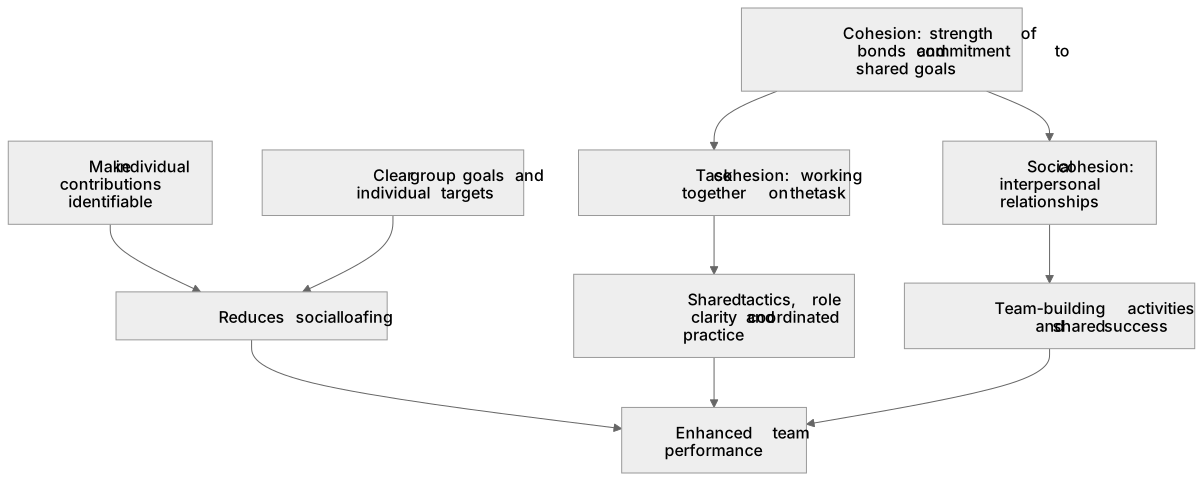
Cohesion is the strength of the bonds that hold a group together and keep members committed to shared goals. Task cohesion concerns working together on the job in hand, while social cohesion concerns interpersonal relationships. To raise group productivity and reduce social loafing, a coach can make individual contributions identifiable, for example by assigning specific roles, publishing individual statistics or using rotation. Setting clear, challenging group goals and individual targets builds commitment. Selecting players who fit the group, developing pride in the team and using positive reinforcement also help. Coaches can increase task cohesion through shared tactics and drills, and social cohesion through team-building activities. The chosen strategy should match the cause of the problem, because a cohesion problem needs a different remedy from a motivation problem.
What earns the marks
- Defines cohesion as the strength of bonds and commitment within a group, distinguishing task cohesion from social cohesion.
- Explains that making individual contributions identifiable, such as through specific roles or individual feedback, reduces social loafing.
- Describes setting clear group goals and individual targets to raise commitment and productivity.
- Explains that team-building activities and shared success can improve social cohesion and interpersonal relationships.
- Explains that shared tactics, role clarity and coordinated practice can improve task cohesion.
- Links the chosen strategy to enhanced team performance, such as better communication, effort and results.
Common mistakes and how to put them right
Treating cohesion as a single idea.
Put it right: Task cohesion is about working together on the shared task, while social cohesion is about interpersonal relationships, and strategies differ for each.
Assuming any team-building activity automatically improves performance.
Put it right: The activity must address the actual cause, such as unclear roles or low identifiability, to affect productivity.
Believing social loafing is solved only by punishment.
Put it right: Increasing identifiability, clarifying roles and setting individual targets are usually more effective and sustainable.
Confusing group productivity with individual effort.
Put it right: Productivity depends on both effort and coordination, so improving cohesion alone may not raise output if tactics remain poor.
Exam tips
- Name the specific strategy and state the mechanism by which it reduces social loafing or improves cohesion.
- Link each strategy to a measurable outcome such as improved communication, effort or results.
- Distinguish task cohesion strategies from social cohesion strategies when the question allows both.
- Use a short applied example, such as assigning a specific marking role in football, to show understanding.
Try the lesson
The start of the Group dynamics: Strategies to improve cohesion, group productivity and overcome social loafing to enhance team performance. lesson, made from checked teaching notes for this specification point.
Have a go first
A rowing coach notices that one squad member puts in noticeably less effort during group training sessions than when tested alone. Which strategy is most likely to reduce this reduced individual effort?
Listen
Cohesion is the strength of the bonds that hold a group together and keep members committed to shared goals. Task cohesion concerns working together on the job in hand, while social cohesion concerns interpersonal relationships. To raise group productivity and reduce social loafing, a coach can make individual contributions identifiable, for example by assigning specific roles, publishing individual statistics or using rotation. Setting clear, challenging group goals and individual targets builds commitment. Selecting players who fit the group, developing pride in the team and using positive reinforcement also help. Coaches can increase task cohesion through shared tactics and drills, and social cohesion through team-building activities. The chosen strategy should match the cause of the problem, because a cohesion problem needs a different remedy from a motivation problem. A strong answer earns marks for these points. Defines cohesion as the strength of bonds and commitment within a group, distinguishing task cohesion from social cohesion. Explains that making individual contributions identifiable, such as through specific roles or individual feedback, reduces social loafing. Describes setting clear group goals and individual targets to raise commitment and productivity. Explains that team-building activities and shared success can improve social cohesion and interpersonal relationships. Exam tip: Name the specific strategy and state the mechanism by which it reduces social loafing or improves cohesion.
See it
Key words
Say what each word means before you turn the card.
Task and social cohesion
Try answering aloud or in your head before turning the card.
Identifiability of individual contribution
Try answering aloud or in your head before turning the card.
Goal setting and role clarity
Try answering aloud or in your head before turning the card.
Team-building and performance
Try answering aloud or in your head before turning the card.
See every definition
- Task and social cohesion
- Task cohesion concerns working together on the job in hand, while social cohesion concerns interpersonal relationships.
- Identifiability of individual contribution
- Making individual contributions identifiable, for example by assigning specific roles, publishing individual statistics or using rotation, reduces social loafing.
- Goal setting and role clarity
- Setting clear, challenging group goals and individual targets builds commitment, and role clarity can improve task cohesion.
- Team-building and performance
- Team-building activities can improve social cohesion and interpersonal relationships, and the chosen strategy should match the cause of the problem to enhance team performance.
Label the diagram
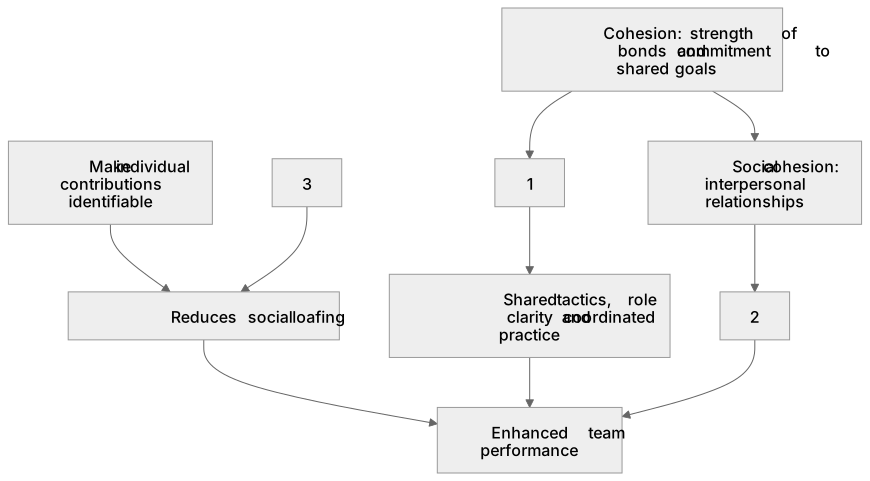
Some boxes have lost their names. Pick the right name for each number.
1Box 1
2Box 2
3Box 3
There is more to this lesson
The full lesson goes on to check your understanding and help you earn the marks. Create a free account to carry on, with your progress saved.
A week of Premium from your first lesson · Then the free plan continues · No card, no charge
Test your understanding of Group dynamics: Strategies to improve cohesion, group productivity and overcome social loafing to enhance team performance.
Active recall beats re-reading. Take an instant quiz now to test what you’ve learned and lock it into long-term memory.
A week of Premium from your first lesson · Then the free plan continues · No card, no charge