AQA · A-Level · Physical Education
Course version: 7582 · Version from Sept 2016
Whole–part–whole.
Full specification wording
Impact of skill classification on structure of practice for learning: Whole–part–whole.
Whole–part–whole is a structuring method in which the learner first attempts the complete skill, then isolates a problematic part for focused rehearsal, and finally reintegrates that part into the…
Checked against the AQA 7582 specification (opens in a new tab) on .
- Point 4 of 10
- 4 key terms
Study notes
From the checked teaching notes for this specification point.
The idea
Whole–part–whole is a structuring method in which the learner first attempts the complete skill, then isolates a problematic part for focused rehearsal, and finally reintegrates that part into the whole skill. It suits skills that are low in organisation, so the parts interact only weakly and can be separated without destroying the movement pattern, yet it also helps when a specific component repeatedly breaks down. For example, a gymnast performs a full floor routine, then practises only the take-off of a particular tumbling element, then performs the routine again with the improved take-off. The method links classification to practice design: low-organisation skills tolerate part practice, while the whole is retained as the frame that gives the part its meaning.
What earns the marks
- Whole–part–whole begins with an attempt at the complete skill, not with an isolated component.
- The middle phase isolates a specific part that is limiting performance, and that part is practised in relative isolation.
- The final phase reintegrates the improved part back into the whole skill so the movement pattern is restored.
- Classification informs the choice: highly organised, fast, discrete skills are less suited to this structure.
Common mistakes and how to put them right
Thinking whole–part–whole means practising every part separately in sequence.
Put it right: Only the problematic part is isolated, and the whole skill opens and closes the process.
Assuming it suits any skill regardless of organisation.
Put it right: It is best for low-organisation skills whose parts can be separated without disrupting the pattern.
Believing the final whole attempt is optional.
Put it right: Reintegration is essential because it transfers the improved part back into the complete skill.
Confusing it with progressive part practice, where parts are chained together cumulatively.
Put it right: Whole–part–whole always returns to the intact whole skill.
Exam tips
- Name all three phases explicitly in your answer so the structure is unmistakable.
- Justify the choice by referring to the skill's position on the organisation continuum.
- Use a concrete sporting example and state which part is isolated and why.
- Contrast the method briefly with part practice or whole practice to show understanding of when each is used.
Try the lesson
The start of the Impact of skill classification on structure of practice for learning: Whole–part–whole. lesson, made from checked teaching notes for this specification point.
Have a go first
A coach teaching a gymnastic floor routine first has the performer attempt the full routine, then practises the individual elements separately, and finally performs the complete routine again. Which practice structure is being used?
Listen
Whole–part–whole is a structuring method in which the learner first attempts the complete skill, then isolates a problematic part for focused rehearsal, and finally reintegrates that part into the whole skill. It suits skills that are low in organisation, so the parts interact only weakly and can be separated without destroying the movement pattern, yet it also helps when a specific component repeatedly breaks down. For example, a gymnast performs a full floor routine, then practises only the take-off of a particular tumbling element, then performs the routine again with the improved take-off. The method links classification to practice design: low-organisation skills tolerate part practice, while the whole is retained as the frame that gives the part its meaning. A strong answer earns marks for these points. Whole–part–whole begins with an attempt at the complete skill, not with an isolated component. The middle phase isolates a specific part that is limiting performance, and that part is practised in relative isolation. The final phase reintegrates the improved part back into the whole skill so the movement pattern is restored. Classification informs the choice: highly organised, fast, discrete skills are less suited to this structure. A common slip: Thinking whole–part–whole means practising every part separately in sequence. Instead, only the problematic part is isolated, and the whole skill opens and closes the process. Exam tip: Name all three phases explicitly in your answer so the structure is unmistakable.
See it
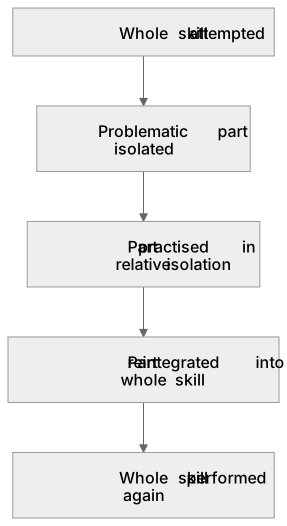
Put it in order
Put these steps in the order they happen.
- 1. Problematic part isolated
- 2. Part practised in relative isolation
- 3. Whole skill attempted
- 4. Whole skill performed again
- 5. Part reintegrated into whole skill
Key words
Say what each word means before you turn the card.
Whole–part–whole
Try answering aloud or in your head before turning the card.
Organisation of skill
Try answering aloud or in your head before turning the card.
Part versus whole practice
Try answering aloud or in your head before turning the card.
Reintegration and transfer of learning
Try answering aloud or in your head before turning the card.
See every definition
- Whole–part–whole
- A structuring method in which the learner first attempts the complete skill, then isolates a problematic part for focused rehearsal, and finally reintegrates that part into the whole skill.
- Organisation of skill
- How strongly the parts of a skill interact; low-organisation skills have parts that interact only weakly and can be separated without destroying the movement pattern.
- Part versus whole practice
- Low-organisation skills tolerate part practice, while the whole is retained as the frame that gives the part its meaning.
- Reintegration and transfer of learning
- The final phase reintegrates the improved part back into the whole skill so the movement pattern is restored, transferring the improved part back into the complete skill.
Label the diagram
Some boxes have lost their names. Pick the right name for each number.
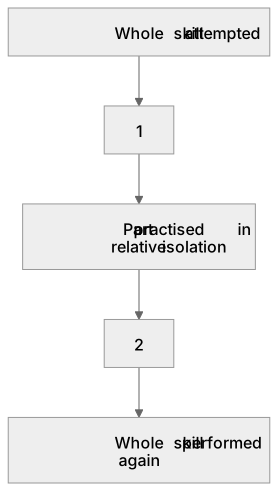
1Box 1
2Box 2
There is more to this lesson
The full lesson goes on to check your understanding and help you earn the marks. Create a free account to carry on, with your progress saved.
A week of Premium from your first lesson · Then the free plan continues · No card, no charge
Test your understanding of Impact of skill classification on structure of practice for learning: Whole–part–whole.
Active recall beats re-reading. Take an instant quiz now to test what you’ve learned and lock it into long-term memory.
A week of Premium from your first lesson · Then the free plan continues · No card, no charge