AQA · A-Level · Physical Education
Course version: 7582 · Version from Sept 2016
Outcome goals, performance related goals, process goals.
Full specification wording
Importance of goal setting: Outcome goals, performance related goals, process goals.
The three goal types differ in what they measure and how much control the performer has.
Checked against the AQA 7582 specification (opens in a new tab) on .
- Point 2 of 4
- 4 key terms
Study notes
From the checked teaching notes for this specification point.
The idea
The three goal types differ in what they measure and how much control the performer has. An outcome goal targets a result, for example winning a tennis match or finishing in the top three, and depends on opponents, officials and conditions. A performance related goal targets the performer's own standard, for example reducing a 200 m time from 26.0 s to 25.5 s or raising a personal best in the shot put, so it is measurable against previous data. A process goal targets technique, tactics or behaviour, for example keeping a low centre of gravity when defending in netball or following a pre-serve routine, and is fully within the performer's control. Coaches often combine all three, using process goals in training, performance goals for progress checks and outcome goals for competition.
What earns the marks
- Outcome goals are concerned with a result or placing, such as winning a final, and are only partly controllable because opponents and officials influence them.
- Performance related goals are concerned with the performer's own previous standard, such as a time, distance, score or personal best, and are measurable.
- Process goals are concerned with technique, tactics or behaviour, such as a specific body position or routine, and are fully controllable.
- The three types can be combined so that process goals support training, performance goals track progress and outcome goals motivate in competition.
- Goal type should match the purpose: process goals suit skill acquisition, performance goals suit measurable improvement and outcome goals suit competitive motivation.
- Specific, measurable, achievable, relevant and time-bound goals are more effective than vague intentions.
Common mistakes and how to put them right
Labelling a personal best as an outcome goal.
Put it right: A personal best is a performance related goal because it is measured against the performer's own previous standard.
Labelling a technique cue as a performance goal.
Put it right: A technique cue is a process goal because it describes how the movement is performed.
Assuming outcome goals are always best because they are the most motivating.
Put it right: They are the least controllable and can damage confidence when results go badly.
Treating the three types as mutually exclusive.
Put it right: A coach can set all three together, with process goals underpinning the others.
Exam tips
- Classify the goal by asking what is being measured: a result, a personal standard or a technique.
- Use the control test: the more the goal depends on opponents or officials, the more it is an outcome goal.
- When a scenario names a time, distance or score compared with the performer's own record, select performance related goal.
Try the lesson
The start of the Importance of goal setting: Outcome goals, performance related goals, process goals. lesson, made from checked teaching notes for this specification point.
Have a go first
A sprinter sets the target of finishing the 100 m final in first place. Which type of goal has the sprinter set?
Listen
The three goal types differ in what they measure and how much control the performer has. An outcome goal targets a result, for example winning a tennis match or finishing in the top three, and depends on opponents, officials and conditions. A performance related goal targets the performer's own standard, for example reducing a 200 m time from 26.0 s to 25.5 s or raising a personal best in the shot put, so it is measurable against previous data. A process goal targets technique, tactics or behaviour, for example keeping a low centre of gravity when defending in netball or following a pre-serve routine, and is fully within the performer's control. Coaches often combine all three, using process goals in training, performance goals for progress checks and outcome goals for competition. A strong answer earns marks for these points. Outcome goals are concerned with a result or placing, such as winning a final, and are only partly controllable because opponents and officials influence them. Performance related goals are concerned with the performer's own previous standard, such as a time, distance, score or personal best, and are measurable. Process goals are concerned with technique, tactics or behaviour, such as a specific body position or routine, and are fully controllable. The three types can be combined so that process goals support training, performance goals track progress and outcome goals motivate in competition. A common slip: Labelling a personal best as an outcome goal. Instead, a personal best is a performance related goal because it is measured against the performer's own previous standard. Exam tip: Classify the goal by asking what is being measured: a result, a personal standard or a technique.
See it

Key words
Say what each word means before you turn the card.
Outcome goal
Try answering aloud or in your head before turning the card.
Performance related goal
Try answering aloud or in your head before turning the card.
Process goal
Try answering aloud or in your head before turning the card.
Combining goal types
Try answering aloud or in your head before turning the card.
See every definition
- Outcome goal
- Targets a result, for example winning a tennis match or finishing in the top three, and depends on opponents, officials and conditions.
- Performance related goal
- Targets the performer's own standard, for example reducing a 200 m time or raising a personal best, so it is measurable against previous data.
- Process goal
- Targets technique, tactics or behaviour, for example keeping a low centre of gravity when defending or following a pre-serve routine, and is fully within the performer's control.
- Combining goal types
- Coaches often use all three, with process goals in training, performance goals for progress checks and outcome goals for competition.
Label the diagram
Some boxes have lost their names. Pick the right name for each number.
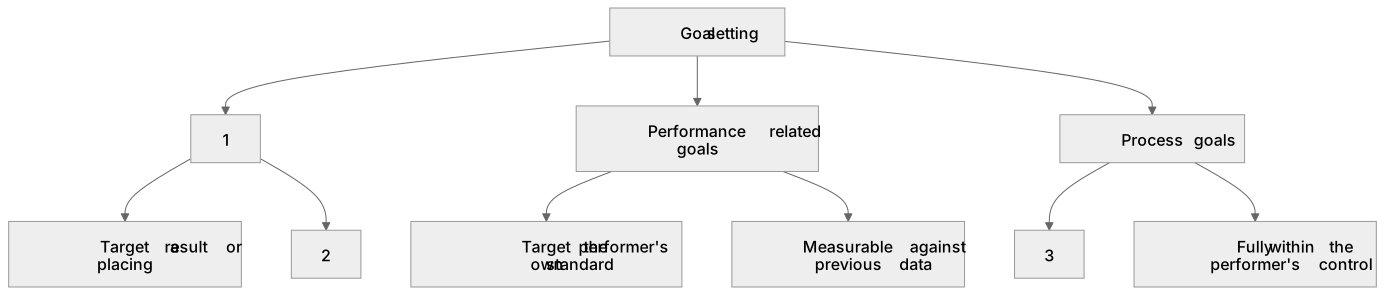
1Box 1
2Box 2
3Box 3
There is more to this lesson
The full lesson goes on to check your understanding and help you earn the marks. Create a free account to carry on, with your progress saved.
A week of Premium from your first lesson · Then the free plan continues · No card, no charge
Test your understanding of Importance of goal setting: Outcome goals, performance related goals, process goals.
Active recall beats re-reading. Take an instant quiz now to test what you’ve learned and lock it into long-term memory.
A week of Premium from your first lesson · Then the free plan continues · No card, no charge