AQA · A-Level · Physical Education
Course version: 7582 · Version from Sept 2016
Industrial and post-industrial (1780–1900): Transport and communication.
Transport and communication covers the improvements in moving people, goods and information during the industrial period 1780–1900.
Checked against the AQA 7582 specification (opens in a new tab) on .
- Point 4 of 12
- 4 key terms
Study notes
From the checked teaching notes for this specification point.
The idea
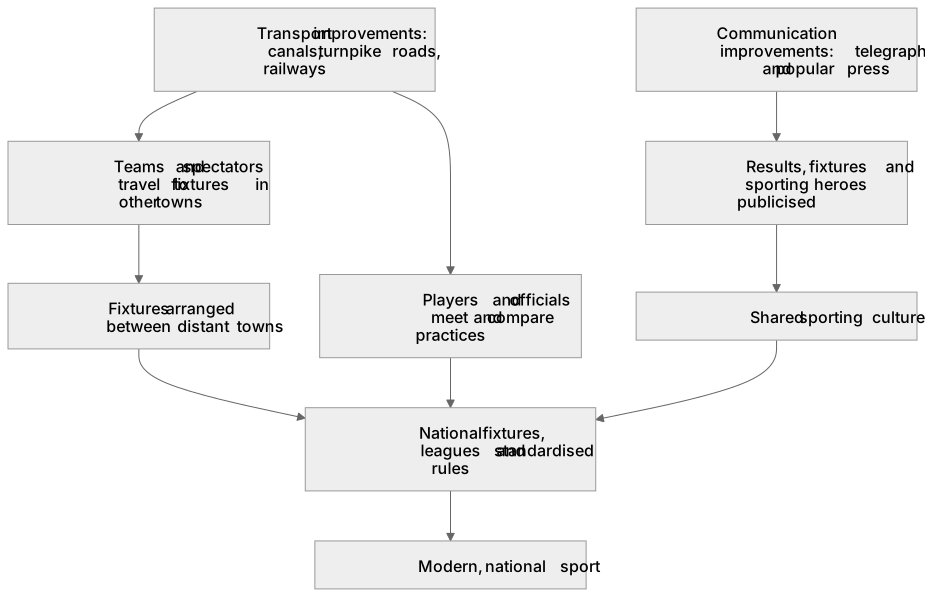
Transport and communication covers the improvements in moving people, goods and information during the industrial period 1780–1900. Canals, turnpike roads, and especially the railway network allowed teams and spectators to travel further, so fixtures could be arranged between distant towns and national competitions became possible. Cheaper, faster travel also helped spread standardised rules, because players and officials could meet and compare practices. Communication improvements, such as the telegraph and wider newspaper readership, publicised results, fixtures and sporting heroes, building shared sporting culture. A useful method is to trace one chain: railway travel lets a team play away, newspapers report the result, and demand grows for regular leagues. This shows transport and communication as linked causes of modern, national sport.
What earns the marks
- Identifies improvements in transport such as canals, turnpike roads and railways within 1780–1900.
- Explains that railways allowed teams and spectators to travel to fixtures in other towns and cities.
- Explains that improved transport enabled national fixtures, leagues and standardised rules.
- Identifies communication developments such as the telegraph and the popular press.
- Explains that newspapers and telegraph spread results, fixtures and sporting heroes, building shared sporting culture.
- Links transport and communication together as causes of commercial, national sport.
Common mistakes and how to put them right
Confusing transport with communication.
Put it right by separating movement of people and goods from movement of information.
Claiming railways only moved spectators.
Put it right by noting they also moved teams, officials and equipment.
Assuming rules spread automatically.
Put it right by explaining that travel and communication allowed people to meet, compare and standardise rules.
Using examples from outside 1780–1900.
Put it right by keeping to canals, turnpikes, railways, telegraph and the press of that period.
Exam tips
- Look for the option that names a specific transport or communication development from 1780–1900, not a modern one.
- Reject options that treat transport and communication as having no effect on sport; both helped create national fixtures and shared rules.
- If two options seem similar, choose the one that links the development to a sporting consequence such as travel to fixtures or spread of results.
Try the lesson
The start of the Industrial and post-industrial (1780–1900): Transport and communication. lesson, made from checked teaching notes for this specification point.
Have a go first
During the industrial period (1780–1900), which development in transport most significantly enabled the establishment of national, regular competitive sports leagues?
Listen
Transport and communication covers the improvements in moving people, goods and information during the industrial period 1780–1900. Canals, turnpike roads, and especially the railway network allowed teams and spectators to travel further, so fixtures could be arranged between distant towns and national competitions became possible. Cheaper, faster travel also helped spread standardised rules, because players and officials could meet and compare practices. Communication improvements, such as the telegraph and wider newspaper readership, publicised results, fixtures and sporting heroes, building shared sporting culture. A useful method is to trace one chain: railway travel lets a team play away, newspapers report the result, and demand grows for regular leagues. This shows transport and communication as linked causes of modern, national sport. A strong answer earns marks for these points. Identifies improvements in transport such as canals, turnpike roads and railways within 1780–1900. Explains that railways allowed teams and spectators to travel to fixtures in other towns and cities. Explains that improved transport enabled national fixtures, leagues and standardised rules. Identifies communication developments such as the telegraph and the popular press. A common slip: Confusing transport with communication. Instead, separating movement of people and goods from movement of information. Exam tip: Look for the option that names a specific transport or communication development from 1780–1900, not a modern one.
See it
Key words
Say what each word means before you turn the card.
Railway expansion
Try answering aloud or in your head before turning the card.
National fixtures and leagues
Try answering aloud or in your head before turning the card.
Standardisation of rules
Try answering aloud or in your head before turning the card.
Telegraph and popular press
Try answering aloud or in your head before turning the card.
See every definition
- Railway expansion
- Improvements in the railway network allowed teams and spectators to travel further, so fixtures could be arranged between distant towns.
- National fixtures and leagues
- Regular competitions became possible because cheaper, faster travel let teams and spectators reach fixtures in other towns and cities.
- Standardisation of rules
- Players and officials could meet and compare practices through travel and communication, helping spread standardised rules.
- Telegraph and popular press
- Communication improvements publicised results, fixtures and sporting heroes, building shared sporting culture.
Label the diagram
Some boxes have lost their names. Pick the right name for each number.
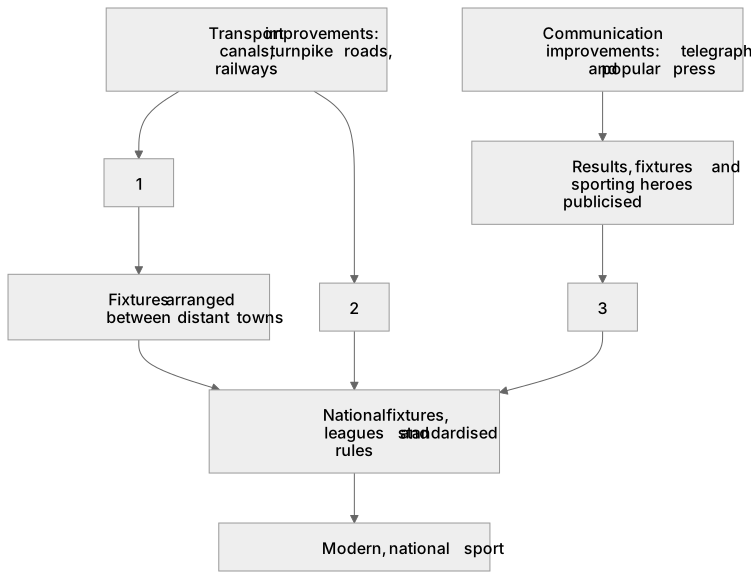
1Box 1
2Box 2
3Box 3
There is more to this lesson
The full lesson goes on to check your understanding and help you earn the marks. Create a free account to carry on, with your progress saved.
A week of Premium from your first lesson · Then the free plan continues · No card, no charge
Test your understanding of Industrial and post-industrial (1780–1900): Transport and communication.
Active recall beats re-reading. Take an instant quiz now to test what you’ve learned and lock it into long-term memory.
A week of Premium from your first lesson · Then the free plan continues · No card, no charge