AQA · A-Level · Physical Education
Course version: 7582 · Version from Sept 2016
Acute (fractures, dislocations, strains, sprains).
Full specification wording
Injury prevention and the rehabilitation of injury: Acute (fractures, dislocations, strains, sprains).
Acute injuries occur suddenly when a single force overloads tissue, so signs appear immediately: pain, swelling, loss of function and deformity.
Checked against the AQA 7582 specification (opens in a new tab) on .
- Point 2 of 12
- 4 key terms
Study notes
From the checked teaching notes for this specification point.
The idea
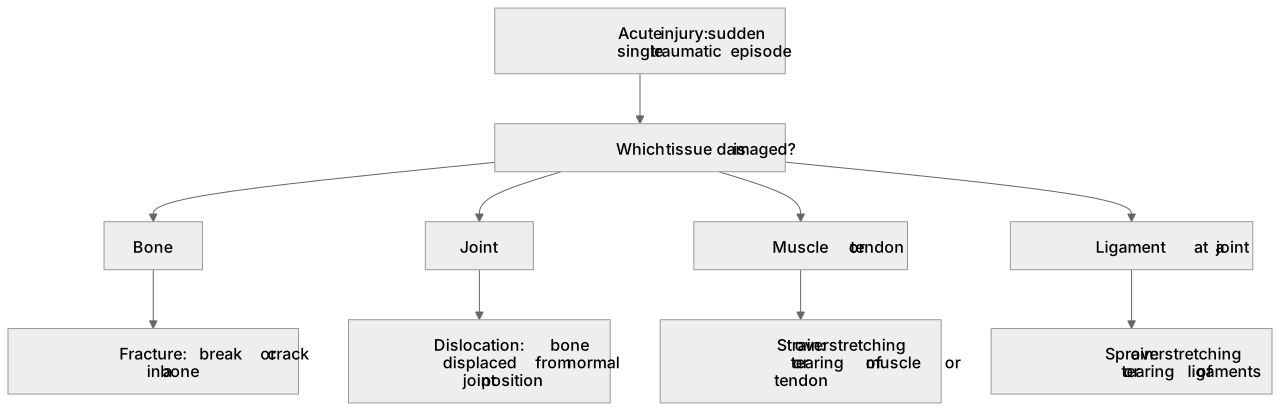
Acute injuries occur suddenly when a single force overloads tissue, so signs appear immediately: pain, swelling, loss of function and deformity. A fracture is a break or crack in a bone, caused by direct impact or indirect force; a dislocation is displacement of a bone from its normal joint position, damaging capsule and ligaments. A strain is overstretching or tearing of muscle or tendon, while a sprain is overstretching or tearing of ligaments at a joint, most often the ankle. Classify by the tissue damaged and the mechanism: bone, joint, muscle-tendon or ligament.
For example: A tackle causing immediate ankle swelling with ligament pain is a sprain, whereas a fall onto an outstretched arm with an audible snap suggests a fracture.
What earns the marks
- Acute injuries arise from a sudden, single traumatic episode rather than repeated cumulative loading.
- A fracture is a break or crack in a bone, caused by direct impact or indirect force.
- A dislocation is displacement of a bone from its normal position at a joint, damaging joint structures.
- A strain is overstretching or tearing of muscle or tendon, typically from explosive or overstretched contraction.
- A sprain is overstretching or tearing of ligaments at a joint, commonly the ankle.
- Classification depends on the tissue damaged and the mechanism of injury, not on the sport alone.
Common mistakes and how to put them right
Confusing a strain with a sprain.
Put it right: A strain damages muscle or tendon, whereas a sprain damages ligaments at a joint.
Assuming every acute injury involves a fracture.
Put it right: Most acute injuries are soft-tissue strains and sprains, and fracture requires bone damage.
Believing a dislocation is simply a sprain.
Put it right: A dislocation displaces the bone from the joint, while a sprain overstretches or tears ligaments without displacement.
Thinking acute injuries develop gradually over weeks.
Put it right: Acute injuries have sudden onset from a single episode, unlike chronic overuse injuries.
Exam tips
- Link each injury to the specific tissue damaged (bone, joint, muscle-tendon, ligament) to justify your classification.
- Use the mechanism of injury, such as direct impact or twisting, to distinguish fracture, dislocation, strain and sprain.
- Check the onset described in the question: immediate sudden onset signals an acute injury rather than a chronic one.
Try the lesson
The start of the Injury prevention and the rehabilitation of injury: Acute (fractures, dislocations, strains, sprains). lesson, made from checked teaching notes for this specification point.
Have a go first
A rugby player is tackled and the bones of the lower leg break cleanly through the skin. Which type of acute injury has the player sustained?
Listen
Acute injuries occur suddenly when a single force overloads tissue, so signs appear immediately: pain, swelling, loss of function and deformity. A fracture is a break or crack in a bone, caused by direct impact or indirect force; a dislocation is displacement of a bone from its normal joint position, damaging capsule and ligaments. A strain is overstretching or tearing of muscle or tendon, while a sprain is overstretching or tearing of ligaments at a joint, most often the ankle. Classify by the tissue damaged and the mechanism: bone, joint, muscle-tendon or ligament. For example, a tackle causing immediate ankle swelling with ligament pain is a sprain, whereas a fall onto an outstretched arm with an audible snap suggests a fracture. A strong answer earns marks for these points. Acute injuries arise from a sudden, single traumatic episode rather than repeated cumulative loading. A fracture is a break or crack in a bone, caused by direct impact or indirect force. A dislocation is displacement of a bone from its normal position at a joint, damaging joint structures. A strain is overstretching or tearing of muscle or tendon, typically from explosive or overstretched contraction. Exam tip: Link each injury to the specific tissue damaged (bone, joint, muscle-tendon, ligament) to justify your classification.
See it
Key words
Say what each word means before you turn the card.
Acute injury
Try answering aloud or in your head before turning the card.
Fracture
Try answering aloud or in your head before turning the card.
Dislocation
Try answering aloud or in your head before turning the card.
Sprain
Try answering aloud or in your head before turning the card.
See every definition
- Acute injury
- An injury that arises from a sudden, single traumatic episode rather than repeated cumulative loading, so signs appear immediately.
- Fracture
- A break or crack in a bone, caused by direct impact or indirect force.
- Dislocation
- Displacement of a bone from its normal position at a joint, damaging joint structures.
- Sprain
- Overstretching or tearing of ligaments at a joint, commonly the ankle.
Label the diagram
Some boxes have lost their names. Pick the right name for each number.
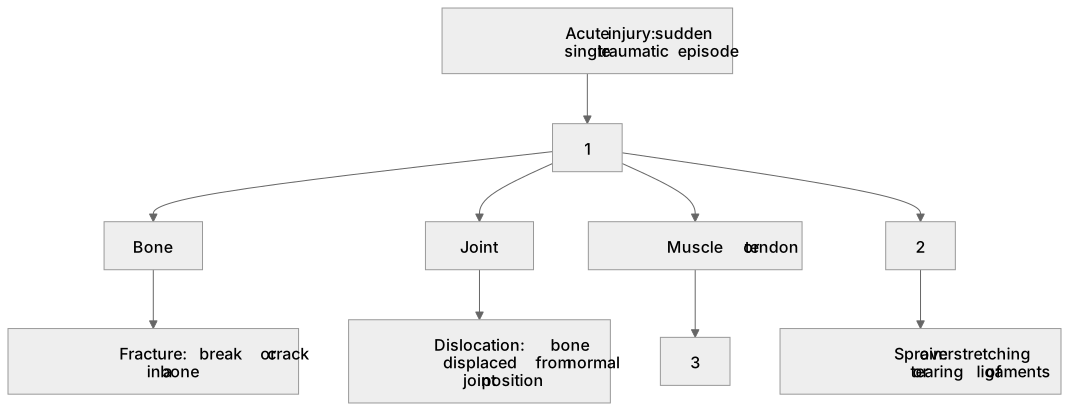
1Box 1
2Box 2
3Box 3
There is more to this lesson
The full lesson goes on to check your understanding and help you earn the marks. Create a free account to carry on, with your progress saved.
A week of Premium from your first lesson · Then the free plan continues · No card, no charge
Test your understanding of Injury prevention and the rehabilitation of injury: Acute (fractures, dislocations, strains, sprains).
Active recall beats re-reading. Take an instant quiz now to test what you’ve learned and lock it into long-term memory.
A week of Premium from your first lesson · Then the free plan continues · No card, no charge