Injury prevention and the rehabilitation of injury — AQA A-Level Physical Education
Verified courseTeaching note checked against the official specification.
Injury prevention in AQA A-Level PE involves understanding intrinsic and extrinsic risk factors, applying warm-up, cool-down, and protective equipment strategies, and using RICE, cryotherapy, and progressive rehabilitation to return safely to sport. The topic links anatomy, physiology, and training principles to real-world sporting contexts and is assessed through short-answer and extended 8-15 mark questions.
Injury prevention and the rehabilitation of injury explained
Injury prevention and the rehabilitation of injury covers 12 specification points, including Types of injury.
Read the full explanation
and Acute (fractures, dislocations, strains,…. Open a point below for its explanation and revision guidance.
Types of injury.
Injuries in physical activity are classified by the tissue damaged and by how the damage occurs. Acute injuries happen suddenly, such as a sprained ankle ligament when the foot rolls over, a strained hamstring during sprinting, a dislocated shoulder from a fall, or a fracture from a direct impact. Chronic injuries develop gradually through repeated overload, such as tendinitis in the Achilles tendon or a stress fracture in a runner's tibia. Injuries are also grouped as soft tissue (muscle, tendon, ligament, skin) or hard tissue (bone). Understanding the type helps the performer and coach choose appropriate prevention and rehabilitation, because acute trauma and overuse damage need different management.
Acute (fractures, dislocations, strains, sprains).
Acute injuries occur suddenly when a single force overloads tissue, so signs appear immediately: pain, swelling, loss of function and deformity. A fracture is a break or crack in a bone, caused by direct impact or indirect force; a dislocation is displacement of a bone from its normal joint position, damaging capsule and ligaments. A strain is overstretching or tearing of muscle or tendon, while a sprain is overstretching or tearing of ligaments at a joint, most often the ankle. Classify by the tissue damaged and the mechanism: bone, joint, muscle-tendon or ligament. For example, a tackle causing immediate ankle swelling with ligament pain is a sprain, whereas a fall onto an outstretched arm with an audible snap suggests a fracture.
Chronic (achilles tendonitis, stress fracture, ‘tennis elbow’).
Chronic injuries develop gradually through repeated loading without adequate recovery, so symptoms build over weeks and worsen with continued activity. Achilles tendonitis is inflammation and degeneration of the Achilles tendon from repetitive running, jumping and calf loading, causing pain and stiffness above the heel. A stress fracture is a small crack in a bone from cumulative impact, common in the tibia, metatarsals and navicular of runners and dancers. Tennis elbow is overuse injury of the tendons attaching to the lateral elbow, caused by repeated wrist extension and gripping, not only by tennis. Classify by cumulative overload of tendon or bone and by the gradual onset, for example a runner with weeks of worsening shin pain suggesting a stress fracture.
Understanding different methods used in injury prevention, rehabilitation and recovery.
This topic links three phases of athlete care. Injury prevention reduces the chance of harm before it occurs, using screening to flag risk factors, warm-ups to prepare tissue, and protective equipment or taping to limit forces. Rehabilitation is the structured process after injury: protect the area, restore range of movement, rebuild strength and gradually reload sport-specific movement. Recovery covers strategies that help the athlete return to normal function and training, such as sleep, nutrition, hydration, active recovery and cryotherapy. A performer with a hamstring strain might be screened for weakness, complete a progressive rehabilitation programme, then use recovery methods before full training. Understanding how these methods differ, and when each is appropriate, is the skill assessed here.
Injury prevention methods: Screening.
Screening is a pre-participation assessment that identifies risk factors for injury before training or competition. It typically examines movement quality, muscle strength and balance, joint range of movement, and previous injury history. For example, a screening test might reveal that one hamstring is weaker than the other, or that an athlete's landing mechanics place stress on the knee. The results guide prevention: the athlete may be given targeted strengthening, mobility work or technique coaching. Screening does not guarantee freedom from injury; it flags risk so that training can be adjusted. In an MCQ, you may be asked to identify what screening assesses, why it is used, or how its findings inform prevention. Understanding its purpose and limitations is essential.
Protective equipment.
Protective equipment is any item worn or used by a performer to reduce the risk of injury during physical activity. It works by absorbing impact, spreading force over a larger area, limiting unwanted joint movement or shielding vulnerable tissue. Common examples include shin pads in football, gum shields in rugby, helmets in cycling and cricket, and padded gloves in boxing. Effective use depends on choosing equipment suited to the activity, ensuring correct fit, checking it is undamaged and wearing it consistently in training and competition. Equipment does not remove risk entirely; it lowers the likelihood or severity of injury when combined with safe technique, rules and officiating. In an MCQ you may be asked to identify a suitable item for a given sport, explain how it protects, or recognise a limitation such as poor fit reducing protection.
Warm up, flexibility training (active, passive, static and ballistic), taping and bracing.
Injury prevention includes warm up, flexibility training, taping and bracing. A warm up raises muscle temperature, increases blood flow and prepares joints and muscles for activity, reducing strain risk. Flexibility training can be active, where the performer moves the joint themselves; passive, where a partner or device applies the stretch; static, holding a position still; and ballistic, using bouncing or swinging movements. Taping supports a joint or muscle, limits unwanted movement and can provide proprioceptive feedback. Bracing uses a rigid or semi-rigid device to stabilise a joint or region. These methods are used alongside safe technique and appropriate equipment. In an MCQ you may need to match a method to its description, identify a benefit or recognise a limitation such as ballistic stretching being unsuitable for some performers.
Injury rehabilitation methods (proprioceptive training, strength training, hyperbaric chambers, cryotherapy, hydrotherapy).
Rehabilitation restores function after injury. Proprioceptive training retrains joint position sense using unstable surfaces or single-leg balances, rebuilding neuromuscular control. Strength training progressively loads damaged tissue so muscle and tendon regain capacity. Hyperbaric chambers expose the body to raised oxygen pressure, increasing oxygen delivery to hypoxic tissue. Cryotherapy applies extreme cold to reduce pain, blood flow and inflammation. Hydrotherapy uses water's buoyancy and resistance for supported movement. Each method suits different injuries and stages, so match the method to the tissue and phase of healing.
Recovery from exercise (compression garments, massage/foam rollers, cold therapy, ice bath, cryotherapy).
Recovery methods help the body return to a ready state after exercise. Compression garments apply graduated pressure to limbs, which may support venous return and reduce swelling. Massage and foam rollers apply mechanical pressure to muscle, aiming to ease soreness and improve tissue mobility. Cold therapy and ice baths lower tissue temperature to reduce pain, blood flow and inflammation after intense work. Cryotherapy extends this cooling, sometimes using very cold air. Each method targets a different recovery mechanism, so match the method to the intended effect.
Physiological reasons for methods used in injury rehabilitation.
Rehabilitation methods are chosen for their physiological effects on healing tissue. Proprioceptive training restores neuromuscular control by stimulating mechanoreceptors, improving balance and joint stability. Strength training uses progressive resistance to induce muscle hypertrophy, increase tendon strength and restore force production. Hydrotherapy uses water buoyancy to reduce load on healing joints, while hydrostatic pressure reduces swelling and warm water increases blood flow. Hyperbaric chambers deliver 100% oxygen under high pressure, increasing dissolved oxygen in blood plasma to accelerate cellular repair and reduce oedema. Cryotherapy lowers local tissue temperature, reducing metabolic demand and pain.
Hyperbaric chambers, cryotherapy.
Hyperbaric chambers and cryotherapy are contrasting rehabilitation methods with different physiological actions. A hyperbaric chamber exposes the body to raised atmospheric pressure with a high oxygen concentration, so more oxygen dissolves in plasma and delivery to hypoxic tissue improves, which can support healing and reduce swelling. Cryotherapy applies cold to tissue, lowering local temperature, metabolic demand and pain, and reducing blood flow, which limits secondary hypoxic damage and swelling in the early stage. Cryotherapy includes whole-body cryotherapy and local ice application. Both methods must be matched to the injury stage and used within safe limits, since oxygen toxicity and cold injury are possible risks.
Importance of sleep and nutrition for improved recovery.
Recovery after training or injury depends on sleep and nutrition. Sleep allows growth hormone release, tissue repair and nervous-system restoration; most adolescents need roughly 8–10 hours per night, and athletes may benefit from more. Nutrition supplies energy and building blocks: carbohydrate replenishes muscle and liver glycogen, protein provides amino acids for muscle protein synthesis, and fluid with electrolytes restores hydration and blood volume. Micronutrients such as calcium and vitamin D support bone remodelling, while iron supports oxygen transport. Poor sleep or inadequate energy, protein or fluid intake slows repair, increases fatigue and raises re-injury risk. A performer should therefore treat sleep and nutrition as planned parts of rehabilitation, not optional extras.
Watch and listen
Listen: Injury prevention and the rehabilitation of injury audio lesson
Read the full guide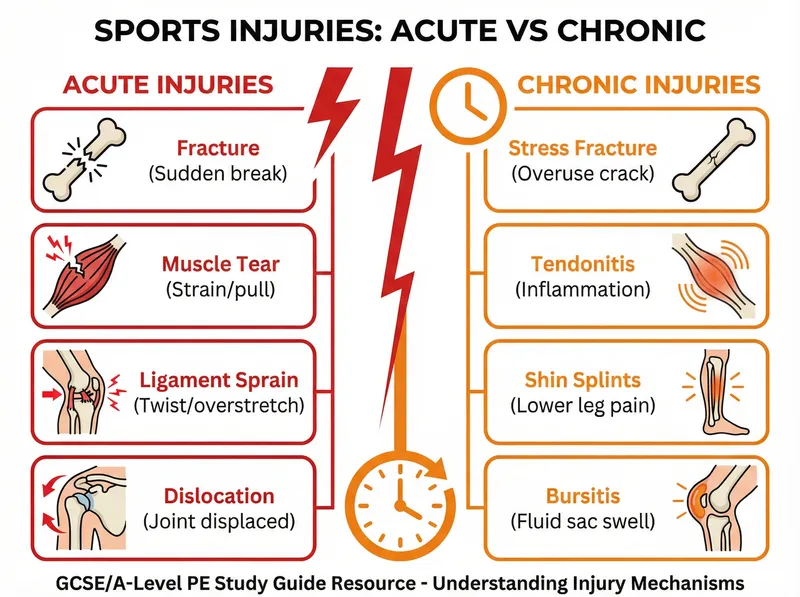
Interactive Diagrams
1 interactive diagram to visualise key concepts
Conceptual Flow Outline
Injury management and rehabilitation pathway
Your focus
- Classify injuries as acute or chronic and as soft or hard tissue.
- Distinguish between a sprain and a strain using correct terminology.
- Give sporting examples of acute and chronic injuries.
Show all 36 objectives
- Define acute injury and state that it results from a sudden traumatic episode.
- Describe fractures, dislocations, strains and sprains in terms of the tissue damaged.
- Classify given injury scenarios as fracture, dislocation, strain or sprain using mechanism and signs.
- Define chronic injury and state that it results from repeated loading with inadequate recovery.
- Describe Achilles tendonitis, stress fracture and tennis elbow in terms of the tissue overloaded and mechanism.
- Classify given injury scenarios as chronic using gradual onset and cumulative mechanism.
- Distinguish between injury prevention, rehabilitation and recovery methods.
- Describe how screening, warm-up and protective equipment contribute to injury prevention.
- Explain how rehabilitation and recovery methods support an athlete's return to training and competition.
- Define screening as a pre-participation assessment for injury risk.
- Describe what screening assesses, such as movement quality, strength and previous injury history.
- Explain how screening results inform injury prevention methods.
- Identify appropriate protective equipment for given physical activities.
- Explain how protective equipment reduces the risk or severity of injury.
- Evaluate the limitations of protective equipment in injury prevention.
- Describe the purpose and components of a warm up.
- Distinguish between active, passive, static and ballistic flexibility training.
- Explain how taping and bracing contribute to injury prevention and support.
- Identify the physiological aim of proprioceptive training, strength training, hyperbaric chambers, cryotherapy and hydrotherapy.
- Match a rehabilitation method to a described injury and stage of healing.
- Distinguish between methods that reduce inflammation and those that restore function.
- Identify the mechanism by which compression garments, massage, foam rollers, cold therapy, ice baths and cryotherapy support recovery.
- Distinguish between recovery methods that use pressure, mechanical force or cold.
- Select the recovery method that best matches a described post-exercise need.
- State the physiological effect of a named rehabilitation method.
- Explain how proprioceptive training, hydrotherapy and hyperbaric chambers aid tissue recovery.
- Justify the use of strength training to reverse muscle atrophy during rehabilitation.
- Describe the physiological action of a hyperbaric chamber.
- Describe the physiological action of cryotherapy.
- Compare the two methods in terms of their effect on injured tissue.
- Describe how sleep contributes to tissue repair and nervous-system recovery.
- Identify the roles of carbohydrate, protein, fluid, electrolytes, calcium, vitamin D and iron in recovery.
- Explain how inadequate sleep or nutrition can slow rehabilitation and increase re-injury risk.
Which command word is this?
Give a detailed account of the features or steps. For example, 'Describe the components of a warm-up' requires naming and explaining each phase (pulse raiser, dynamic stretches, skill drills) without justification.
Injury prevention and the rehabilitation of injury exam tips
Topic Overview
This topic examines how performers can reduce the risk of injury through intrinsic and extrinsic factor management, effective warm-up and cool-down protocols, and correct use of protective equipment. It also covers the physiological healing process and rehabilitation strategies such as RICE, cryotherapy, and progressive strengthening to return athletes to full fitness safely.
Understanding injury prevention and rehabilitation is essential for careers in sports therapy, coaching, and physical education. It connects anatomy (muscles, joints, ligaments), physiology (inflammatory response, tissue healing), and training principles (progressive overload, specificity) to real-world sporting scenarios, making it a high-yield topic for AQA A-Level exam questions.
Key Concepts
- →Intrinsic risk factors are internal to the performer (age, sex, muscle imbalance, poor technique, previous injury, inadequate fitness) and extrinsic risk factors are external (surface, equipment, environment, coaching, opponents, clothing, heat).
- →A warm-up should include a pulse raiser, dynamic stretches, and skill-related drills to increase muscle temperature, blood flow, and neuromuscular coordination, reducing injury risk.
- →RICE (Rest, Ice, Compression, Elevation) is the immediate treatment for acute soft tissue injuries, working by reducing blood flow, swelling, and pain through vasoconstriction and gravity.
- →Rehabilitation follows a progressive model: pain management, restore range of motion, build strength (isometric then eccentric), and sport-specific conditioning before return to play.
- →Cryotherapy and thermotherapy are contrasting modalities: cryotherapy reduces inflammation and pain in acute stages, while thermotherapy increases blood flow and tissue extensibility in chronic stages.
Marking Points
- Acute injuries occur suddenly from a single traumatic event, for example a sprained ligament, a muscle strain, a dislocation or a fracture.
- Chronic injuries develop gradually from repeated overload over time, for example tendinitis or a stress fracture.
- Soft tissue injuries involve muscle, tendon, ligament, cartilage or skin, such as a hamstring strain or an ankle sprain.
- Hard tissue injuries involve bone, such as a closed fracture or a stress fracture.
- Classifying an injury by tissue type and by onset (acute or chronic) guides appropriate prevention and rehabilitation choices.
- A sprain damages ligaments at a joint, whereas a strain damages muscle or tendon, so the two terms are not interchangeable.
- Acute injuries arise from a sudden, single traumatic episode rather than repeated cumulative loading.
- A fracture is a break or crack in a bone, caused by direct impact or indirect force.
- A dislocation is displacement of a bone from its normal position at a joint, damaging joint structures.
- A strain is overstretching or tearing of muscle or tendon, typically from explosive or overstretched contraction.
- A sprain is overstretching or tearing of ligaments at a joint, commonly the ankle.
- Classification depends on the tissue damaged and the mechanism of injury, not on the sport alone.
- Chronic injuries develop gradually from repeated loading with inadequate recovery rather than a single traumatic event.
- Achilles tendonitis is overuse inflammation and degeneration of the Achilles tendon from repetitive running, jumping and calf loading.
- A stress fracture is a small crack in a bone caused by cumulative impact, common in the tibia, metatarsals and navicular.
- Tennis elbow is overuse injury of the tendons attaching to the lateral elbow, caused by repeated wrist extension and gripping.
- Chronic injuries typically show gradual onset, pain that worsens with continued activity and relief with rest.
- Classification depends on the tissue overloaded (tendon or bone) and the cumulative mechanism, not on the sport alone.
- Injury prevention methods include screening, warm-up, protective equipment, taping and bracing, and appropriate training load.
- Screening identifies risk factors such as muscle imbalance, joint instability or previous injury history before participation.
- Rehabilitation is a staged process: protect and manage initial symptoms, restore range of movement, rebuild strength and power, then return to sport-specific loading.
- Recovery methods include sleep, nutrition and hydration, active recovery, massage, cryotherapy and compression, used to restore the athlete after training or competition.
- Prevention, rehabilitation and recovery are distinct but linked phases, and the method chosen depends on the athlete's stage and the nature of the injury.
- Screening is a pre-participation assessment used to identify injury risk factors.
- Screening may assess movement quality, muscle strength and balance, joint range of movement, and previous injury history.
- Screening results inform prevention by guiding targeted strengthening, mobility work or technique coaching.
- Screening does not guarantee freedom from injury; it identifies risk so training can be adjusted.
- Screening is one method of injury prevention alongside warm-up, protective equipment and load management.
- Protective equipment reduces injury risk by absorbing or dispersing impact forces.
- Correct fit and condition are essential for equipment to work effectively.
- Different activities require different equipment matched to their specific risks.
- Equipment supplements, but does not replace, safe technique and adherence to rules.
- Examples include shin pads, gum shields, helmets and padded gloves.
- Warm up raises muscle temperature and blood flow, preparing the body for activity.
- Active flexibility is performed by the individual moving the joint themselves.
- Passive flexibility uses an external force such as a partner or device.
- Static flexibility involves holding a stretch still, while ballistic flexibility uses bouncing or swinging movements.
- Taping and bracing support or stabilise a joint, limiting unwanted movement and providing feedback.
- Proprioceptive training retrains joint position sense and neuromuscular control, often using unstable surfaces or single-leg balance work.
- Strength training progressively loads muscle and tendon so the injured tissue regains force capacity without re-injury.
- Hyperbaric chambers raise the pressure of oxygen breathed, increasing oxygen delivery to poorly perfused or hypoxic tissue.
- Cryotherapy applies extreme cold to reduce pain, local blood flow and inflammation in the early stage of healing.
- Hydrotherapy uses buoyancy to reduce joint load and water resistance to provide graded exercise during rehabilitation.
- Selecting the correct method depends on the injured tissue, the stage of healing and the rehabilitation goal.
- Compression garments apply graduated pressure to limbs, which may support venous return and limit swelling after exercise.
- Massage and foam rollers apply mechanical pressure to muscle, aiming to reduce soreness and improve tissue mobility.
- Cold therapy lowers tissue temperature to reduce pain, local blood flow and inflammation after intense exercise.
- Ice baths immerse the body or limbs in cold water to produce the same cooling effects as other cold therapy.
- Cryotherapy uses extreme cold, often cold air, to cool tissue and support recovery.
- The best recovery method depends on the mechanism targeted, such as circulation, soreness or inflammation.
- Proprioceptive training stimulates mechanoreceptors to restore neuromuscular control and joint stability.
- Strength training applies progressive resistance to induce muscle hypertrophy and restore force production.
- Hydrotherapy uses buoyancy to reduce joint loading, while hydrostatic pressure reduces oedema and warm water increases blood flow.
- Hyperbaric chambers increase blood plasma oxygen concentration under pressure, accelerating cellular repair and reducing swelling.
- Cryotherapy lowers local tissue temperature, reducing metabolic demand and pain so secondary hypoxic injury is limited.
- A hyperbaric chamber uses raised atmospheric pressure with high oxygen concentration, increasing dissolved oxygen in plasma and delivery to hypoxic tissue.
- Improved oxygen delivery can support tissue healing and reduce swelling after injury.
- Cryotherapy lowers local tissue temperature, reducing metabolic demand, pain and blood flow.
- Reduced blood flow and metabolic demand limit secondary hypoxic damage and swelling in the early stage of healing.
- Both methods carry risks, such as oxygen toxicity in hyperbaric therapy and cold injury in cryotherapy, so use must be controlled.
- Sleep supports tissue repair and growth hormone release, aiding recovery from training or injury.
- Most adolescents need approximately 8–10 hours of sleep per night, and athletes may require more.
- Carbohydrate replenishes muscle and liver glycogen stores after exercise.
- Protein provides amino acids for muscle protein synthesis and repair.
- Fluid and electrolytes restore hydration and blood volume after sweating.
- Calcium and vitamin D support bone remodelling and repair.
- Iron supports oxygen transport and energy production.
- Inadequate sleep or nutrition slows repair, increases fatigue and raises re-injury risk.
Examiner Tips
- 💡Classify each injury by both onset (acute or chronic) and tissue (soft or hard) to show precise understanding.
- 💡Use a named sporting example for each type, such as a sprinter's hamstring strain or a runner's stress fracture.
- 💡Distinguish sprain from strain explicitly in your answer, as examiners look for correct use of terminology.
- 💡Link each injury to the specific tissue damaged (bone, joint, muscle-tendon, ligament) to justify your classification.
- 💡Use the mechanism of injury, such as direct impact or twisting, to distinguish fracture, dislocation, strain and sprain.
- 💡Check the onset described in the question: immediate sudden onset signals an acute injury rather than a chronic one.
- 💡Identify the tissue overloaded, tendon or bone, and the repetitive mechanism to justify a chronic classification.
- 💡Use the gradual onset and worsening-with-activity pattern in the question to distinguish chronic from acute injury.
- 💡Name the specific site, such as the Achilles tendon or lateral elbow tendons, to show precise anatomical knowledge.
- 💡Read the question stem carefully to identify whether it asks about prevention, rehabilitation or recovery before selecting an option.
- 💡Eliminate options that describe a method from the wrong phase, such as choosing a rehabilitation method for a prevention question.
- 💡Link each method to its purpose: prevention reduces risk, rehabilitation restores function, recovery restores readiness.
- 💡Look for the purpose of screening in the question: is it about identifying risk, guiding training, or both?
- 💡Eliminate options that describe treatment or rehabilitation rather than pre-participation assessment.
- 💡Remember that screening is one part of a wider prevention programme, not a standalone solution.
- 💡Link each piece of equipment to the specific injury it helps prevent, such as shin pads reducing impact to the tibia.
- 💡Check whether the question asks for a benefit or a limitation, and answer accordingly.
- 💡Use precise terms like absorb impact, spread force or restrict movement rather than vague phrases like keep safe.
- 💡Learn a clear definition and example for each flexibility type so you can match them quickly in MCQs.
- 💡Distinguish taping from bracing: taping uses adhesive tape, bracing uses a fitted device.
- 💡When a question asks about injury prevention, link the method to how it reduces risk, not just what it is.
- 💡Read the question stem for the injured tissue and stage before choosing, because the best method changes with context.
- 💡Eliminate options that describe the wrong medium, such as water exercise for a cold-therapy question.
- 💡Link each method to one clear physiological effect so you can justify the correct option quickly.
- 💡Identify the recovery mechanism named in the question, such as circulation, soreness or inflammation, before selecting.
- 💡Reject options that describe a training effect rather than a recovery effect.
- 💡Use the medium of each method, pressure, water or cold air, to separate similar options.
- 💡Link each method to a named physiological effect, such as increased plasma oxygen or reduced metabolic demand, rather than saying it 'helps recovery'.
- 💡Specify how hydrotherapy aids rehabilitation by distinguishing between the effects of buoyancy, temperature and hydrostatic pressure.
- 💡Explain that strength training is essential for reversing muscle atrophy and increasing connective tissue strength post-injury.
- 💡Contrast the two methods directly by naming the physiological variable each changes: pressure and oxygen delivery versus temperature and blood flow.
- 💡Use correct terminology such as dissolved oxygen in plasma, metabolic demand and secondary hypoxic damage.
- 💡Link each method to the healing stage where it is most appropriate rather than listing benefits without context.
- 💡Link each recovery factor to a specific physiological process, such as glycogen resynthesis or muscle protein synthesis.
- 💡Use approximate figures where appropriate, for example 8–10 hours of sleep for adolescents, rather than vague statements.
- 💡When a question asks about recovery, address both sleep and nutrition to cover the full statement.
- 💡Always link risk factors to specific sporting examples (e.g., a hard tennis court causing ankle sprains) to demonstrate application and access higher marks.
- 💡For rehabilitation questions, structure answers chronologically (immediate, short-term, long-term) and use correct terminology such as 'vasoconstriction', 'oedema', 'eccentric', and 'proprioception'.
- 💡When evaluating injury prevention strategies, consider both strengths and limitations (e.g., taping supports but can weaken muscles if overused) to reach Level 4 in 15-mark questions.
Common Mistakes
- Using sprain and strain as synonyms: a sprain is ligament damage at a joint, while a strain is muscle or tendon damage.
- Calling a stress fracture an acute injury: it develops gradually through repeated overload, so it is chronic.
- Assuming all chronic injuries are minor: tendinitis and stress fractures can limit performance severely and need progressive loading in rehabilitation.
- Believing a dislocation is a soft tissue injury: it involves displacement of bones at a joint, so it is classified as hard tissue damage.
- Confusing a strain with a sprain: a strain damages muscle or tendon, whereas a sprain damages ligaments at a joint.
- Assuming every acute injury involves a fracture: most acute injuries are soft-tissue strains and sprains, and fracture requires bone damage.
- Believing a dislocation is simply a sprain: a dislocation displaces the bone from the joint, while a sprain overstretches or tears ligaments without displacement.
- Thinking acute injuries develop gradually over weeks: acute injuries have sudden onset from a single episode, unlike chronic overuse injuries.
- Treating chronic injuries as sudden events: chronic injuries develop gradually through repeated loading, unlike acute injuries.
- Assuming tennis elbow only affects tennis players: it is an overuse tendon injury of the lateral elbow caused by repeated wrist extension and gripping in many activities.
- Confusing Achilles tendonitis with an acute ankle sprain: tendonitis is gradual tendon overuse, whereas a sprain is sudden ligament damage.
- Believing a stress fracture is a complete bone break from one impact: it is a small crack from cumulative loading over time.
- Confusing prevention with rehabilitation: prevention happens before injury, while rehabilitation is the structured process after injury. Correct by linking each method to the athlete's current stage.
- Treating recovery as identical to rehabilitation: recovery restores the athlete after normal training or competition, whereas rehabilitation addresses a specific injury. Correct by defining the purpose of each.
- Assuming screening guarantees no injury: screening identifies risk factors but does not remove them. Correct by explaining that screening informs prevention, not replaces it.
- Believing one method suits every athlete: the appropriate method depends on the injury, stage and sport demands. Correct by matching the method to the context.
- Thinking screening prevents injury by itself: screening identifies risk factors, and prevention follows through targeted training. Correct by stating that screening informs prevention.
- Believing screening is only for elite athletes: screening can be used at any level to flag risk. Correct by recognising its broad applicability.
- Confusing screening with diagnosis: screening flags potential risk, while diagnosis identifies a specific condition. Correct by distinguishing the two.
- Assuming a clear screening means no injury will occur: screening reduces risk but cannot eliminate it. Correct by acknowledging its limitations.
- Thinking protective equipment eliminates all injury risk; it only reduces the likelihood or severity of injury.
- Assuming any equipment will do regardless of sport; equipment must match the specific demands and risks of the activity.
- Ignoring fit and condition; poorly fitted or damaged equipment provides little protection and may itself cause harm.
- Believing equipment is only for competition; it should be used in training as well.
- Confusing active and passive flexibility; active is self-produced movement, passive relies on an external force.
- Thinking ballistic stretching is always safe; its bouncing action can trigger the stretch reflex and increase injury risk if performed incorrectly.
- Believing taping or bracing cures an injury; they support and protect but do not replace rehabilitation or safe technique.
- Skipping warm up before flexibility work; a warm up prepares tissues and makes stretching safer and more effective.
- Confusing cryotherapy with hydrotherapy: cryotherapy is cold application, whereas hydrotherapy is exercise in water; correct by linking each to its medium and main effect.
- Believing hyperbaric chambers build muscle: they increase oxygen delivery to tissue, whereas strength training builds force capacity; correct by matching each method to its physiological aim.
- Thinking proprioceptive training only builds strength: it retrains balance and joint position sense; correct by describing the balance or unstable-surface task.
- Assuming all rehabilitation methods suit every stage: method choice depends on tissue type and healing phase; correct by stating the stage each method fits.
- Treating ice baths and cryotherapy as unrelated: both use cold to reduce pain and inflammation; correct by grouping them as cold therapies with different delivery.
- Thinking compression garments increase blood flow to the surface: they apply pressure to support venous return; correct by describing the direction of pressure.
- Believing massage builds strength: it targets soreness and mobility; correct by linking it to recovery rather than performance gain.
- Assuming one recovery method covers all needs: methods target different mechanisms; correct by matching method to the intended recovery effect.
- Thinking hyperbaric chambers only improve fitness: they are used in rehabilitation to increase oxygen delivery to damaged tissues, accelerating repair.
- Confusing the physiological effects of hydrotherapy: buoyancy reduces weight-bearing load, whereas hydrostatic pressure is what reduces swelling.
- Believing proprioceptive training directly heals torn ligaments: it retrains the neuromuscular system and mechanoreceptors to restore balance and prevent re-injury.
- Confusing the two methods: hyperbaric therapy raises pressure and oxygen delivery, while cryotherapy lowers tissue temperature.
- Thinking cryotherapy speeds healing by increasing blood flow: cold reduces local blood flow and metabolic demand, which limits secondary damage rather than directly repairing tissue.
- Believing hyperbaric chambers are risk-free: raised oxygen pressure can cause oxygen toxicity, so exposure is controlled.
- Thinking sleep is only for feeling rested: correct this by explaining that sleep also drives growth hormone release and tissue repair.
- Believing any food is adequate for recovery: correct this by specifying carbohydrate for glycogen, protein for muscle repair, and fluid with electrolytes for rehydration.
- Assuming supplements replace a balanced diet: correct this by stating that whole foods and adequate energy intake form the foundation, with supplements only filling specific gaps.
- Ignoring the role of micronutrients: correct this by naming calcium and vitamin D for bone remodelling and iron for oxygen transport.
- Students often think ice should be applied directly to the skin for long periods. Correction: Ice should be wrapped in a towel and applied for no more than 20 minutes every 2-3 hours to avoid ice burns and nerve damage.
- Many believe that complete rest is best after injury. Correction: While acute rest is important, prolonged immobilisation leads to muscle atrophy and joint stiffness; early controlled mobilisation and progressive loading enhance recovery.
- Students frequently confuse cryotherapy with thermotherapy. Correction: Cryotherapy (cold) is used in the acute phase to reduce swelling and pain; thermotherapy (heat) is used in later stages to increase blood flow and relax muscles.
Revision Plan
- 1Day 1-2: Create a two-column table of intrinsic and extrinsic risk factors with sporting examples for each. Use flashcards to memorise them.
- 2Day 3-4: Learn the components and physiological benefits of a warm-up and cool-down. Write a 6-mark model answer and self-assess against the mark scheme.
- 3Day 5-6: Study RICE and the healing process. Draw a flowchart of the three phases of healing and annotate with treatment strategies.
- 4Day 7-8: Design a 4-week rehabilitation programme for a common injury (e.g., ankle sprain) applying progressive overload and specificity. Peer-review with a classmate.
- 5Day 9-10: Complete past paper questions on injury prevention and rehabilitation. Focus on 8-15 mark questions and use the command word guide to structure responses.
Exam Question Types
- 📋Short-answer questions (2-4 marks): Define intrinsic and extrinsic risk factors, or outline the components of a warm-up. Advice: Be precise and use correct terminology; avoid vague statements.
- 📋Data analysis questions (4-6 marks): Interpret injury statistics or graphs to identify risk factors and suggest prevention strategies. Advice: Quote data accurately and link to specific prevention methods.
- 📋Extended writing questions (8-15 marks): Evaluate the effectiveness of injury prevention strategies or design a rehabilitation programme. Advice: Use a structured approach with an introduction, balanced arguments, and a conclusion; include sporting examples.
Command Word Expectations (AQA)
Give a detailed account of the features or steps. For example, 'Describe the components of a warm-up' requires naming and explaining each phase (pulse raiser, dynamic stretches, skill drills) without justification.
Provide reasons or mechanisms. For example, 'Explain how ice reduces swelling' requires stating that ice causes vasoconstriction, which reduces blood flow and oedema, not just 'it makes it cold'.
Weigh up strengths and weaknesses and reach a justified conclusion. For example, 'Evaluate the use of taping in injury prevention' requires discussing benefits (support, proprioception) and limitations (cost, muscle weakness, skin irritation) before concluding.
How Students Lose Marks (Examiner Pitfalls)
Step-by-Step Worked Solutions
Question: Explain how a warm-up can prevent injury in a 6-mark question for AQA A-Level PE.
- 1.Step 1: Identify the components of a warm-up: pulse raiser, dynamic stretches, skill-related drills.
- 2.Step 2: Link each component to physiological effects: increased muscle temperature, increased blood flow, increased elasticity of muscles and tendons.
- 3.Step 3: Explain how these effects reduce injury risk: greater flexibility, improved proprioception, faster nerve impulse transmission, and reduced risk of muscle tears and strains.
- 4.Step 4: Conclude with a specific sporting example, such as a footballer performing dynamic lunges before a match to prepare hamstrings and hip flexors.
Question: A 400m sprinter suffers a grade 2 hamstring strain. Describe the immediate treatment and outline a 4-week rehabilitation programme using the principles of progressive overload and specificity. (8 marks)
- 1.Step 1: Immediate treatment: apply RICE for 48-72 hours to reduce swelling and pain. Avoid HARM (Heat, Alcohol, Running, Massage) for the first 72 hours.
- 2.Step 2: Week 1-2: pain-free isometric contractions, gentle range of motion exercises, and low-intensity cycling to maintain blood flow without stressing the hamstring.
- 3.Step 3: Week 3-4: introduce eccentric strengthening (e.g., Nordic hamstring curls), progressive resistance training, and sport-specific drills such as stride-outs at 60-70% intensity.
- 4.Step 4: Apply progressive overload by gradually increasing load, volume, and intensity each week. Apply specificity by including running mechanics and acceleration drills that mimic sprinting demands.
- 5.Step 5: Conclude with return-to-sport criteria: full pain-free range of motion, hamstring strength within 90% of the uninjured side, and completion of sport-specific movements without discomfort.