AQA · A-Level · Physical Education
Course version: 7582 · Version from Sept 2016
Skill, skill continuums and transfer of skills: Zero.
A zero transfer continuum position describes a situation in which learning or performing one skill produces no measurable change in the learning or performance of another skill.
Checked against the AQA 7582 specification (opens in a new tab) on .
- Point 12 of 14
- 3 key terms
Study notes
From the checked teaching notes for this specification point.
The idea
A zero transfer continuum position describes a situation in which learning or performing one skill produces no measurable change in the learning or performance of another skill. The two skills are practised and assessed independently, so improvement in the first does not help or hinder the second. A useful method is to compare performance scores before and after practising the first skill: if the second skill's score stays essentially the same, the relationship sits at the zero point. This differs from positive transfer, where the first skill aids the second, and negative transfer, where it interferes. In an AQA A-Level Physical Education multiple-choice question, you would be asked to identify the continuum position or the example that best matches it, so you must distinguish zero transfer from both positive and negative transfer using the evidence in the stem.
What earns the marks
- Identifies zero transfer as no measurable effect of learning or performing one skill on another skill.
- Distinguishes zero transfer from positive transfer, where one skill aids another, and negative transfer, where one skill interferes with another.
- Applies the continuum position to a practical example by comparing performance of the second skill before and after practice of the first.
- Selects the option in which the two skills are independent and no change in the second skill is described.
Common mistakes and how to put them right
Confusing zero transfer with negative transfer.
Put it right: Zero transfer means no effect, whereas negative transfer means the first skill actively harms the second, so check whether the stem describes no change or a worsening.
Assuming every pair of skills shows transfer.
Put it right: Many skills are independent, so do not select positive or negative transfer unless the stem gives evidence of a change.
Treating zero transfer as a failure of learning.
Put it right: It simply describes the relationship between two skills, not the quality of the performer's learning.
Ignoring the direction of any stated change.
Put it right: If the stem says performance improved, that is positive transfer, and if it declined, that is negative transfer, leaving zero only when no change is reported.
Exam tips
- Underline the key phrase in the stem, such as no effect or unchanged, before looking at the options.
- Eliminate any option that describes improvement or decline when the stem reports no change.
- Check that the example in the option involves two distinct skills, because transfer is a relationship between skills rather than within one skill.
Try the lesson
The start of the Skill, skill continuums and transfer of skills: Zero. lesson, made from checked teaching notes for this specification point.
Have a go first
In skill classification, what does the term 'zero transfer' describe?
Listen
A zero transfer continuum position describes a situation in which learning or performing one skill produces no measurable change in the learning or performance of another skill. The two skills are practised and assessed independently, so improvement in the first does not help or hinder the second. A useful method is to compare performance scores before and after practising the first skill: if the second skill's score stays essentially the same, the relationship sits at the zero point. This differs from positive transfer, where the first skill aids the second, and negative transfer, where it interferes. In an AQA A-Level Physical Education multiple-choice question, you would be asked to identify the continuum position or the example that best matches it, so you must distinguish zero transfer from both positive and negative transfer using the evidence in the stem. A strong answer earns marks for these points. Identifies zero transfer as no measurable effect of learning or performing one skill on another skill. Distinguishes zero transfer from positive transfer, where one skill aids another, and negative transfer, where one skill interferes with another. Applies the continuum position to a practical example by comparing performance of the second skill before and after practice of the first. Selects the option in which the two skills are independent and no change in the second skill is described. Exam tip: Underline the key phrase in the stem, such as no effect or unchanged, before looking at the options.
See it
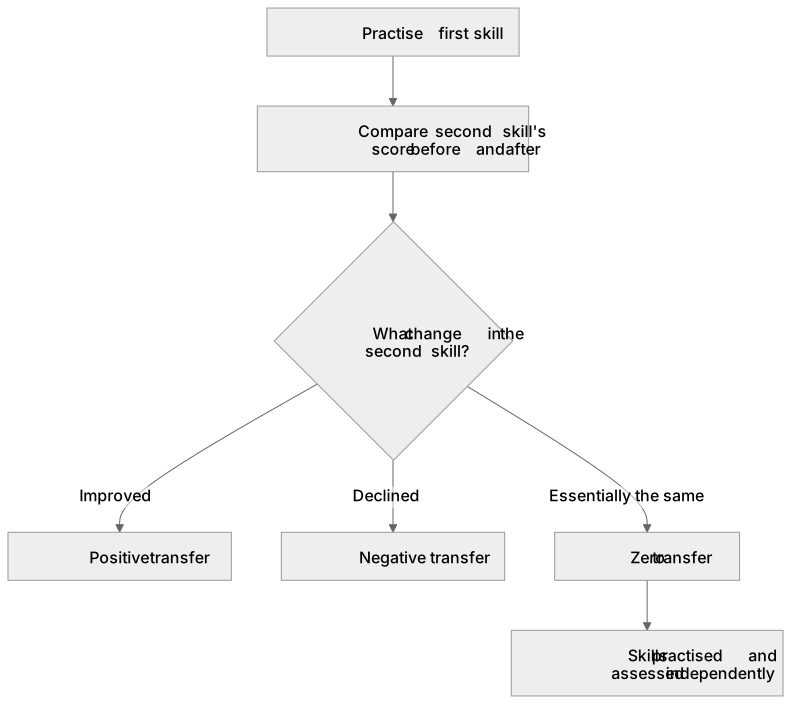
Key words
Say what each word means before you turn the card.
Zero transfer
Try answering aloud or in your head before turning the card.
Positive transfer
Try answering aloud or in your head before turning the card.
Negative transfer
Try answering aloud or in your head before turning the card.
See every definition
- Zero transfer
- A continuum position in which learning or performing one skill produces no measurable change in the learning or performance of another skill.
- Positive transfer
- A relationship in which the first skill aids the second.
- Negative transfer
- A relationship in which the first skill interferes with the second.
Label the diagram
Some boxes have lost their names. Pick the right name for each number.
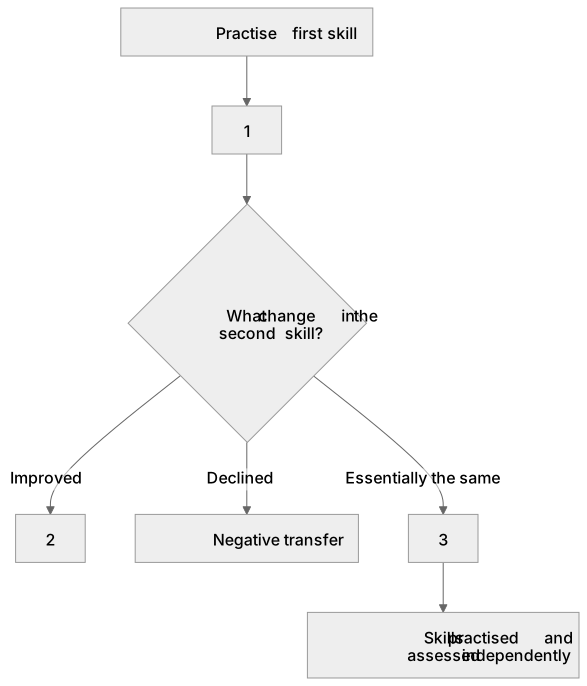
1Box 1
2Box 2
3Box 3
There is more to this lesson
The full lesson goes on to check your understanding and help you earn the marks. Create a free account to carry on, with your progress saved.
A week of Premium from your first lesson · Then the free plan continues · No card, no charge
Test your understanding of Skill, skill continuums and transfer of skills: Zero.
Active recall beats re-reading. Take an instant quiz now to test what you’ve learned and lock it into long-term memory.
A week of Premium from your first lesson · Then the free plan continues · No card, no charge