AQA · A-Level · Physical Education
Course version: 7582 · Version from Sept 2016
Skill, skill continuums and transfer of skills: Positive.
Positive transfer occurs when the learning or performance of one skill facilitates the learning or performance of another.
Checked against the AQA 7582 specification (opens in a new tab) on .
- Point 10 of 14
- 4 key terms
Study notes
From the checked teaching notes for this specification point.
The idea
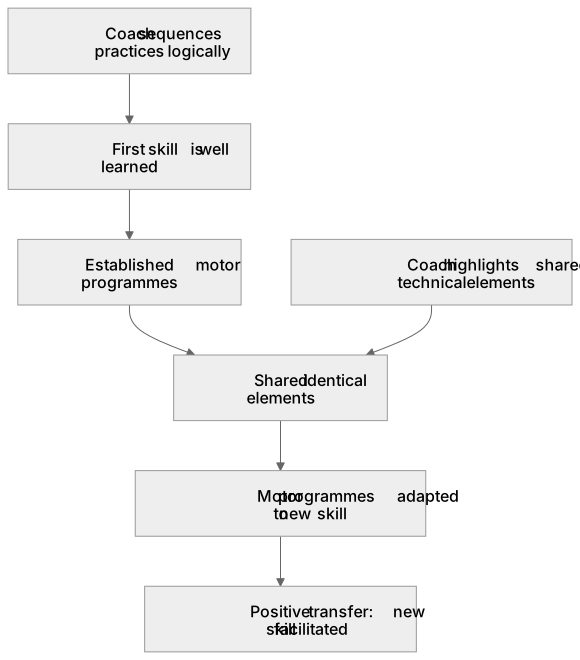
Positive transfer occurs when the learning or performance of one skill facilitates the learning or performance of another. This beneficial effect happens when two skills share similar movement patterns, cognitive demands, or environmental cues. Because the motor programmes are already established, the performer can adapt them to the new skill. For example, the overarm throwing action in cricket shares a similar motor programme with a tennis serve, allowing the established throwing technique to support the racket skill. Coaches can maximise positive transfer by ensuring the first skill is well learned before introducing the second, sequencing practices logically, and explicitly highlighting the shared technical elements to the performer.
What earns the marks
- Positive transfer is defined as the process where the learning or performance of one skill facilitates or aids another.
- Established motor programmes from a previously learned skill are adapted to accelerate the acquisition of the new skill.
- A classic example is the transfer of an overarm throwing technique to a tennis serve or volleyball spike.
- Coaches promote positive transfer by ensuring the foundational skill is fully grooved and by explicitly pointing out similarities.
Common mistakes and how to put them right
Confusing positive transfer with general fitness improvements.
Put it right: Transfer specifically relates to the acquisition and execution of motor skills.
Assuming positive transfer happens automatically between any two sports.
Put it right: It requires shared identical elements or similar motor programmes.
Believing that positive transfer only occurs from a previously learned skill to a new one (proactive).
Put it right: A newly learned skill can also improve an existing one (retroactive).
Exam tips
- Always define positive transfer in terms of one skill facilitating or helping another skill.
- Use the concept of 'identical elements' or shared motor programmes to explain why positive transfer occurs.
- Provide a clear, specific sporting example, such as an overarm throw aiding a tennis serve, to illustrate the concept.
Try the lesson
The start of the Skill, skill continuums and transfer of skills: Positive. lesson, made from checked teaching notes for this specification point.
Have a go first
A gymnast who has already mastered a handstand finds it easier to learn a cartwheel because the balance and arm-support demands are similar. Which type of transfer does this describe?
Listen
Positive transfer occurs when the learning or performance of one skill facilitates the learning or performance of another. This beneficial effect happens when two skills share similar movement patterns, cognitive demands, or environmental cues. Because the motor programmes are already established, the performer can adapt them to the new skill. For example, the overarm throwing action in cricket shares a similar motor programme with a tennis serve, allowing the established throwing technique to support the racket skill. Coaches can maximise positive transfer by ensuring the first skill is well learned before introducing the second, sequencing practices logically, and explicitly highlighting the shared technical elements to the performer. A strong answer earns marks for these points. Positive transfer is defined as the process where the learning or performance of one skill facilitates or aids another. Established motor programmes from a previously learned skill are adapted to accelerate the acquisition of the new skill. A classic example is the transfer of an overarm throwing technique to a tennis serve or volleyball spike. Coaches promote positive transfer by ensuring the foundational skill is fully grooved and by explicitly pointing out similarities. A common slip: Confusing positive transfer with general fitness improvements. Instead, transfer specifically relates to the acquisition and execution of motor skills. Exam tip: Always define positive transfer in terms of one skill facilitating or helping another skill.
See it
Key words
Say what each word means before you turn the card.
Positive transfer
Try answering aloud or in your head before turning the card.
Identical elements
Try answering aloud or in your head before turning the card.
Motor programmes
Try answering aloud or in your head before turning the card.
Coaching strategies
Try answering aloud or in your head before turning the card.
See every definition
- Positive transfer
- The process where the learning or performance of one skill facilitates or aids another.
- Identical elements
- Shared movement patterns, perceptual cues, or decision-making demands that positive transfer relies on.
- Motor programmes
- Established patterns from a previously learned skill that are adapted to accelerate the acquisition of the new skill.
- Coaching strategies
- Ensuring the foundational skill is fully grooved and explicitly pointing out similarities to promote positive transfer.
Label the diagram
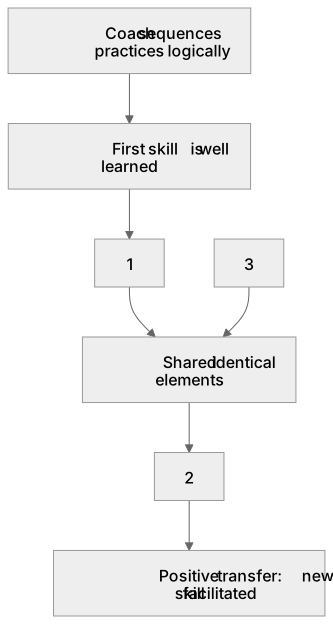
Some boxes have lost their names. Pick the right name for each number.
1Box 1
2Box 2
3Box 3
There is more to this lesson
The full lesson goes on to check your understanding and help you earn the marks. Create a free account to carry on, with your progress saved.
A week of Premium from your first lesson · Then the free plan continues · No card, no charge
Test your understanding of Skill, skill continuums and transfer of skills: Positive.
Active recall beats re-reading. Take an instant quiz now to test what you’ve learned and lock it into long-term memory.
A week of Premium from your first lesson · Then the free plan continues · No card, no charge