AQA · A-Level · Physical Education
Course version: 7582 · Version from Sept 2016
Understanding the key terms relating to equal opportunities.
Full specification wording
Sociological theory applied to equal opportunities: Understanding the key terms relating to equal opportunities.
Understanding equal opportunities requires defining five key terms: discrimination, prejudice, stereotype, myth, and role model.
Checked against the AQA 7582 specification (opens in a new tab) on .
- Point 11 of 18
- 4 key terms
Study notes
From the checked teaching notes for this specification point.
The idea
Understanding equal opportunities requires defining five key terms: discrimination, prejudice, stereotype, myth, and role model. Prejudice is a preconceived opinion not based on reason. Discrimination is the unfair treatment of individuals based on characteristics like race or gender; it is prejudice in action. A stereotype is a widely held but oversimplified image of a particular type of person. A myth is a widely held but false belief or idea. A role model is a person looked to by others as an example to be imitated.
For example: The myth that women are physically incapable of playing rugby can reinforce gender stereotypes and reduce female participation, hindering equal opportunities.
What earns the marks
- Define prejudice as a preconceived opinion or attitude that is not based on reason or actual experience.
- Define discrimination as the unfair treatment or action against individuals based on characteristics such as race or gender.
- Define stereotype as a widely held but oversimplified image or idea of a particular type of person, and myth as a widely held but false belief.
- Define role model as a person looked to by others as an example to be imitated.
- Explain how stereotypes, myths, and discrimination hinder equal opportunities, while positive role models promote them.
Common mistakes and how to put them right
Confusing prejudice with discrimination.
Put it right: Prejudice is an attitude or belief, whereas discrimination is the unequal treatment or action that follows from it.
Assuming stereotypes and myths are accurate representations.
Put it right: Stereotypes are oversimplified images and myths are false beliefs that create unfair barriers to participation.
Believing role models only impact elite athletes.
Put it right: Role models are crucial at the grassroots level for inspiring underrepresented groups and promoting equal opportunities.
Exam tips
- When distinguishing between terms, look for 'action' or 'treatment' to identify discrimination, and 'attitude' or 'belief' for prejudice.
- Use specific sporting examples to illustrate how a lack of role models or the presence of myths can reinforce stereotypes and reduce participation.
- Eliminate options that define a term incorrectly or swap the definitions of prejudice, discrimination, and myth.
Try the lesson
The start of the Sociological theory applied to equal opportunities: Understanding the key terms relating to equal opportunities. lesson, made from checked teaching notes for this specification point.
Have a go first
Which term describes the unfair treatment of a person or group because of characteristics such as gender, ethnicity or disability?
Listen
Understanding equal opportunities requires defining five key terms: discrimination, prejudice, stereotype, myth, and role model. Prejudice is a preconceived opinion not based on reason. Discrimination is the unfair treatment of individuals based on characteristics like race or gender; it is prejudice in action. A stereotype is a widely held but oversimplified image of a particular type of person. A myth is a widely held but false belief or idea. A role model is a person looked to by others as an example to be imitated. For example, the myth that women are physically incapable of playing rugby can reinforce gender stereotypes and reduce female participation, hindering equal opportunities. A strong answer earns marks for these points. Define prejudice as a preconceived opinion or attitude that is not based on reason or actual experience. Define discrimination as the unfair treatment or action against individuals based on characteristics such as race or gender. Define stereotype as a widely held but oversimplified image or idea of a particular type of person, and myth as a widely held but false belief. Define role model as a person looked to by others as an example to be imitated. A common slip: Confusing prejudice with discrimination. Instead, prejudice is an attitude or belief, whereas discrimination is the unequal treatment or action that follows from it. Exam tip: When distinguishing between terms, look for 'action' or 'treatment' to identify discrimination, and 'attitude' or 'belief' for prejudice.
See it
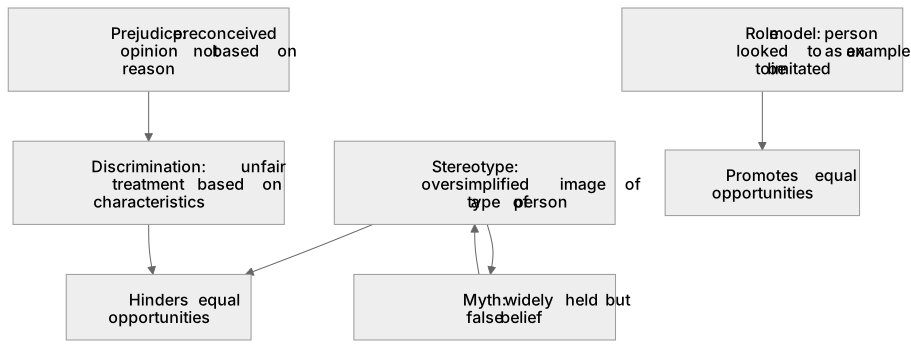
Key words
Say what each word means before you turn the card.
Prejudice
Try answering aloud or in your head before turning the card.
Discrimination
Try answering aloud or in your head before turning the card.
Stereotype
Try answering aloud or in your head before turning the card.
Myth
Try answering aloud or in your head before turning the card.
See every definition
- Prejudice
- A preconceived opinion or attitude that is not based on reason or actual experience.
- Discrimination
- The unfair treatment or action against individuals based on characteristics such as race or gender; it is prejudice in action.
- Stereotype
- A widely held but oversimplified image or idea of a particular type of person.
- Myth
- A widely held but false belief or idea.
Label the diagram
Some boxes have lost their names. Pick the right name for each number.
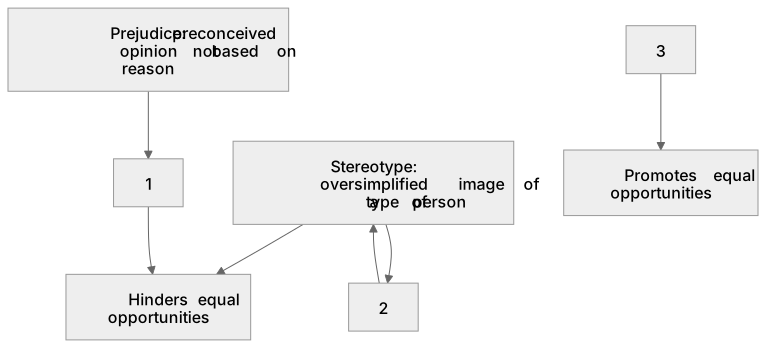
1Box 1
2Box 2
3Box 3
There is more to this lesson
The full lesson goes on to check your understanding and help you earn the marks. Create a free account to carry on, with your progress saved.
A week of Premium from your first lesson · Then the free plan continues · No card, no charge
Test your understanding of Sociological theory applied to equal opportunities: Understanding the key terms relating to equal opportunities.
Active recall beats re-reading. Take an instant quiz now to test what you’ve learned and lock it into long-term memory.
A week of Premium from your first lesson · Then the free plan continues · No card, no charge