AQA · A-Level · Physical Education
Course version: 7582 · Version from Sept 2016
Stress management: Attentional control and cue utilisation.
Attentional control is a performer's ability to direct and maintain focus on the most relevant information while ignoring distractions.
Checked against the AQA 7582 specification (opens in a new tab) on .
- Point 8 of 12
- 2 key terms
Study notes
From the checked teaching notes for this specification point.
The idea
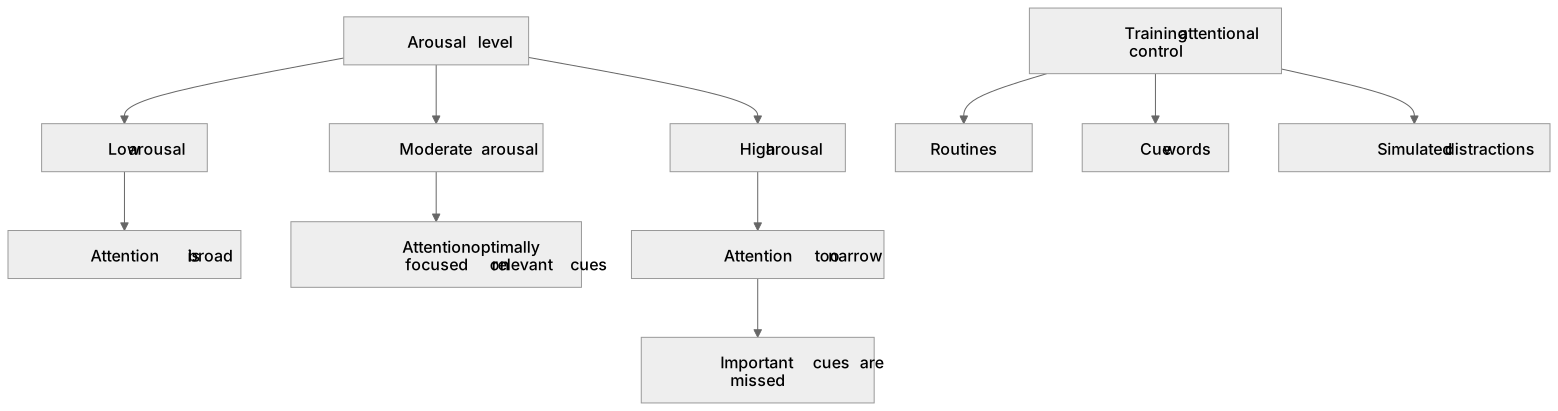
Attentional control is a performer's ability to direct and maintain focus on the most relevant information while ignoring distractions. Cue utilisation explains how attention narrows or widens according to arousal: at low arousal attention is broad, at moderate arousal it is optimally focused on relevant cues, and at high arousal it becomes too narrow, so important cues are missed. A tennis player at moderate arousal reads the opponent's toss and movement; when overaroused, they may lock onto the ball only and miss the opponent's positioning. Training attentional control means using routines, cue words and simulated distractions so focus stays flexible and appropriate to the task.
What earns the marks
- Attentional control is the ability to direct and maintain focus on relevant cues while ignoring irrelevant ones.
- Cue utilisation describes how attention narrows or widens as arousal changes.
- At low arousal attention is broad; at moderate arousal it is optimally focused; at high arousal it becomes too narrow and relevant cues are missed.
- Performers can train attentional control using routines, cue words and distraction practice.
- Effective attentional control allows flexible switching between broad and narrow focus as the task demands.
Common mistakes and how to put them right
Thinking high arousal always improves focus.
Put it right: Beyond an optimum, attention narrows too much and important cues are missed.
Treating attentional control as a fixed trait.
Put it right: It is a trainable skill developed through routines, cue words and practice under distraction.
Confusing attentional control with arousal control.
Put it right: Attentional control is about directing focus, while arousal control is about managing activation level.
Assuming a broad focus is always best.
Put it right: The appropriate focus depends on the task, so a sprinter at the start needs a narrow, external focus.
Exam tips
- Use the arousal continuum to explain cue utilisation, stating what happens to attention at low, moderate and high arousal.
- Give a named sporting example showing the cue a performer should attend to and the consequence of missing it.
- Suggest a practical training method, such as cue words or distraction drills, to show how attentional control can be improved.
Try the lesson
The start of the Stress management: Attentional control and cue utilisation. lesson, made from checked teaching notes for this specification point.
Have a go first
In attentional control, what is meant by cue utilisation?
Listen
Attentional control is a performer's ability to direct and maintain focus on the most relevant information while ignoring distractions. Cue utilisation explains how attention narrows or widens according to arousal: at low arousal attention is broad, at moderate arousal it is optimally focused on relevant cues, and at high arousal it becomes too narrow, so important cues are missed. A tennis player at moderate arousal reads the opponent's toss and movement; when overaroused, they may lock onto the ball only and miss the opponent's positioning. Training attentional control means using routines, cue words and simulated distractions so focus stays flexible and appropriate to the task. A strong answer earns marks for these points. Attentional control is the ability to direct and maintain focus on relevant cues while ignoring irrelevant ones. Cue utilisation describes how attention narrows or widens as arousal changes. At low arousal attention is broad; at moderate arousal it is optimally focused; at high arousal it becomes too narrow and relevant cues are missed. Performers can train attentional control using routines, cue words and distraction practice. Exam tip: Use the arousal continuum to explain cue utilisation, stating what happens to attention at low, moderate and high arousal.
See it
Key words
Say what each word means before you turn the card.
Attentional control
Try answering aloud or in your head before turning the card.
Cue utilisation
Try answering aloud or in your head before turning the card.
See every definition
- Attentional control
- A performer's ability to direct and maintain focus on the most relevant information while ignoring distractions.
- Cue utilisation
- Explains how attention narrows or widens according to arousal, from broad at low arousal to too narrow at high arousal.
Label the diagram
Some boxes have lost their names. Pick the right name for each number.
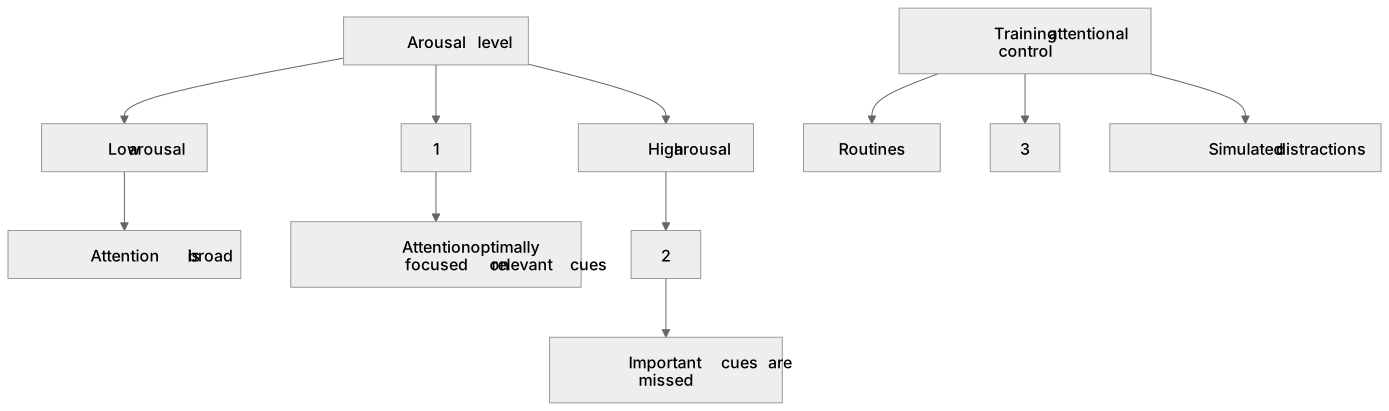
1Box 1
2Box 2
3Box 3
There is more to this lesson
The full lesson goes on to check your understanding and help you earn the marks. Create a free account to carry on, with your progress saved.
A week of Premium from your first lesson · Then the free plan continues · No card, no charge
Test your understanding of Stress management: Attentional control and cue utilisation.
Active recall beats re-reading. Take an instant quiz now to test what you’ve learned and lock it into long-term memory.
A week of Premium from your first lesson · Then the free plan continues · No card, no charge