AQA · A-Level · Physical Education
Course version: 7582 · Version from Sept 2016
Stress management: Thought stopping.
Thought stopping is a cognitive stress-management technique in which a performer notices a negative or unhelpful thought and deliberately interrupts it, then replaces it with a more useful cue.
Checked against the AQA 7582 specification (opens in a new tab) on .
- Point 9 of 12
Study notes
From the checked teaching notes for this specification point.
The idea
Thought stopping is a cognitive stress-management technique in which a performer notices a negative or unhelpful thought and deliberately interrupts it, then replaces it with a more useful cue. In practice, a gymnast about to perform a routine may become aware of the thought that she will fall on the beam. She recognises the thought, says a sharp internal cue such as stop, and refocuses on the first skill of the routine. The aim is to break the spiral in which anxious thoughts increase arousal and reduce concentration. It is a self-regulation skill, so it must be learned and rehearsed, not simply known. It works best alongside other techniques such as positive self-talk and mental rehearsal.
What earns the marks
- Thought stopping is a cognitive technique used to manage stress and anxiety before or during performance.
- The performer first identifies or becomes aware of a negative, unhelpful or distracting thought.
- The performer deliberately interrupts that thought using a cue, which may be internal or spoken.
- The interruption is followed by a replacement thought or attentional cue that is more useful.
- The purpose is to break the cycle in which negative thinking raises arousal and lowers concentration.
Common mistakes and how to put them right
Thinking that thought stopping means suppressing all thoughts.
Put it right: The performer interrupts one specific unhelpful thought and replaces it with a useful cue.
Confusing thought stopping with positive self-talk.
Put it right: Thought stopping is the interruption step, while positive self-talk is the encouraging replacement statement.
Assuming thought stopping is a physical relaxation technique.
Put it right: It is cognitive, working on the content and direction of the performer's thinking.
Believing the technique works immediately without practice.
Put it right: It must be learned and rehearsed so the cue becomes automatic under pressure.
Exam tips
- Define the technique precisely, then apply it to a named sporting context rather than leaving it abstract.
- When a question asks you to explain, link the interruption of the thought to a consequence such as reduced arousal or improved concentration.
- If a question asks you to evaluate, consider that thought stopping requires self-awareness and may be less effective if the performer does not recognise the negative thought.
Try the lesson
The start of the Stress management: Thought stopping. lesson, made from checked teaching notes for this specification point.
Have a go first
In thought stopping, what is the performer trained to do at the moment a negative or worrying thought begins to enter awareness?
Listen
Thought stopping is a cognitive stress-management technique in which a performer notices a negative or unhelpful thought and deliberately interrupts it, then replaces it with a more useful cue. In practice, a gymnast about to perform a routine may become aware of the thought that she will fall on the beam. She recognises the thought, says a sharp internal cue such as stop, and refocuses on the first skill of the routine. The aim is to break the spiral in which anxious thoughts increase arousal and reduce concentration. It is a self-regulation skill, so it must be learned and rehearsed, not simply known. It works best alongside other techniques such as positive self-talk and mental rehearsal. A strong answer earns marks for these points. Thought stopping is a cognitive technique used to manage stress and anxiety before or during performance. The performer first identifies or becomes aware of a negative, unhelpful or distracting thought. The performer deliberately interrupts that thought using a cue, which may be internal or spoken. The interruption is followed by a replacement thought or attentional cue that is more useful. A common slip: Thinking that thought stopping means suppressing all thoughts. Instead, the performer interrupts one specific unhelpful thought and replaces it with a useful cue. Exam tip: Define the technique precisely, then apply it to a named sporting context rather than leaving it abstract.
See it
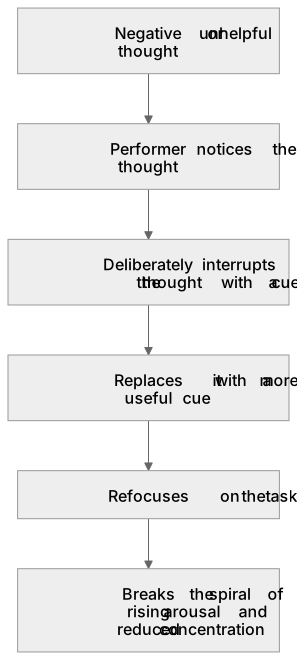
Put it in order
Put these steps in the order they happen.
- 1. Deliberately interrupts the thought with a cue
- 2. Performer notices the thought
- 3. Negative or unhelpful thought
- 4. Breaks the spiral of rising arousal and reduced concentration
- 5. Refocuses on the task
- 6. Replaces it with a more useful cue
Label the diagram
Some boxes have lost their names. Pick the right name for each number.
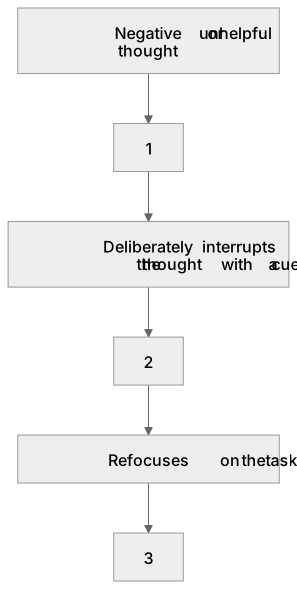
1Box 1
2Box 2
3Box 3
There is more to this lesson
The full lesson goes on to check your understanding and help you earn the marks. Create a free account to carry on, with your progress saved.
A week of Premium from your first lesson · Then the free plan continues · No card, no charge
Test your understanding of Stress management: Thought stopping.
Active recall beats re-reading. Take an instant quiz now to test what you’ve learned and lock it into long-term memory.
A week of Premium from your first lesson · Then the free plan continues · No card, no charge