AQA · A-Level · Physical Education
Course version: 7582 · Version from Sept 2016
Stress management: Positive self-talk.
Positive self-talk is a cognitive stress-management technique in which a performer uses encouraging, task-focused statements to control arousal, build confidence and direct attention.
Checked against the AQA 7582 specification (opens in a new tab) on .
- Point 10 of 12
- 3 key terms
Study notes
From the checked teaching notes for this specification point.
The idea
Positive self-talk is a cognitive stress-management technique in which a performer uses encouraging, task-focused statements to control arousal, build confidence and direct attention. A tennis player serving at a crucial point might say to herself, first serve in, watch the ball, or use a short phrase such as I can do this. The statements may be motivational, raising confidence and effort, or instructional, guiding technique and attention. Self-talk can be said aloud or internally, and it is most effective when it is specific, realistic and rehearsed. It helps the performer replace negative or distracting thoughts with cues that support execution, and it can be combined with techniques such as thought stopping and mental rehearsal.
What earns the marks
- Positive self-talk is a cognitive technique used to manage stress and improve performance.
- Self-talk may be motivational, building confidence and effort, or instructional, guiding technique and attention.
Common mistakes and how to put them right
Thinking that any self-talk is positive self-talk.
Put it right: The statements must be encouraging or task-focused rather than critical or negative.
Assuming self-talk only means shouting praise.
Put it right: Instructional cues about technique and attention are also valid forms.
Believing self-talk is only useful before performance.
Put it right: It can be used before, during and after performance to regulate arousal and focus.
Treating self-talk as a physical technique.
Put it right: It is cognitive, working through the performer's thoughts and attentional focus.
Exam tips
- Give a specific example of a self-talk statement in a named sporting situation to show understanding.
- Distinguish between motivational and instructional self-talk when a question asks you to explain how it works.
- When evaluating, consider that self-talk must be realistic and rehearsed, and that negative self-talk can have the opposite effect.
Try the lesson
The start of the Stress management: Positive self-talk. lesson, made from checked teaching notes for this specification point.
Have a go first
What is meant by positive self-talk as a stress-management technique?
Listen
Positive self-talk is a cognitive stress-management technique in which a performer uses encouraging, task-focused statements to control arousal, build confidence and direct attention. A tennis player serving at a crucial point might say to herself, first serve in, watch the ball, or use a short phrase such as I can do this. The statements may be motivational, raising confidence and effort, or instructional, guiding technique and attention. Self-talk can be said aloud or internally, and it is most effective when it is specific, realistic and rehearsed. It helps the performer replace negative or distracting thoughts with cues that support execution, and it can be combined with techniques such as thought stopping and mental rehearsal. A strong answer earns marks for these points. Positive self-talk is a cognitive technique used to manage stress and improve performance. Self-talk may be motivational, building confidence and effort, or instructional, guiding technique and attention. A common slip: Thinking that any self-talk is positive self-talk. Instead, the statements must be encouraging or task-focused rather than critical or negative. Exam tip: Give a specific example of a self-talk statement in a named sporting situation to show understanding.
See it

Key words
Say what each word means before you turn the card.
Cognitive stress management
Try answering aloud or in your head before turning the card.
Attentional control
Try answering aloud or in your head before turning the card.
Arousal regulation
Try answering aloud or in your head before turning the card.
See every definition
- Cognitive stress management
- A technique that works through the performer's thoughts to manage stress and improve performance.
- Attentional control
- Directing attention towards relevant cues rather than distractions, guided by instructional statements.
- Arousal regulation
- Controlling arousal through encouraging, task-focused statements the performer directs at themselves.
Label the diagram
Some boxes have lost their names. Pick the right name for each number.
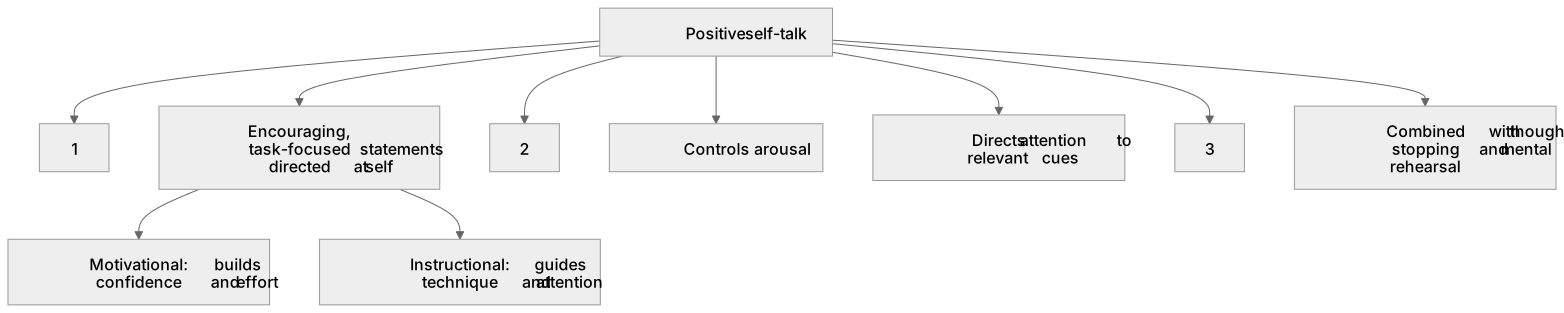
1Box 1
2Box 2
3Box 3
There is more to this lesson
The full lesson goes on to check your understanding and help you earn the marks. Create a free account to carry on, with your progress saved.
A week of Premium from your first lesson · Then the free plan continues · No card, no charge
Test your understanding of Stress management: Positive self-talk.
Active recall beats re-reading. Take an instant quiz now to test what you’ve learned and lock it into long-term memory.
A week of Premium from your first lesson · Then the free plan continues · No card, no charge