AQA · GCSE · Physics
Course version: 8463 · Version from Sept 2016
The greater the braking force the greater the deceleration of the vehicle.…
Full specification wording
Factors affecting braking distance 2: The greater the braking force the greater the deceleration of the vehicle. Large decelerations may lead to brakes overheating and/or loss of control.
Deceleration follows from Newton's Second Law: a = F ÷ m, so for a given mass a larger braking force gives a larger deceleration.
Checked against the AQA 8463 specification (opens in a new tab) on .
- Point 3 of 5
- 3 key terms
Study notes
From the checked teaching notes for this specification point.
The idea
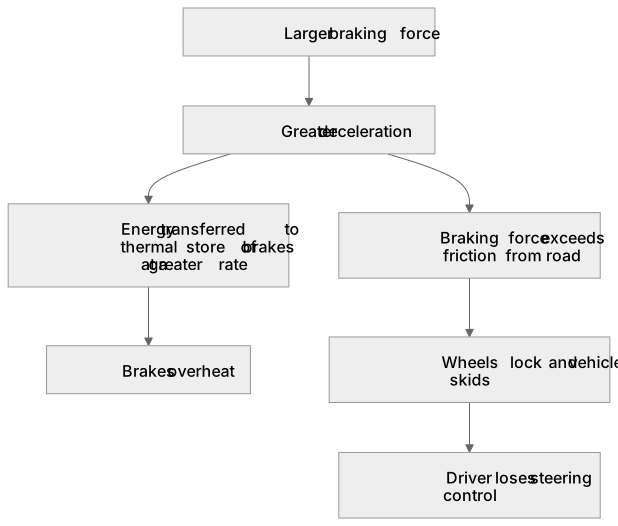
Deceleration follows from Newton's Second Law: a = F ÷ m, so for a given mass a larger braking force gives a larger deceleration. Braking hard therefore stops the vehicle in less distance, but it brings two dangers. First, the energy removed from the kinetic store is transferred into the thermal store of the brakes in a shorter time, so the temperature rises steeply and the brakes can overheat and fade, losing their grip. Second, if the braking force demanded exceeds the friction the tyres can get from the road, the wheels lock and the vehicle skids; a skidding tyre gives less friction and no steering, so the driver loses control. Anti-lock braking systems exist for this reason, releasing and reapplying the brakes rapidly so the wheels keep turning and the tyres keep their grip.
What earns the marks
- Using a = F ÷ m to link a larger braking force to a larger deceleration.
- Stating that energy is transferred to the thermal store of the brakes at a greater rate, so they overheat.
- Stating that the tyres may lose grip so the vehicle skids.
- The consequence that the driver loses steering control of the vehicle.
Common mistakes and how to put them right
Saying the brakes 'stop working' instead of describing overheating and brake fade.
Forgetting that the deceleration depends on the mass as well as on the braking force.
Claiming a skidding tyre has more friction because it is sliding.
Confusing the braking force with the weight of the vehicle.
Exam tips
- Give two distinct dangers when a question asks about large decelerations; overheating and skidding are the standard pair.
- Say that deceleration is an acceleration in the opposite direction to the motion rather than dropping the sign.
- Link every danger to a physical cause, not just to 'it is unsafe'.
Try the lesson
The start of the Factors affecting braking distance 2: The greater the braking force the greater the deceleration of the vehicle. Large decelerations may lead to brakes overheating and/or loss of control. lesson, made from checked teaching notes for this specification point.
Have a go first
A car is braking. What happens to the deceleration of the car when the braking force is increased?
Listen
Deceleration follows from Newton's Second Law: a = F ÷ m, so for a given mass a larger braking force gives a larger deceleration. Braking hard therefore stops the vehicle in less distance, but it brings two dangers. First, the energy removed from the kinetic store is transferred into the thermal store of the brakes in a shorter time, so the temperature rises steeply and the brakes can overheat and fade, losing their grip. Second, if the braking force demanded exceeds the friction the tyres can get from the road, the wheels lock and the vehicle skids; a skidding tyre gives less friction and no steering, so the driver loses control. Anti-lock braking systems exist for this reason, releasing and reapplying the brakes rapidly so the wheels keep turning and the tyres keep their grip. A strong answer earns marks for these points. using a = F ÷ m to link a larger braking force to a larger deceleration. stating that energy is transferred to the thermal store of the brakes at a greater rate, so they overheat. stating that the tyres may lose grip so the vehicle skids. the consequence that the driver loses steering control of the vehicle. Exam tip: Give two distinct dangers when a question asks about large decelerations; overheating and skidding are the standard pair.
See it
Key words
Say what each word means before you turn the card.
deceleration
Try answering aloud or in your head before turning the card.
braking force
Try answering aloud or in your head before turning the card.
brake overheating
Try answering aloud or in your head before turning the card.
See every definition
- deceleration
- The acceleration of a vehicle in the opposite direction to its motion, which is greater when the braking force is greater.
- braking force
- The force acting on a vehicle that produces its deceleration, with a larger value giving a larger deceleration for a given mass.
- brake overheating
- The steep rise in temperature of the brakes when energy is transferred to their thermal store at a greater rate, causing them to fade and lose their grip.
Label the diagram
Some boxes have lost their names. Pick the right name for each number.
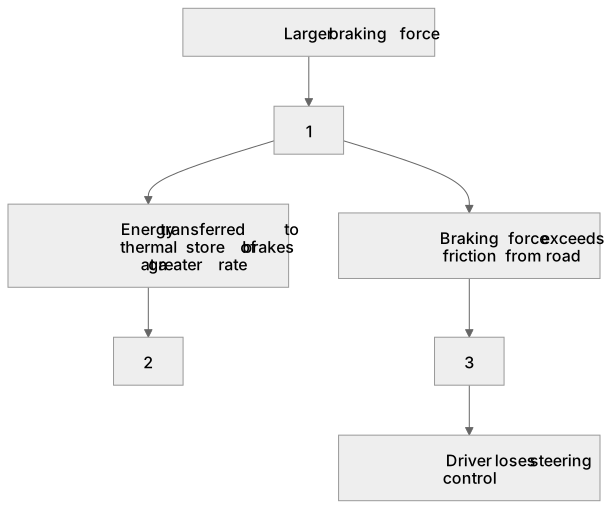
1Box 1
2Box 2
3Box 3
There is more to this lesson
The full lesson goes on to check your understanding and help you earn the marks. Create a free account to carry on, with your progress saved.
A week of Premium from your first lesson · Then the free plan continues · No card, no charge
Test your understanding of Factors affecting braking distance 2: The greater the braking force the greater the deceleration of the vehicle. Large decelerations may lead to brakes overheating and/or loss of control.
Active recall beats re-reading. Take an instant quiz now to test what you’ve learned and lock it into long-term memory.
A week of Premium from your first lesson · Then the free plan continues · No card, no charge