AQA · GCSE · Physics
Course version: 8463 · Version from Sept 2016
Students should be able to draw/interpret diagrams representing nuclear…
Full specification wording
Nuclear fission: Students should be able to draw/interpret diagrams representing nuclear fission and how a chain reaction may occur.
Fission diagrams follow a fixed grammar, and the marks are for the details.
Checked against the AQA 8463 specification (opens in a new tab) on .
- Point 9 of 9
- 2 key terms
Study notes
From the checked teaching notes for this specification point.
The idea
Fission diagrams follow a fixed grammar, and the marks are for the details. Start with a neutron drawn arriving at a large nucleus and being absorbed. Show that nucleus splitting into two fragments, with two or three neutrons drawn leaving it. Then take at least one of those neutrons to another large nucleus and show it being absorbed and causing a second fission, which itself releases two or three further neutrons. Label the neutrons and the nuclei, since an examiner cannot credit an unlabelled circle. Reading a diagram works the same way in reverse: check how many neutrons each fission releases, whether they reach further nuclei, and whether the number of fissions grows, stays constant or dies out.
What earns the marks
- The first nucleus shown splitting into two fragments and releasing two or three neutrons.
- At least one fission neutron shown being absorbed by an additional large nucleus and causing fission.
- Two or three further neutrons shown being released from that second fission.
- Labelling the neutrons and the nuclei so the two can be told apart.
Common mistakes and how to put them right
Drawing neutrons that leave the first fission but reach no second nucleus.
Drawing arrows from the daughter nuclei instead of from the released neutrons.
Showing only one neutron released per fission.
Leaving circles unlabelled, so a neutron cannot be distinguished from a nucleus.
Drawing the chain reaction but omitting the neutron that started the first fission.
Exam tips
- Work through the diagram in the order the marks come: split, absorb, split again.
- Use different sizes or clear labels for neutrons and nuclei; consistency matters more than artistry.
- If the figure is partly drawn for you, add to it rather than starting your own alongside.
Try the lesson
The start of the Nuclear fission: Students should be able to draw/interpret diagrams representing nuclear fission and how a chain reaction may occur. lesson, made from checked teaching notes for this specification point.
Have a go first
In a diagram of a chain reaction, a neutron is absorbed by a uranium-235 nucleus. What happens to that nucleus immediately after it absorbs the neutron?
Listen
Fission diagrams follow a fixed grammar, and the marks are for the details. Start with a neutron drawn arriving at a large nucleus and being absorbed. Show that nucleus splitting into two fragments, with two or three neutrons drawn leaving it. Then take at least one of those neutrons to another large nucleus and show it being absorbed and causing a second fission, which itself releases two or three further neutrons. Label the neutrons and the nuclei, since an examiner cannot credit an unlabelled circle. Reading a diagram works the same way in reverse: check how many neutrons each fission releases, whether they reach further nuclei, and whether the number of fissions grows, stays constant or dies out. A strong answer earns marks for these points. the first nucleus shown splitting into two fragments and releasing two or three neutrons. at least one fission neutron shown being absorbed by an additional large nucleus and causing fission. two or three further neutrons shown being released from that second fission. labelling the neutrons and the nuclei so the two can be told apart. Exam tip: Work through the diagram in the order the marks come: split, absorb, split again.
See it
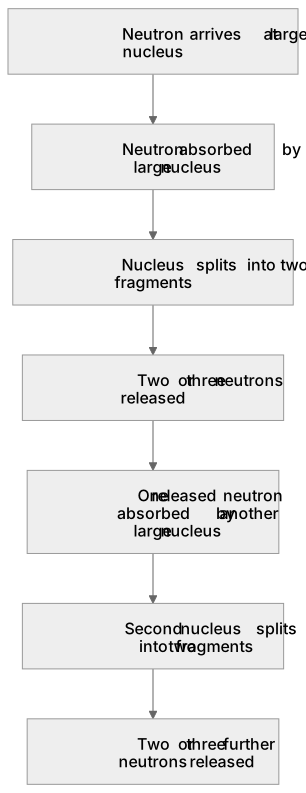
Put it in order
Put these steps in the order they happen.
- 1. Two or three further neutrons released
- 2. Second nucleus splits into two fragments
- 3. Nucleus splits into two fragments
- 4. One released neutron absorbed by another large nucleus
- 5. Neutron arrives at large nucleus
- 6. Neutron absorbed by large nucleus
- 7. Two or three neutrons released
Key words
Say what each word means before you turn the card.
neutron absorbed by second nucleus
Try answering aloud or in your head before turning the card.
labelling
Try answering aloud or in your head before turning the card.
See every definition
- neutron absorbed by second nucleus
- At least one fission neutron is shown being absorbed by an additional large nucleus and causing fission.
- labelling
- Marking the neutrons and the nuclei so the two can be told apart, since an examiner cannot credit an unlabelled circle.
Label the diagram
Some boxes have lost their names. Pick the right name for each number.
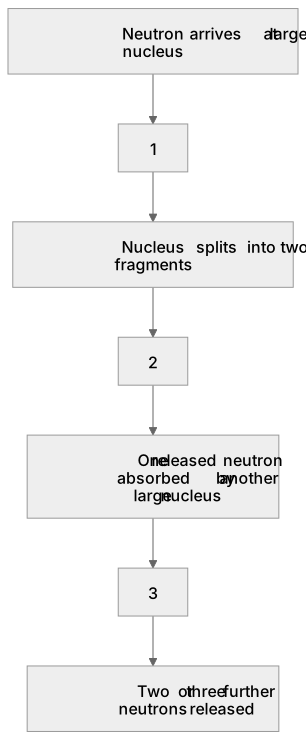
1Box 1
2Box 2
3Box 3
There is more to this lesson
The full lesson goes on to check your understanding and help you earn the marks. Create a free account to carry on, with your progress saved.
A week of Premium from your first lesson · Then the free plan continues · No card, no charge
Test your understanding of Nuclear fission: Students should be able to draw/interpret diagrams representing nuclear fission and how a chain reaction may occur.
Active recall beats re-reading. Take an instant quiz now to test what you’ve learned and lock it into long-term memory.
A week of Premium from your first lesson · Then the free plan continues · No card, no charge