AQA · GCSE · Physics
Course version: 8463 · Version from Sept 2016
The explosion caused by a nuclear weapon is caused by an uncontrolled…
Full specification wording
Nuclear fission: The explosion caused by a nuclear weapon is caused by an uncontrolled chain reaction.
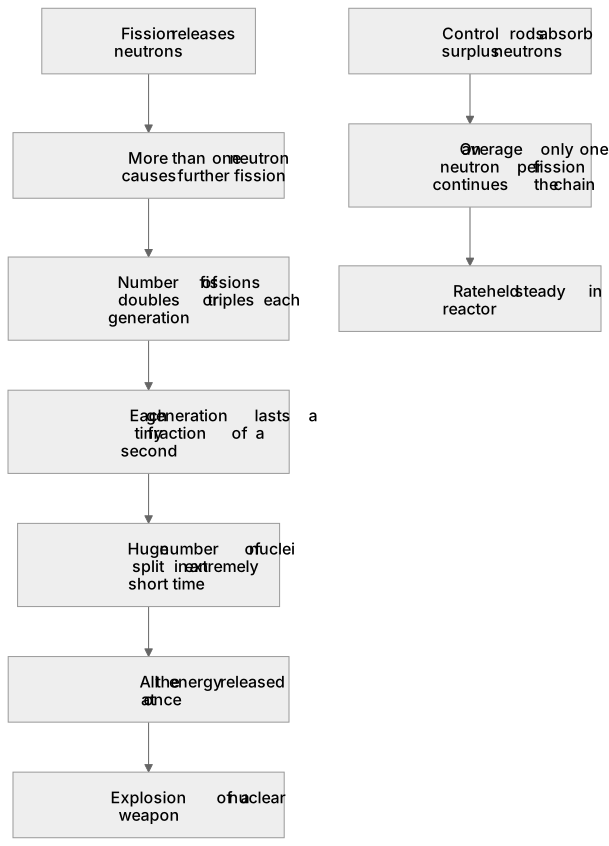
If more than one neutron from each fission goes on to cause a further fission, the number of fissions doubles or triples with every generation.
Checked against the AQA 8463 specification (opens in a new tab) on .
- Point 8 of 9
- 3 key terms
Study notes
From the checked teaching notes for this specification point.
The idea
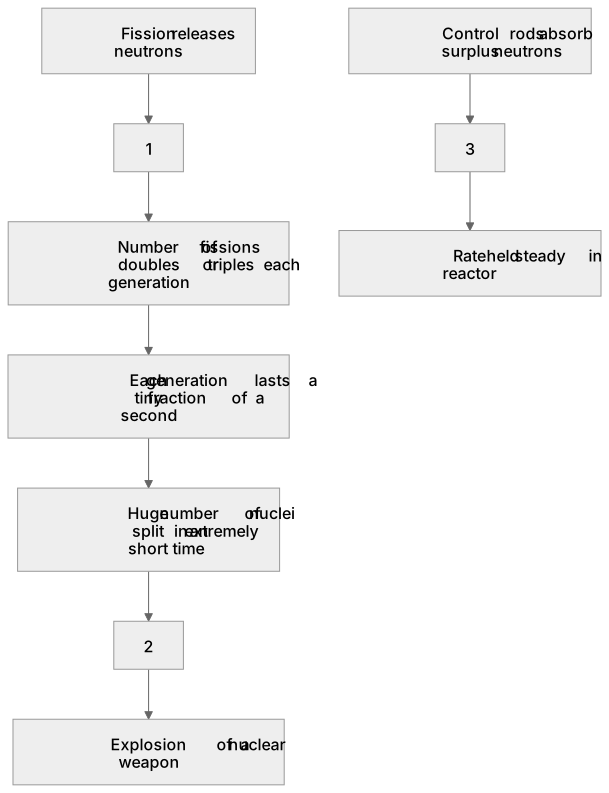
If more than one neutron from each fission goes on to cause a further fission, the number of fissions doubles or triples with every generation. Because each generation lasts a tiny fraction of a second, a huge number of nuclei split in an extremely short time and all the energy is released at once, which is the explosion of a nuclear weapon. The same runaway behaviour in a power station, where the fuel is not suitable for a bomb-type explosion, shows itself as a meltdown, the core overheating and damaging the reactor, as at Chernobyl; at Fukushima the meltdown followed a loss of cooling after the reactors had already shut down, not a runaway chain reaction. A reactor avoids this by absorbing the surplus neutrons in control rods so that on average only one neutron per fission continues the chain.
What earns the marks
- Each fission causing more than one further fission, so the number of fissions grows rapidly.
- A named consequence of an uncontrolled chain reaction, such as a nuclear explosion, a nuclear bomb or a meltdown.
- The energy being released in a very short time rather than steadily.
- The contrast with a reactor, where control rods absorb surplus neutrons to hold the rate steady.
Common mistakes and how to put them right
Describing the explosion as a chemical one, like burning or an ordinary bomb.
Writing about fusion when the question is about an uncontrolled fission chain reaction.
Answering 'it is very dangerous' instead of naming a consequence.
Saying the explosion happens because the uranium gets hot rather than because the fission rate multiplies.
Claiming a UK power station reactor could detonate exactly like a nuclear weapon.
Exam tips
- Naming an accident such as Chernobyl is accepted as a consequence, so it is a safe one-mark answer.
- Use the words 'uncontrolled' and 'controlled' explicitly when contrasting a weapon with a reactor.
- Anchor the explanation on the number of neutrons that go on to cause fission, which is the physics being tested.
Try the lesson
The start of the Nuclear fission: The explosion caused by a nuclear weapon is caused by an uncontrolled chain reaction. lesson, made from checked teaching notes for this specification point.
Have a go first
What type of chain reaction causes the explosion of a nuclear weapon?
Listen
If more than one neutron from each fission goes on to cause a further fission, the number of fissions doubles or triples with every generation. Because each generation lasts a tiny fraction of a second, a huge number of nuclei split in an extremely short time and all the energy is released at once, which is the explosion of a nuclear weapon. The same runaway behaviour in a power station, where the fuel is not suitable for a bomb-type explosion, shows itself as a meltdown, the core overheating and damaging the reactor, as at Chernobyl; at Fukushima the meltdown followed a loss of cooling after the reactors had already shut down, not a runaway chain reaction. A reactor avoids this by absorbing the surplus neutrons in control rods so that on average only one neutron per fission continues the chain. A strong answer earns marks for these points. each fission causing more than one further fission, so the number of fissions grows rapidly. a named consequence of an uncontrolled chain reaction, such as a nuclear explosion, a nuclear bomb or a meltdown. the energy being released in a very short time rather than steadily. the contrast with a reactor, where control rods absorb surplus neutrons to hold the rate steady. Exam tip: Naming an accident such as Chernobyl is accepted as a consequence, so it is a safe one-mark answer.
See it
Key words
Say what each word means before you turn the card.
uncontrolled chain reaction
Try answering aloud or in your head before turning the card.
nuclear explosion
Try answering aloud or in your head before turning the card.
meltdown
Try answering aloud or in your head before turning the card.
See every definition
- uncontrolled chain reaction
- A chain reaction in which more than one neutron from each fission goes on to cause a further fission, so the number of fissions doubles or triples with every generation.
- nuclear explosion
- The explosion of a nuclear weapon, caused by an uncontrolled chain reaction releasing all the energy at once.
- meltdown
- The same runaway behaviour in a power station, where the fuel is not suitable for a bomb-type explosion, showing itself as the core overheating and damaging the reactor.
Label the diagram
Some boxes have lost their names. Pick the right name for each number.
1Box 1
2Box 2
3Box 3
There is more to this lesson
The full lesson goes on to check your understanding and help you earn the marks. Create a free account to carry on, with your progress saved.
A week of Premium from your first lesson · Then the free plan continues · No card, no charge
Test your understanding of Nuclear fission: The explosion caused by a nuclear weapon is caused by an uncontrolled chain reaction.
Active recall beats re-reading. Take an instant quiz now to test what you’ve learned and lock it into long-term memory.
A week of Premium from your first lesson · Then the free plan continues · No card, no charge