AQA · GCSE · Physics
Course version: 8463 · Version from Sept 2016
The chain reaction is controlled in a nuclear reactor to control the…
Full specification wording
Nuclear fission: The chain reaction is controlled in a nuclear reactor to control the energy released.
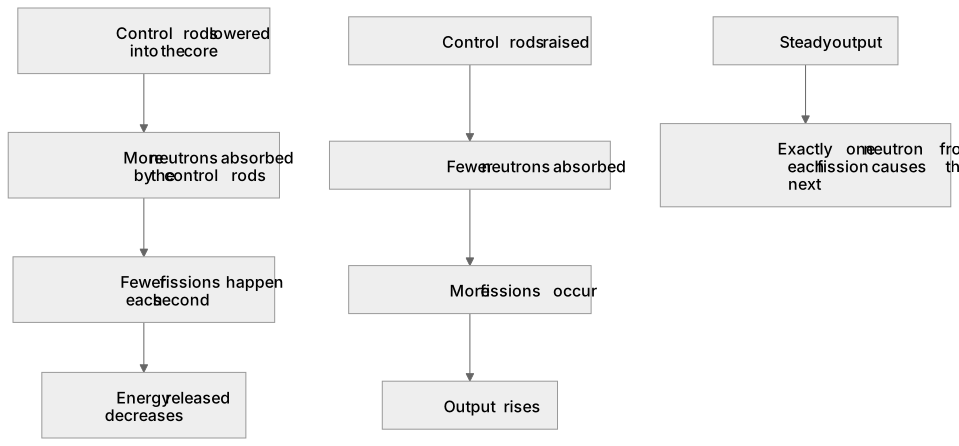
A reactor has to hold the chain reaction at a steady rate, which means exactly one neutron from each fission going on to cause the next.
Checked against the AQA 8463 specification (opens in a new tab) on .
- Point 7 of 9
- 4 key terms
Study notes
From the checked teaching notes for this specification point.
The idea
A reactor has to hold the chain reaction at a steady rate, which means exactly one neutron from each fission going on to cause the next. The surplus neutrons are mopped up by control rods, usually boron, which absorb neutrons without undergoing fission. Lowering the rods further into the core increases the number of neutrons absorbed, so fewer fissions happen each second and the energy released decreases; raising them absorbs fewer neutrons, so more fissions occur and the output rises. Dropping the rods fully shuts the reactor down. The moderator, a separate component, does a different job: it slows the fast neutrons so they are readily absorbed by uranium-235 and can cause the next fission.
What earns the marks
- The control rods absorbing neutrons.
- Lowering the control rods increasing the number of neutrons absorbed.
- The energy released decreasing as a result, or the converse for raising the rods.
- A steady output requiring one neutron per fission on average to go on to cause the next fission.
Common mistakes and how to put them right
Saying control rods slow the neutrons down, which is the job of the moderator.
Writing that raising the control rods shuts the reactor down.
Claiming the rods absorb the radiation or the energy rather than neutrons.
Stating only that the rods control the reaction, with no mention of neutron absorption.
Treating the coolant as the part that regulates the rate of fission.
Exam tips
- Give the chain of reasoning in three steps, rods lowered, more neutrons absorbed, fewer fissions and less energy, since each step can carry a mark.
- The converse description is accepted, so you can argue from raising the rods if that is easier.
- A vague answer about the rods changing the number of neutrons absorbed still earns one mark, so write it even if you are unsure of the direction.
Try the lesson
The start of the Nuclear fission: The chain reaction is controlled in a nuclear reactor to control the energy released. lesson, made from checked teaching notes for this specification point.
Have a go first
In a nuclear reactor, what is the purpose of controlling the chain reaction?
Listen
A reactor has to hold the chain reaction at a steady rate, which means exactly one neutron from each fission going on to cause the next. The surplus neutrons are mopped up by control rods, usually boron, which absorb neutrons without undergoing fission. Lowering the rods further into the core increases the number of neutrons absorbed, so fewer fissions happen each second and the energy released decreases; raising them absorbs fewer neutrons, so more fissions occur and the output rises. Dropping the rods fully shuts the reactor down. The moderator, a separate component, does a different job: it slows the fast neutrons so they are readily absorbed by uranium-235 and can cause the next fission. A strong answer earns marks for these points. the control rods absorbing neutrons. lowering the control rods increasing the number of neutrons absorbed. the energy released decreasing as a result, or the converse for raising the rods. a steady output requiring one neutron per fission on average to go on to cause the next fission. Exam tip: Give the chain of reasoning in three steps, rods lowered, more neutrons absorbed, fewer fissions and less energy, since each step can carry a mark.
See it
Key words
Say what each word means before you turn the card.
control rods
Try answering aloud or in your head before turning the card.
neutron absorption
Try answering aloud or in your head before turning the card.
steady output
Try answering aloud or in your head before turning the card.
reactor shutdown
Try answering aloud or in your head before turning the card.
See every definition
- control rods
- Usually boron, these absorb surplus neutrons without undergoing fission, mopping up the neutrons left over from each fission.
- neutron absorption
- The process by which control rods take in surplus neutrons; lowering the rods further into the core increases the number absorbed.
- steady output
- A reactor held at a steady rate, which means exactly one neutron from each fission going on to cause the next.
- reactor shutdown
- Dropping the control rods fully into the core, which shuts the reactor down.
Label the diagram
Some boxes have lost their names. Pick the right name for each number.
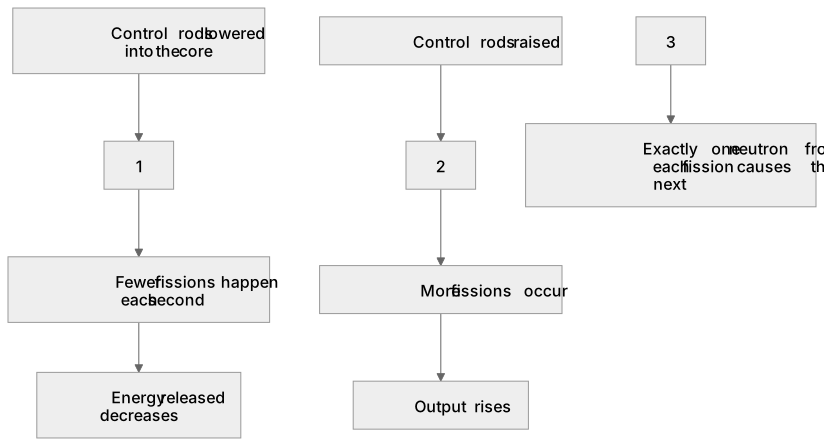
1Box 1
2Box 2
3Box 3
There is more to this lesson
The full lesson goes on to check your understanding and help you earn the marks. Create a free account to carry on, with your progress saved.
A week of Premium from your first lesson · Then the free plan continues · No card, no charge
Test your understanding of Nuclear fission: The chain reaction is controlled in a nuclear reactor to control the energy released.
Active recall beats re-reading. Take an instant quiz now to test what you’ve learned and lock it into long-term memory.
A week of Premium from your first lesson · Then the free plan continues · No card, no charge