AQA · GCSE · Physics
Course version: 8463 · Version from Sept 2016
Students should be able to describe the factors which influence floating…
Full specification wording
Pressure in a fluid 2 (HT only): Students should be able to describe the factors which influence floating and sinking.
An object floats when it can displace a weight of fluid equal to its own weight before it is fully under.
Checked against the AQA 8463 specification (opens in a new tab) on .
- Point 6 of 6
- 4 key terms
Study notes
From the checked teaching notes for this specification point.
The idea
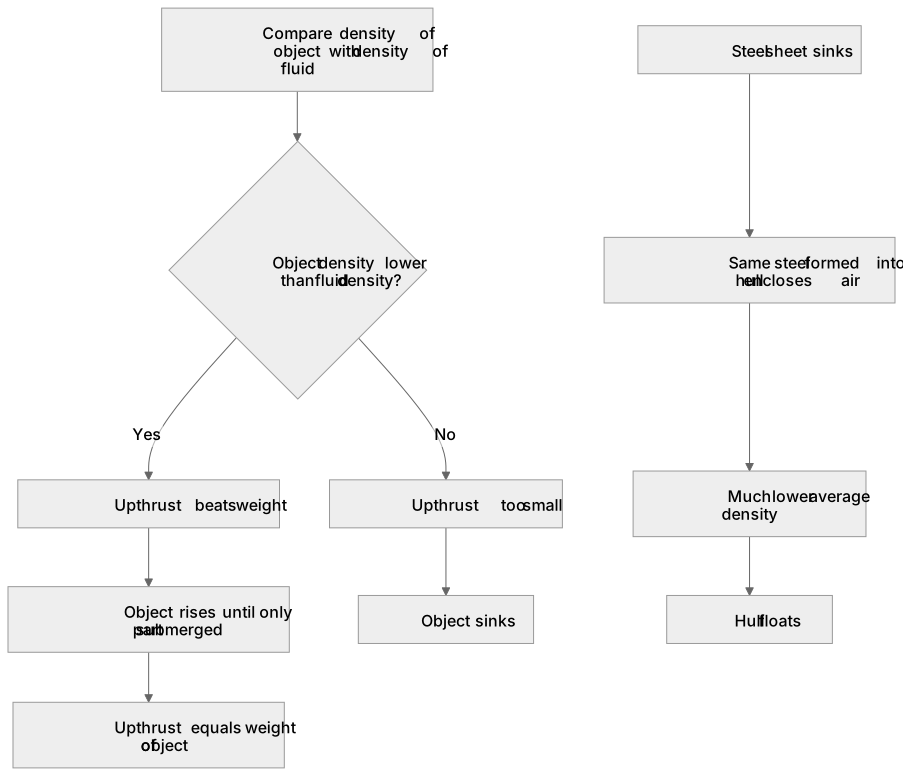
An object floats when it can displace a weight of fluid equal to its own weight before it is fully under. Push a solid object right under and it displaces its own volume, so the upthrust is the weight of that volume of fluid: if the object's density is lower than the fluid's, that upthrust beats its weight and the object rises until only part of it is submerged; if its density is higher, the upthrust is too small and it sinks. The factors are therefore the density of the object, the density of the fluid and the volume submerged. Shape matters only because it changes the volume displaced - a steel sheet sinks, but the same steel formed into a hull encloses air, has a much lower average density and floats. Salt water is denser than fresh, so objects float higher in it.
What earns the marks
- Comparing the density of the object with the density of the fluid.
- Floating when the upthrust is equal to the weight of the object.
- The upthrust equal to the weight of fluid displaced by the submerged volume.
- Explaining a hollow shape as lowering the average density of the object.
Common mistakes and how to put them right
Saying heavy objects sink and light ones float, with no mention of density or volume.
Claiming a steel ship floats because of its shape, without mentioning the enclosed air or the average density.
Stating that a floating object has no weight acting on it.
Ignoring the density of the fluid, so treating fresh and salt water as identical.
Exam tips
- Compare two densities in the first sentence of any floating or sinking answer.
- For a ship, use the phrase average density including the air inside.
Try the lesson
The start of the Pressure in a fluid 2 (HT only): Students should be able to describe the factors which influence floating and sinking. lesson, made from checked teaching notes for this specification point.
Have a go first
A solid object is placed in a liquid. Which pair of quantities determines whether the object floats or sinks?
Listen
An object floats when it can displace a weight of fluid equal to its own weight before it is fully under. Push a solid object right under and it displaces its own volume, so the upthrust is the weight of that volume of fluid: if the object's density is lower than the fluid's, that upthrust beats its weight and the object rises until only part of it is submerged; if its density is higher, the upthrust is too small and it sinks. The factors are therefore the density of the object, the density of the fluid and the volume submerged. Shape matters only because it changes the volume displaced - a steel sheet sinks, but the same steel formed into a hull encloses air, has a much lower average density and floats. Salt water is denser than fresh, so objects float higher in it. A strong answer earns marks for these points. comparing the density of the object with the density of the fluid. floating when the upthrust is equal to the weight of the object. the upthrust equal to the weight of fluid displaced by the submerged volume. explaining a hollow shape as lowering the average density of the object. Exam tip: Compare two densities in the first sentence of any floating or sinking answer.
See it
Key words
Say what each word means before you turn the card.
floating and sinking
Try answering aloud or in your head before turning the card.
density comparison
Try answering aloud or in your head before turning the card.
volume displaced
Try answering aloud or in your head before turning the card.
average density
Try answering aloud or in your head before turning the card.
See every definition
- floating and sinking
- An object floats when it can displace a weight of fluid equal to its own weight before it is fully under, and sinks when its density is higher than the fluid's.
- density comparison
- Comparing the density of the object with the density of the fluid: if the object's density is lower, upthrust beats its weight and it rises.
- volume displaced
- A solid object pushed right under displaces its own volume, so the upthrust is the weight of that volume of fluid.
- average density
- A hull encloses air, which lowers the average density of the object so that it floats.
There is more to this lesson
The full lesson goes on to check your understanding and help you earn the marks. Create a free account to carry on, with your progress saved.
A week of Premium from your first lesson · Then the free plan continues · No card, no charge
Test your understanding of Pressure in a fluid 2 (HT only): Students should be able to describe the factors which influence floating and sinking.
Active recall beats re-reading. Take an instant quiz now to test what you’ve learned and lock it into long-term memory.
A week of Premium from your first lesson · Then the free plan continues · No card, no charge