AQA · GCSE · Physics
Course version: 8463 · Version from Sept 2016
The frequency of a wave is the number of waves passing a point each second.
Full specification wording
Properties of waves: The frequency of a wave is the number of waves passing a point each second.
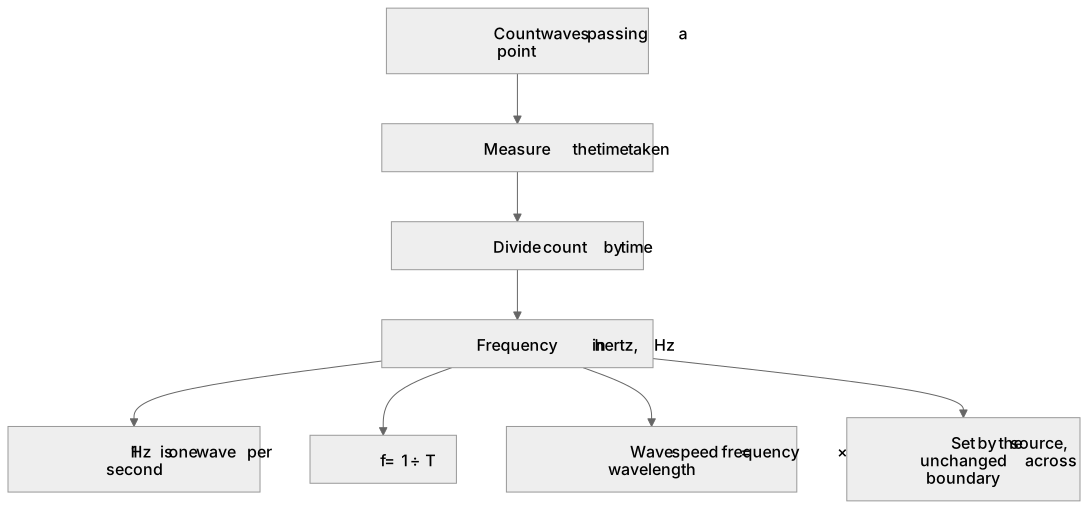
Frequency counts complete waves rather than measuring a distance: it is the number of waves passing a fixed point every second, and its unit is the hertz, where 1 Hz is one wave per second.
Checked against the AQA 8463 specification (opens in a new tab) on .
- Point 4 of 7
- 4 key terms
Study notes
From the checked teaching notes for this specification point.
The idea
Frequency counts complete waves rather than measuring a distance: it is the number of waves passing a fixed point every second, and its unit is the hertz, where 1 Hz is one wave per second. In a ripple tank you count the waves crossing a mark over a measured time and divide, so 40 waves in 10 s gives 4 Hz. Frequency is set by the source, not by the medium, so it is unchanged when a wave crosses a boundary. It is the reciprocal of the period, f = 1 ÷ T, and it appears in wave speed = frequency × wavelength. A higher frequency sound is heard as a higher pitch. Frequencies cover an enormous range: a bass note is around 50 Hz, the upper limit of human hearing about 20 000 Hz, and visible light of the order of 10¹⁴ Hz.
What earns the marks
- Frequency as the number of complete waves passing a point each second.
- The unit hertz, Hz.
- Counting waves over a measured time and dividing by that time.
- Using f = 1 ÷ T to convert a period into a frequency.
Common mistakes and how to put them right
Counting the waves in 10 s and quoting the count itself as the frequency.
Confusing frequency with wave speed, so a higher frequency is taken to mean a faster wave.
Giving frequency the unit seconds because it involves time.
Assuming frequency changes when a wave moves into a new medium.
Exam tips
- Count waves over ten seconds rather than one, then divide; it reduces the timing uncertainty.
- Write 1 ÷ T rather than T when converting; the reciprocal step is where marks are lost.
- Give the unit Hz with every frequency answer, including ones read from a graph.
Try the lesson
The start of the Properties of waves: The frequency of a wave is the number of waves passing a point each second. lesson, made from checked teaching notes for this specification point.
Have a go first
What does the frequency of a wave measure?
Listen
Frequency counts complete waves rather than measuring a distance: it is the number of waves passing a fixed point every second, and its unit is the hertz, where 1 Hz is one wave per second. In a ripple tank you count the waves crossing a mark over a measured time and divide, so 40 waves in 10 s gives 4 Hz. Frequency is set by the source, not by the medium, so it is unchanged when a wave crosses a boundary. It is the reciprocal of the period, f = 1 ÷ T, and it appears in wave speed = frequency × wavelength. A higher frequency sound is heard as a higher pitch. Frequencies cover an enormous range: a bass note is around 50 Hz, the upper limit of human hearing about 20 000 Hz, and visible light of the order of 10¹⁴ Hz. A strong answer earns marks for these points. frequency as the number of complete waves passing a point each second. the unit hertz, Hz. counting waves over a measured time and dividing by that time. using f = 1 ÷ T to convert a period into a frequency. Exam tip: Count waves over ten seconds rather than one, then divide; it reduces the timing uncertainty.
See it
Key words
Say what each word means before you turn the card.
frequency
Try answering aloud or in your head before turning the card.
hertz
Try answering aloud or in your head before turning the card.
f = 1 ÷ T
Try answering aloud or in your head before turning the card.
pitch
Try answering aloud or in your head before turning the card.
See every definition
- frequency
- The number of waves passing a point each second, set by the source and unchanged when a wave crosses a boundary.
- hertz
- The unit of frequency, where 1 Hz is one wave per second.
- f = 1 ÷ T
- The relationship showing that frequency is the reciprocal of the period.
- pitch
- What is heard as higher when a sound has a higher frequency.
Label the diagram
Some boxes have lost their names. Pick the right name for each number.
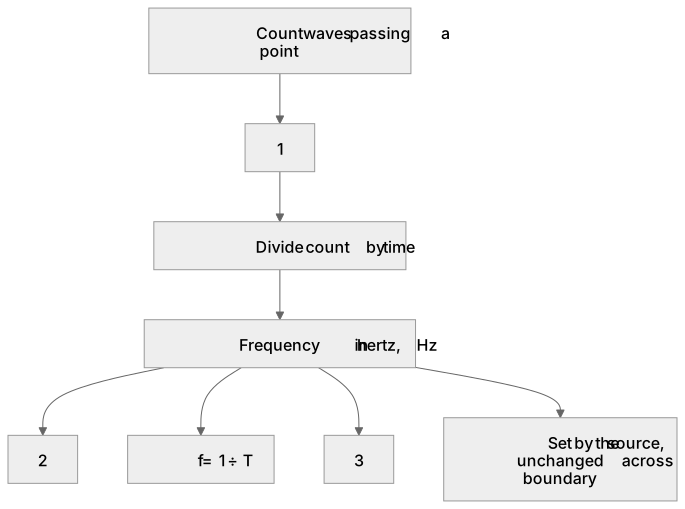
1Box 1
2Box 2
3Box 3
There is more to this lesson
The full lesson goes on to check your understanding and help you earn the marks. Create a free account to carry on, with your progress saved.
A week of Premium from your first lesson · Then the free plan continues · No card, no charge
Test your understanding of Properties of waves: The frequency of a wave is the number of waves passing a point each second.
Active recall beats re-reading. Take an instant quiz now to test what you’ve learned and lock it into long-term memory.
A week of Premium from your first lesson · Then the free plan continues · No card, no charge