AQA · GCSE · Physics
Course version: 8463 · Version from Sept 2016
The irradiated object does not become radioactive.
Full specification wording
Radioactive contamination: The irradiated object does not become radioactive.
For the alpha, beta and gamma sources used at GCSE, irradiating an object does not make it radioactive.
Checked against the AQA 8463 specification (opens in a new tab) on .
- Point 5 of 8
- 4 key terms
Study notes
From the checked teaching notes for this specification point.
The idea
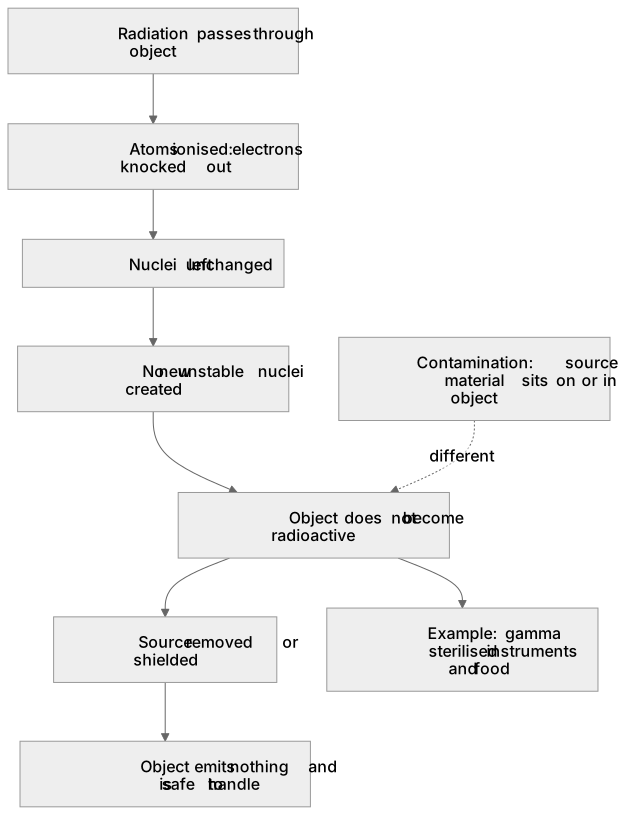
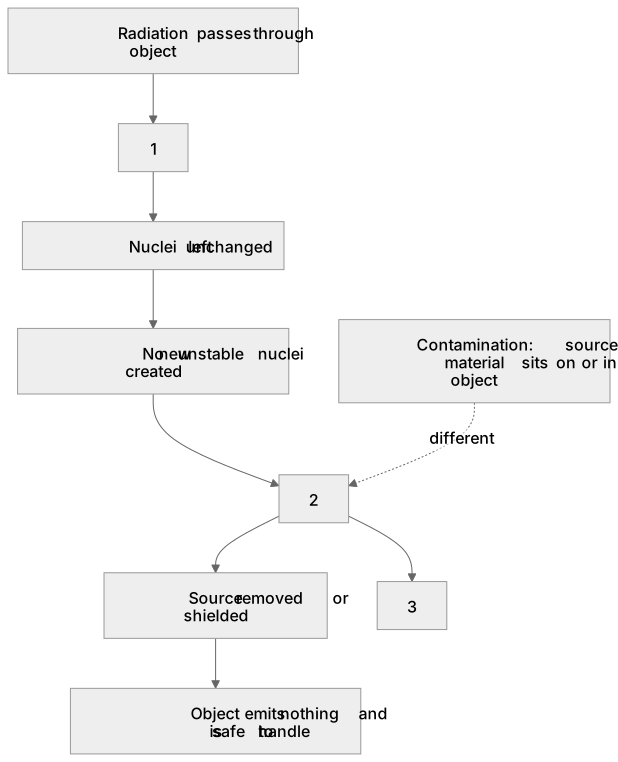
For the alpha, beta and gamma sources used at GCSE, irradiating an object does not make it radioactive. Radiation passing through matter ionises atoms, knocking electrons out of them, but it leaves the nuclei unchanged. Radioactivity comes from unstable nuclei, so if no new unstable nuclei are created the object cannot become a source. As soon as the radioactive source is removed or shielded, the object emits nothing and can be handled safely. This is exactly why gamma irradiation is used to sterilise surgical instruments and food: the radiation kills bacteria as it passes through the sealed packet, then the contents are inert. Contamination is different, because there the source material itself is now sitting on or in the object.
What earns the marks
- The irradiated object not becoming a source of radiation itself.
- The radiation ionising atoms by removing electrons while leaving the nuclei unchanged.
- The object emitting nothing once the source is removed or shielded.
- Applying this to sterilised food or instruments being safe to handle or eat afterwards.
Common mistakes and how to put them right
Claiming irradiated food is radioactive and therefore dangerous to eat.
Saying some radiation is left behind, or soaks into, the irradiated object.
Concluding that irradiation is harmless to living tissue because nothing is transferred.
Confusing the ionisation of electrons with a change to the nucleus.
Using this statement to argue that a contaminated object is also not radioactive.
Exam tips
- Answer with the nucleus: saying the nuclei are unchanged is what earns the explanation mark rather than just repeating the statement.
- Pair this point with contamination in comparison questions, because the contrast is what is being tested.
- Use a worked example such as sterilised instruments to show the idea applied, not just stated.
Try the lesson
The start of the Radioactive contamination: The irradiated object does not become radioactive. lesson, made from checked teaching notes for this specification point.
Have a go first
What happens to an object that is irradiated?
Listen
For the alpha, beta and gamma sources used at GCSE, irradiating an object does not make it radioactive. Radiation passing through matter ionises atoms, knocking electrons out of them, but it leaves the nuclei unchanged. Radioactivity comes from unstable nuclei, so if no new unstable nuclei are created the object cannot become a source. As soon as the radioactive source is removed or shielded, the object emits nothing and can be handled safely. This is exactly why gamma irradiation is used to sterilise surgical instruments and food: the radiation kills bacteria as it passes through the sealed packet, then the contents are inert. Contamination is different, because there the source material itself is now sitting on or in the object. A strong answer earns marks for these points. the irradiated object not becoming a source of radiation itself. the radiation ionising atoms by removing electrons while leaving the nuclei unchanged. the object emitting nothing once the source is removed or shielded. applying this to sterilised food or instruments being safe to handle or eat afterwards. Exam tip: Answer with the nucleus: saying the nuclei are unchanged is what earns the explanation mark rather than just repeating the statement.
See it
Key words
Say what each word means before you turn the card.
irradiation leaves nuclei unchanged
Try answering aloud or in your head before turning the card.
ionisation of electrons
Try answering aloud or in your head before turning the card.
sterilisation
Try answering aloud or in your head before turning the card.
safe after removal
Try answering aloud or in your head before turning the card.
See every definition
- irradiation leaves nuclei unchanged
- Radiation passing through matter ionises atoms by knocking electrons out of them, but it leaves the nuclei unchanged, so the object does not become radioactive.
- ionisation of electrons
- Radiation passing through matter ionises atoms by knocking electrons out of them.
- sterilisation
- Gamma irradiation is used to sterilise surgical instruments and food because the radiation kills bacteria as it passes through the sealed packet.
- safe after removal
- As soon as the radioactive source is removed or shielded, the object emits nothing and can be handled safely.
Label the diagram
Some boxes have lost their names. Pick the right name for each number.
1Box 1
2Box 2
3Box 3
There is more to this lesson
The full lesson goes on to check your understanding and help you earn the marks. Create a free account to carry on, with your progress saved.
A week of Premium from your first lesson · Then the free plan continues · No card, no charge
Test your understanding of Radioactive contamination: The irradiated object does not become radioactive.
Active recall beats re-reading. Take an instant quiz now to test what you’ve learned and lock it into long-term memory.
A week of Premium from your first lesson · Then the free plan continues · No card, no charge