AQA · GCSE · Physics
Course version: 8463 · Version from Sept 2016
Irradiation is the process of exposing an object to nuclear radiation.
Full specification wording
Radioactive contamination: Irradiation is the process of exposing an object to nuclear radiation.
Irradiation is being exposed to radiation from a source that stays outside the object.
Checked against the AQA 8463 specification (opens in a new tab) on .
- Point 4 of 8
- 4 key terms
Study notes
From the checked teaching notes for this specification point.
The idea
Irradiation is being exposed to radiation from a source that stays outside the object. The source is separate; nothing is transferred. Radiation travels from it, some is absorbed by the object, and the moment the source is removed or shielded, the exposure stops. That is the crucial practical difference from contamination, where the material has moved onto or into the object and keeps decaying there. Irradiation is used deliberately: gamma sources sterilise surgical instruments and food by killing bacteria, and radiotherapy beams irradiate a tumour to destroy unwanted tissue. The exposure is controlled by time, distance and shielding, which is why sources are kept in lead-lined boxes and handled at arm's length with tongs.
What earns the marks
- Irradiation being the exposure of an object to nuclear radiation from a source outside it.
- The radioactive source remaining separate, with no radioactive material transferred.
- The exposure ending as soon as the source is removed or shielded.
- A named use or control measure, such as sterilising instruments or storing the source in a lead-lined box.
Common mistakes and how to put them right
Writing that irradiation makes the object radioactive.
Using irradiation and contamination as though they mean the same thing.
Saying gloves prevent irradiation.
Assuming irradiated food carries radioactive material and is unsafe to eat.
Describing irradiation as harmless because nothing is transferred, ignoring the damage the radiation does while it passes through.
Exam tips
- Keep 'exposure to radiation' as your opening phrase; it is the wording the mark scheme uses.
- If both terms appear in a question, define each in one sentence rather than describing only the difference.
- Name time, distance and shielding as the three ways exposure is reduced, since questions often want one of each.
Try the lesson
The start of the Radioactive contamination: Irradiation is the process of exposing an object to nuclear radiation. lesson, made from checked teaching notes for this specification point.
Have a go first
Which statement describes irradiation?
Listen
Irradiation is being exposed to radiation from a source that stays outside the object. The source is separate; nothing is transferred. Radiation travels from it, some is absorbed by the object, and the moment the source is removed or shielded, the exposure stops. That is the crucial practical difference from contamination, where the material has moved onto or into the object and keeps decaying there. Irradiation is used deliberately: gamma sources sterilise surgical instruments and food by killing bacteria, and radiotherapy beams irradiate a tumour to destroy unwanted tissue. The exposure is controlled by time, distance and shielding, which is why sources are kept in lead-lined boxes and handled at arm's length with tongs. A strong answer earns marks for these points. irradiation being the exposure of an object to nuclear radiation from a source outside it. the radioactive source remaining separate, with no radioactive material transferred. the exposure ending as soon as the source is removed or shielded. a named use or control measure, such as sterilising instruments or storing the source in a lead-lined box. Exam tip: Keep 'exposure to radiation' as your opening phrase; it is the wording the mark scheme uses.
See it
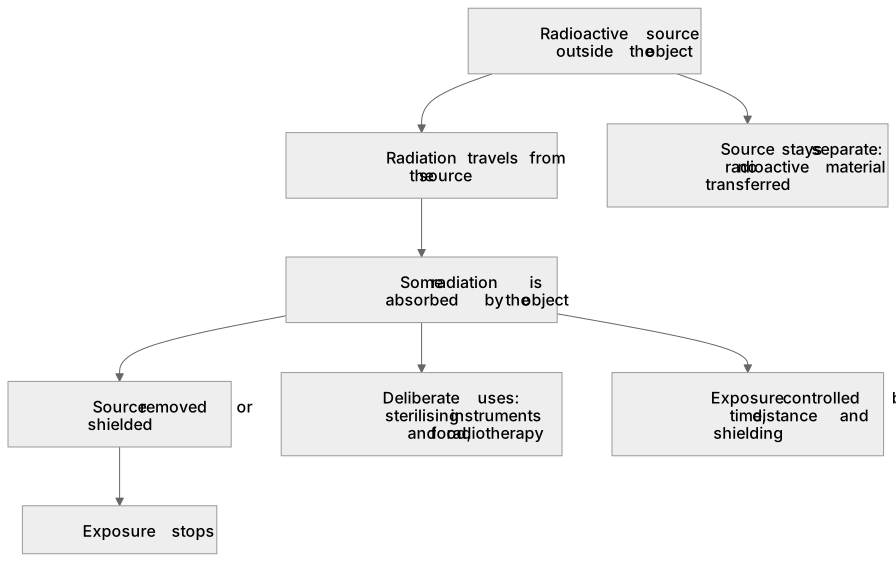
Key words
Say what each word means before you turn the card.
irradiation
Try answering aloud or in your head before turning the card.
source stays separate
Try answering aloud or in your head before turning the card.
exposure stops on removal
Try answering aloud or in your head before turning the card.
sterilisation
Try answering aloud or in your head before turning the card.
See every definition
- irradiation
- The process of exposing an object to nuclear radiation from a source that stays outside the object.
- source stays separate
- The radioactive source remains separate from the object, with no radioactive material transferred.
- exposure stops on removal
- The exposure ends as soon as the source is removed or shielded.
- sterilisation
- Gamma sources sterilise surgical instruments and food by killing bacteria.
Label the diagram
Some boxes have lost their names. Pick the right name for each number.
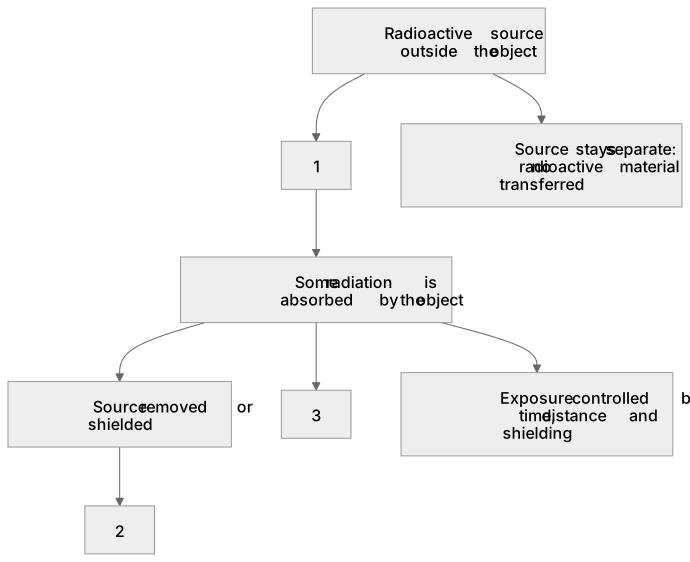
1Box 1
2Box 2
3Box 3
There is more to this lesson
The full lesson goes on to check your understanding and help you earn the marks. Create a free account to carry on, with your progress saved.
A week of Premium from your first lesson · Then the free plan continues · No card, no charge
Test your understanding of Radioactive contamination: Irradiation is the process of exposing an object to nuclear radiation.
Active recall beats re-reading. Take an instant quiz now to test what you’ve learned and lock it into long-term memory.
A week of Premium from your first lesson · Then the free plan continues · No card, no charge