AQA · GCSE · Physics
Course version: 8463 · Version from Sept 2016
The type of radiation emitted affects the level of hazard.
Full specification wording
Radioactive contamination: The type of radiation emitted affects the level of hazard.
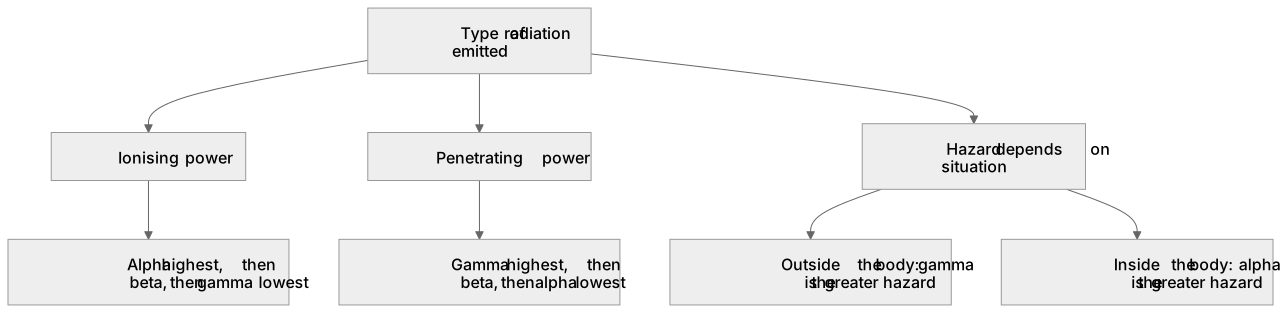
Alpha, beta and gamma differ in two opposite ways and the hazard depends on which one matters in a given situation.
Checked against the AQA 8463 specification (opens in a new tab) on .
- Point 3 of 8
- 4 key terms
Study notes
From the checked teaching notes for this specification point.
The idea
Alpha, beta and gamma differ in two opposite ways and the hazard depends on which one matters in a given situation. Ionising power runs alpha, then beta, then gamma: an alpha particle is large and doubly charged, so it rips electrons from atoms quickly and gives up all its energy within a few centimetres of air. Penetrating power runs the other way: alpha is stopped by paper or skin, beta by a few millimetres of aluminium, and gamma is only reduced by thick lead or concrete. Outside the body a gamma source is the greater hazard because the radiation reaches internal organs. Inside the body an alpha source is far worse, because all that ionisation happens inside a small volume of living tissue.
What earns the marks
- Ranking ionising power as alpha highest, then beta, then gamma lowest.
- Ranking penetration as gamma highest, then beta, then alpha, with a named absorber for each.
- Gamma being the greater hazard outside the body because it passes through skin to reach organs.
- Alpha being the greater hazard inside the body because it is highly ionising and is absorbed by tissue.
Common mistakes and how to put them right
Matching alpha to high penetrating power because it is the most dangerous kind they have heard of.
Stating that gamma is the most dangerous radiation in every situation.
Saying beta is stopped by paper, or that gamma is stopped by aluminium.
Treating ionising power and penetrating power as the same ranking.
Naming an absorber without saying which radiation it stops in a line-matching question.
Exam tips
- In a draw-one-line question, check you have exactly one line from each radiation type; extra lines mean the list principle is applied and marks are lost.
- Always say whether the source is inside or outside the body before you rank the hazard, because the answer reverses.
- Name the absorber, not just 'thick material', when describing penetration.
Try the lesson
The start of the Radioactive contamination: The type of radiation emitted affects the level of hazard. lesson, made from checked teaching notes for this specification point.
Have a go first
Two radioactive sources have the same activity. One emits alpha radiation and the other emits gamma radiation. Which source is more hazardous when the source is outside the body?
Listen
Alpha, beta and gamma differ in two opposite ways and the hazard depends on which one matters in a given situation. Ionising power runs alpha, then beta, then gamma: an alpha particle is large and doubly charged, so it rips electrons from atoms quickly and gives up all its energy within a few centimetres of air. Penetrating power runs the other way: alpha is stopped by paper or skin, beta by a few millimetres of aluminium, and gamma is only reduced by thick lead or concrete. Outside the body a gamma source is the greater hazard because the radiation reaches internal organs. Inside the body an alpha source is far worse, because all that ionisation happens inside a small volume of living tissue. A strong answer earns marks for these points. ranking ionising power as alpha highest, then beta, then gamma lowest. ranking penetration as gamma highest, then beta, then alpha, with a named absorber for each. gamma being the greater hazard outside the body because it passes through skin to reach organs. alpha being the greater hazard inside the body because it is highly ionising and is absorbed by tissue. Exam tip: In a draw-one-line question, check you have exactly one line from each radiation type; extra lines mean the list principle is applied and marks are lost.
See it
Key words
Say what each word means before you turn the card.
ionising power
Try answering aloud or in your head before turning the card.
penetrating power
Try answering aloud or in your head before turning the card.
internal versus external hazard
Try answering aloud or in your head before turning the card.
absorbers
Try answering aloud or in your head before turning the card.
See every definition
- ionising power
- Runs alpha, then beta, then gamma, because an alpha particle is large and doubly charged and rips electrons from atoms quickly.
- penetrating power
- Runs the other way: alpha is stopped by paper or skin, beta by a few millimetres of aluminium, and gamma is only reduced by thick lead or concrete.
- internal versus external hazard
- Outside the body a gamma source is the greater hazard because the radiation reaches internal organs, while inside the body an alpha source is far worse.
- absorbers
- Paper or skin stops alpha, a few millimetres of aluminium stops beta, and thick lead or concrete reduces gamma.
Label the diagram
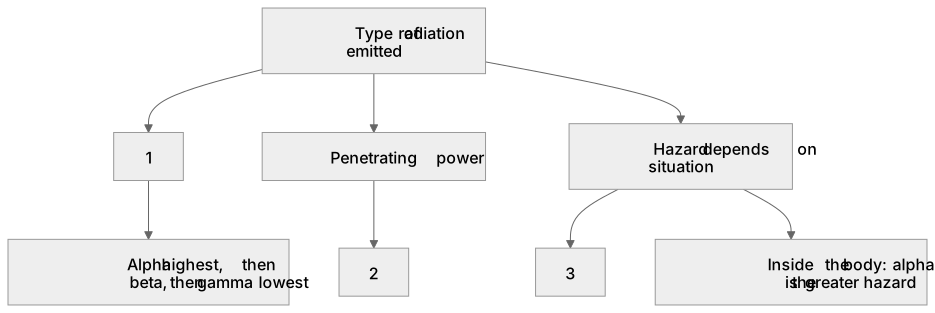
Some boxes have lost their names. Pick the right name for each number.
1Box 1
2Box 2
3Box 3
There is more to this lesson
The full lesson goes on to check your understanding and help you earn the marks. Create a free account to carry on, with your progress saved.
A week of Premium from your first lesson · Then the free plan continues · No card, no charge
Test your understanding of Radioactive contamination: The type of radiation emitted affects the level of hazard.
Active recall beats re-reading. Take an instant quiz now to test what you’ve learned and lock it into long-term memory.
A week of Premium from your first lesson · Then the free plan continues · No card, no charge