AQA · GCSE · Physics
Course version: 8463 · Version from Sept 2016
The resistance of a thermistor decreases as the temperature increases.
Full specification wording
Resistors: The resistance of a thermistor decreases as the temperature increases.
A thermistor is a resistor whose resistance depends strongly on its temperature: warm it and the resistance falls, cool it and the resistance rises.
Checked against the AQA 8463 specification (opens in a new tab) on .
- Point 7 of 13
- 4 key terms
Study notes
From the checked teaching notes for this specification point.
The idea
A thermistor is a resistor whose resistance depends strongly on its temperature: warm it and the resistance falls, cool it and the resistance rises. That makes it a temperature sensor, because a change in surroundings shows up directly as a change in an electrical reading. Put a thermistor in a circuit and the consequences follow from V = I R. As the thermistor warms, its resistance falls, so the total resistance of the circuit falls, so the current from the supply increases and the power transferred increases. The relationship is not a straight line; the resistance falls steeply at first and then more gently, so a thermistor is most sensitive over the temperature range it was chosen for.
What earns the marks
- Stating that the resistance of a thermistor decreases as its temperature increases.
- Deducing the change in the total resistance of the circuit.
- Concluding that the current increases when the total resistance decreases.
- Linking the increased current to a greater power output using P = I V.
Common mistakes and how to put them right
Reversing the relationship and saying resistance increases with temperature, as a filament does.
Assuming the current through the thermistor changes its resistance, when the change is caused by temperature.
Treating the resistance change as proportional to temperature rather than a curve.
Forgetting that the supply potential difference stays the same while the current changes.
Exam tips
- Answer in the order resistance, current, power, since later marks depend on the earlier steps.
- State the direction of the temperature change first so the rest of the chain has something to hang on.
- Say total resistance of the circuit, not just resistance, when other components are present.
Try the lesson
The start of the Resistors: The resistance of a thermistor decreases as the temperature increases. lesson, made from checked teaching notes for this specification point.
Have a go first
What happens to the resistance of a thermistor as its temperature increases?
Listen
A thermistor is a resistor whose resistance depends strongly on its temperature: warm it and the resistance falls, cool it and the resistance rises. That makes it a temperature sensor, because a change in surroundings shows up directly as a change in an electrical reading. Put a thermistor in a circuit and the consequences follow from V = I R. As the thermistor warms, its resistance falls, so the total resistance of the circuit falls, so the current from the supply increases and the power transferred increases. The relationship is not a straight line; the resistance falls steeply at first and then more gently, so a thermistor is most sensitive over the temperature range it was chosen for. A strong answer earns marks for these points. stating that the resistance of a thermistor decreases as its temperature increases. deducing the change in the total resistance of the circuit. concluding that the current increases when the total resistance decreases. linking the increased current to a greater power output using P = I V. Exam tip: Answer in the order resistance, current, power, since later marks depend on the earlier steps.
See it
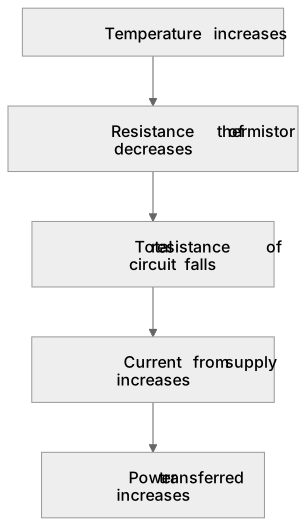
Put it in order
Put these steps in the order they happen.
- 1. Resistance of thermistor decreases
- 2. Total resistance of circuit falls
- 3. Temperature increases
- 4. Power transferred increases
- 5. Current from supply increases
Key words
Say what each word means before you turn the card.
thermistor
Try answering aloud or in your head before turning the card.
temperature sensor
Try answering aloud or in your head before turning the card.
resistance falls as temperature rises
Try answering aloud or in your head before turning the card.
non-linear response
Try answering aloud or in your head before turning the card.
See every definition
- thermistor
- A resistor whose resistance depends strongly on its temperature: warm it and the resistance falls, cool it and the resistance rises.
- temperature sensor
- A device that shows a change in surroundings directly as a change in an electrical reading, which a thermistor does.
- resistance falls as temperature rises
- The relationship in a thermistor, where warming it makes its resistance fall and cooling it makes its resistance rise.
- non-linear response
- The relationship is not a straight line; the resistance falls steeply at first and then more gently.
Label the diagram
Some boxes have lost their names. Pick the right name for each number.
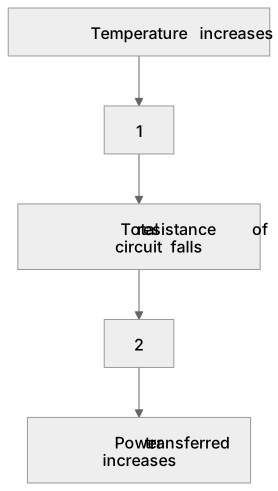
1Box 1
2Box 2
There is more to this lesson
The full lesson goes on to check your understanding and help you earn the marks. Create a free account to carry on, with your progress saved.
A week of Premium from your first lesson · Then the free plan continues · No card, no charge
Test your understanding of Resistors: The resistance of a thermistor decreases as the temperature increases.
Active recall beats re-reading. Take an instant quiz now to test what you’ve learned and lock it into long-term memory.
A week of Premium from your first lesson · Then the free plan continues · No card, no charge