AQA · GCSE · Physics
Course version: 8463 · Version from Sept 2016
The current through a diode flows in one direction only. The diode has a…
Full specification wording
Resistors: The current through a diode flows in one direction only. The diode has a very high resistance in the reverse direction.
A diode only lets current pass one way.
Checked against the AQA 8463 specification (opens in a new tab) on .
- Point 6 of 13
- 4 key terms
Study notes
From the checked teaching notes for this specification point.
The idea
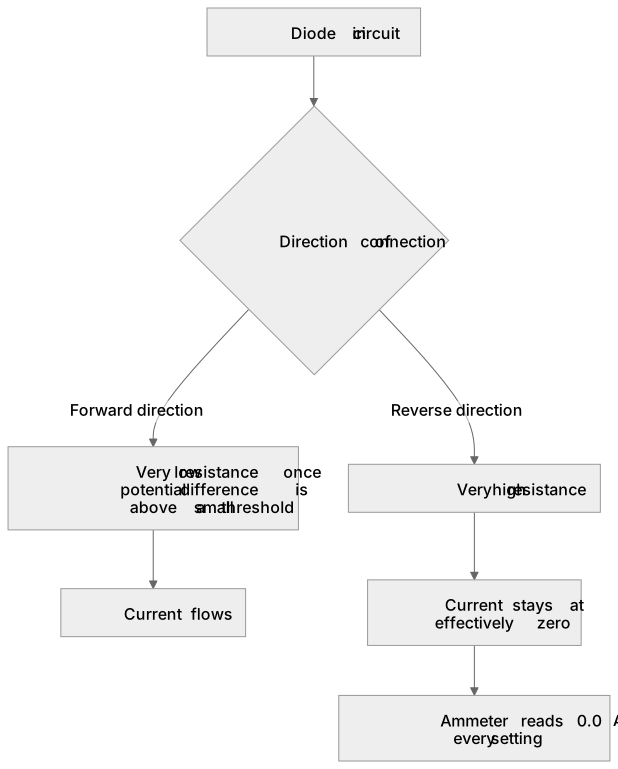
A diode only lets current pass one way. Connected in the forward direction it has a very low resistance once the potential difference is above a small threshold, so the characteristic rises steeply. Reverse the connections and its resistance is very high, so the current stays at effectively zero however far the potential difference is turned up, which is why an ammeter in that circuit reads 0.0 A at every setting. The graph is therefore flat along the reverse side and sharply rising on the forward side. Light emitting diodes behave the same way and emit light only when connected the right way round, which is why they are used as indicators and why diodes are used to protect circuits from reversed batteries.
What earns the marks
- Stating that the diode has a very high resistance in the reverse direction.
- Concluding that the current is therefore zero when the connections are reversed.
- Stating that current passes in one direction only.
- Describing the forward characteristic as a low resistance above a small threshold potential difference.
Common mistakes and how to put them right
Saying the diode blocks the potential difference rather than passing almost no current.
Claiming the ammeter reads zero because the circuit is broken, when it is complete but high in resistance.
Drawing a symmetrical characteristic, so showing current in both directions.
Assuming an LED lights whichever way round it is connected.
Exam tips
- For the reversed LED question, the second mark depends on the first, so lead with the very high reverse resistance.
- An answer of LEDs only allow current in one direction earns one mark on its own, so include it as well.
- Label both halves of a sketched diode characteristic, forward and reverse, so the asymmetry is obvious.
Try the lesson
The start of the Resistors: The current through a diode flows in one direction only. The diode has a very high resistance in the reverse direction. lesson, made from checked teaching notes for this specification point.
Have a go first
In which direction can current flow through a diode?
Listen
A diode only lets current pass one way. Connected in the forward direction it has a very low resistance once the potential difference is above a small threshold, so the characteristic rises steeply. Reverse the connections and its resistance is very high, so the current stays at effectively zero however far the potential difference is turned up, which is why an ammeter in that circuit reads 0.0 A at every setting. The graph is therefore flat along the reverse side and sharply rising on the forward side. Light emitting diodes behave the same way and emit light only when connected the right way round, which is why they are used as indicators and why diodes are used to protect circuits from reversed batteries. A strong answer earns marks for these points. stating that the diode has a very high resistance in the reverse direction. concluding that the current is therefore zero when the connections are reversed. stating that current passes in one direction only. describing the forward characteristic as a low resistance above a small threshold potential difference. Exam tip: For the reversed LED question, the second mark depends on the first, so lead with the very high reverse resistance.
See it
Key words
Say what each word means before you turn the card.
diodes
Try answering aloud or in your head before turning the card.
forward and reverse direction
Try answering aloud or in your head before turning the card.
very high reverse resistance
Try answering aloud or in your head before turning the card.
LEDs
Try answering aloud or in your head before turning the card.
See every definition
- diodes
- Components through which current flows in one direction only and which have a very high resistance in the reverse direction.
- forward and reverse direction
- The two ways a diode can be connected, with current passing in one direction only and the resistance being very high in the reverse direction.
- very high reverse resistance
- The property of a diode in the reverse direction, which means the current stays at effectively zero however far the potential difference is turned up.
- LEDs
- Light emitting diodes, which behave the same way as diodes and emit light only when connected the right way round.
There is more to this lesson
The full lesson goes on to check your understanding and help you earn the marks. Create a free account to carry on, with your progress saved.
A week of Premium from your first lesson · Then the free plan continues · No card, no charge
Test your understanding of Resistors: The current through a diode flows in one direction only. The diode has a very high resistance in the reverse direction.
Active recall beats re-reading. Take an instant quiz now to test what you’ve learned and lock it into long-term memory.
A week of Premium from your first lesson · Then the free plan continues · No card, no charge