AQA · GCSE · Physics
Course version: 8463 · Version from Sept 2016
Resistors: The resistance of an LDR decreases as light intensity increases.
A light dependent resistor, or LDR, responds to light rather than heat: the brighter the light falling on it, the lower its resistance.
Checked against the AQA 8463 specification (opens in a new tab) on .
- Point 9 of 13
- 4 key terms
Study notes
From the checked teaching notes for this specification point.
The idea
A light dependent resistor, or LDR, responds to light rather than heat: the brighter the light falling on it, the lower its resistance. In darkness its resistance is very high, often hundreds of thousands of ohms, while in bright light it can fall to a few hundred. That makes it a light sensor. In a circuit the consequence again follows from V = I R. Brighter light lowers the resistance of the LDR, which lowers the total resistance of the circuit, so the current from the supply increases. The response is not linear, and the resistance changes over several orders of magnitude, which is why LDR circuits are usually drawn with a fixed resistor beside them to give a workable output.
What earns the marks
- Stating that the resistance of an LDR decreases as the light intensity increases.
- Deducing the effect on the total resistance of the circuit.
- Concluding whether the current increases or decreases.
- Interpreting a resistance against light intensity graph correctly.
Common mistakes and how to put them right
Reversing the relationship and saying resistance rises in brighter light.
Confusing light intensity with the colour or wavelength of the light.
Assuming resistance halves when light intensity doubles, treating a curve as a straight line.
Mixing up the LDR with the thermistor when a circuit contains both.
Exam tips
- Fix the two extremes in your memory: dark means high resistance, bright means low resistance.
- Follow the same chain as for a thermistor: resistance, total resistance, current.
- Read values from a resistance against intensity graph rather than estimating, since the scale is often unequal.
Try the lesson
The start of the Resistors: The resistance of an LDR decreases as light intensity increases. lesson, made from checked teaching notes for this specification point.
Have a go first
What happens to the resistance of a light-dependent resistor (LDR) when the light intensity falling on it increases?
Listen
A light dependent resistor, or LDR, responds to light rather than heat: the brighter the light falling on it, the lower its resistance. In darkness its resistance is very high, often hundreds of thousands of ohms, while in bright light it can fall to a few hundred. That makes it a light sensor. In a circuit the consequence again follows from V = I R. Brighter light lowers the resistance of the LDR, which lowers the total resistance of the circuit, so the current from the supply increases. The response is not linear, and the resistance changes over several orders of magnitude, which is why LDR circuits are usually drawn with a fixed resistor beside them to give a workable output. A strong answer earns marks for these points. stating that the resistance of an LDR decreases as the light intensity increases. deducing the effect on the total resistance of the circuit. concluding whether the current increases or decreases. interpreting a resistance against light intensity graph correctly. Exam tip: Fix the two extremes in your memory: dark means high resistance, bright means low resistance.
See it
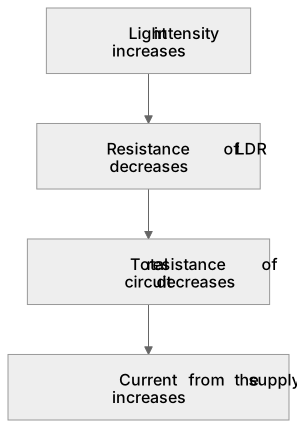
Put it in order
Put these steps in the order they happen.
- 1. Total resistance of circuit decreases
- 2. Current from the supply increases
- 3. Resistance of LDR decreases
- 4. Light intensity increases
Key words
Say what each word means before you turn the card.
light dependent resistors
Try answering aloud or in your head before turning the card.
light intensity
Try answering aloud or in your head before turning the card.
sensing light
Try answering aloud or in your head before turning the card.
non-linear response
Try answering aloud or in your head before turning the card.
See every definition
- light dependent resistors
- A component that responds to light rather than heat, with resistance that is very high in darkness and can fall to a few hundred in bright light.
- light intensity
- The brightness of the light falling on an LDR; as it increases, the resistance of the LDR decreases.
- sensing light
- The role of an LDR, which makes it a light sensor rather than a source of energy.
- non-linear response
- The way an LDR's resistance changes over several orders of magnitude, so its resistance against light intensity graph is a curve rather than a straight line.
Label the diagram
Some boxes have lost their names. Pick the right name for each number.
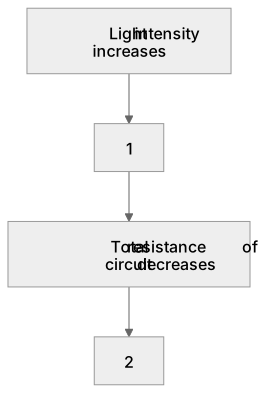
1Box 1
2Box 2
There is more to this lesson
The full lesson goes on to check your understanding and help you earn the marks. Create a free account to carry on, with your progress saved.
A week of Premium from your first lesson · Then the free plan continues · No card, no charge
Test your understanding of Resistors: The resistance of an LDR decreases as light intensity increases.
Active recall beats re-reading. Take an instant quiz now to test what you’ve learned and lock it into long-term memory.
A week of Premium from your first lesson · Then the free plan continues · No card, no charge