AQA · GCSE · Physics
Course version: 8463 · Version from Sept 2016
The application of LDRs in circuits eg switching lights on when it gets…
Full specification wording
Resistors: The application of LDRs in circuits eg switching lights on when it gets dark is required.
The obvious use of an LDR is switching lights on when it gets dark.
Checked against the AQA 8463 specification (opens in a new tab) on .
- Point 10 of 13
- 2 key terms
Study notes
From the checked teaching notes for this specification point.
The idea
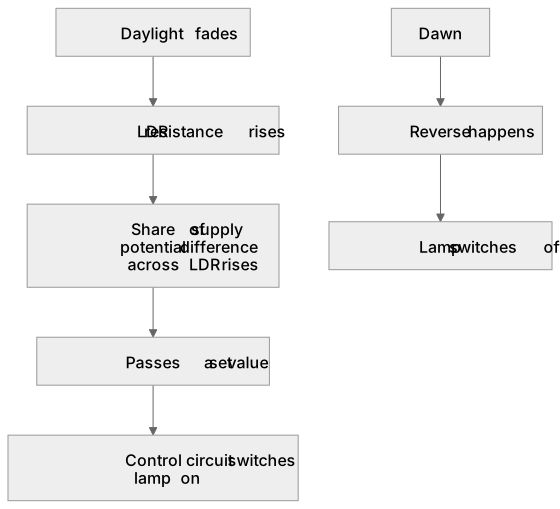
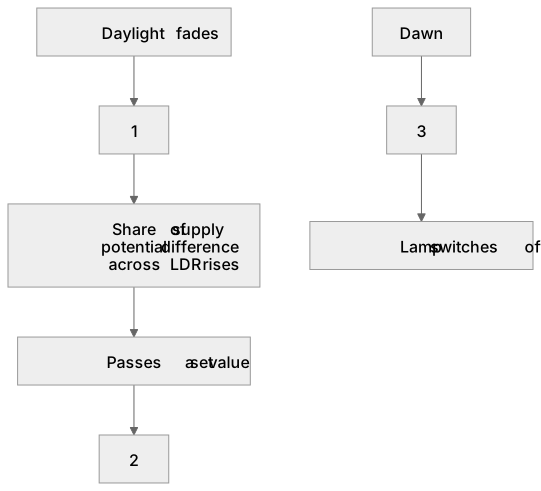
The obvious use of an LDR is switching lights on when it gets dark. The LDR is placed in series with a fixed resistor across the supply, so as daylight fades the LDR resistance rises, the share of the supply potential difference across it rises, and once it passes a set value the control circuit switches the street lamp or security light on. At dawn the reverse happens and the lamp switches off. The same idea runs a garden light, a night light and the automatic headlights on a car. Other applications use the current directly: a camera adjusts its exposure from the light reaching an LDR, and a burglar alarm triggers when a beam falling on the LDR is broken.
What earns the marks
- Naming a suitable application such as automatic street lighting or a burglar alarm.
- Stating that the LDR resistance rises as the light level falls.
- Linking that to the potential difference across the LDR in a potential divider.
- Describing the switching action that results, such as turning the lamp on.
Common mistakes and how to put them right
Saying the LDR turns the light on by itself rather than triggering a switching circuit.
Getting the direction wrong, so claiming resistance falls as it gets dark.
Describing the LDR as producing electricity when light falls on it, which is a solar cell.
Naming an application with no mention of what changes inside the circuit.
Exam tips
- Trace the chain from the light level through the resistance to the potential difference and the switch.
- Name the component that does the switching, since the LDR only provides the signal.
- Use the same reasoning pattern as for a thermistor; only the trigger quantity changes.
Try the lesson
The start of the Resistors: The application of LDRs in circuits eg switching lights on when it gets dark is required. lesson, made from checked teaching notes for this specification point.
Have a go first
A street lamp uses an LDR in a circuit so that the lamp switches on automatically at dusk. Why does the LDR cause the lamp to switch on when it gets dark?
Listen
The obvious use of an LDR is switching lights on when it gets dark. The LDR is placed in series with a fixed resistor across the supply, so as daylight fades the LDR resistance rises, the share of the supply potential difference across it rises, and once it passes a set value the control circuit switches the street lamp or security light on. At dawn the reverse happens and the lamp switches off. The same idea runs a garden light, a night light and the automatic headlights on a car. Other applications use the current directly: a camera adjusts its exposure from the light reaching an LDR, and a burglar alarm triggers when a beam falling on the LDR is broken. A strong answer earns marks for these points. naming a suitable application such as automatic street lighting or a burglar alarm. stating that the LDR resistance rises as the light level falls. linking that to the potential difference across the LDR in a potential divider. describing the switching action that results, such as turning the lamp on. Exam tip: Trace the chain from the light level through the resistance to the potential difference and the switch.
See it
Key words
Say what each word means before you turn the card.
burglar alarms
Try answering aloud or in your head before turning the card.
camera exposure
Try answering aloud or in your head before turning the card.
See every definition
- burglar alarms
- An application that triggers when a beam falling on the LDR is broken.
- camera exposure
- An application that uses the current directly, adjusting exposure from the light reaching an LDR.
Label the diagram
Some boxes have lost their names. Pick the right name for each number.
1Box 1
2Box 2
3Box 3
There is more to this lesson
The full lesson goes on to check your understanding and help you earn the marks. Create a free account to carry on, with your progress saved.
A week of Premium from your first lesson · Then the free plan continues · No card, no charge
Test your understanding of Resistors: The application of LDRs in circuits eg switching lights on when it gets dark is required.
Active recall beats re-reading. Take an instant quiz now to test what you’ve learned and lock it into long-term memory.
A week of Premium from your first lesson · Then the free plan continues · No card, no charge