AQA · GCSE · Physics
Course version: 8463 · Version from Sept 2016
This means that the resistance remains constant as the current changes.
Full specification wording
Resistors: This means that the resistance remains constant as the current changes.
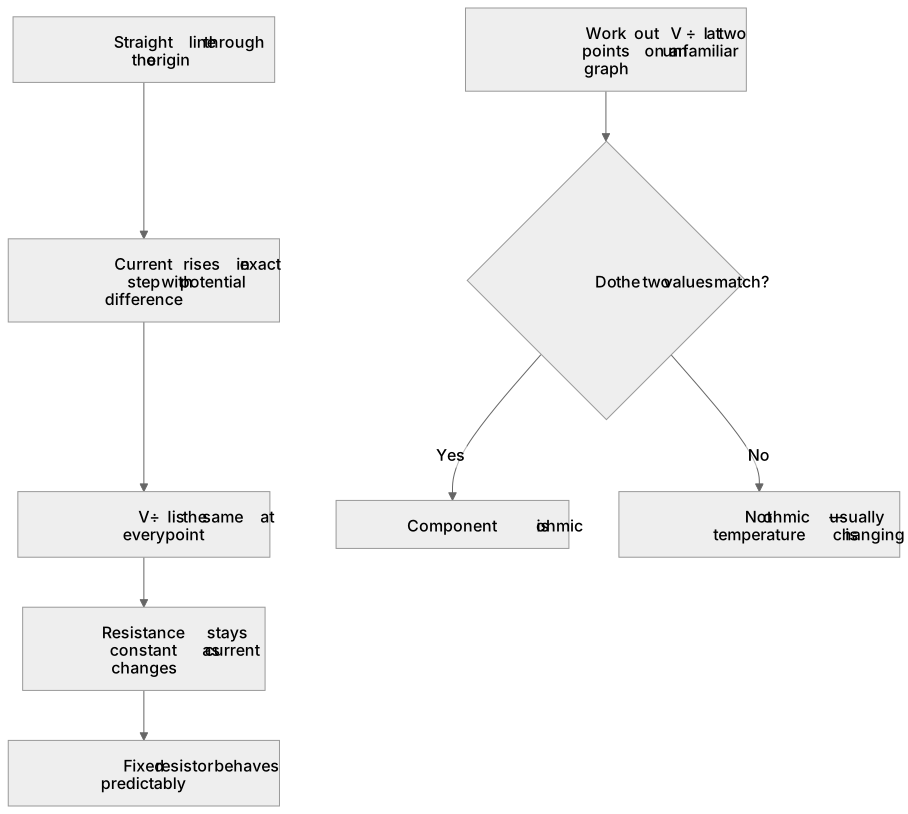
Direct proportionality has a consequence worth stating separately: if current rises in exact step with potential difference, then V ÷ I is the same at every point, so the resistance stays constant…
Checked against the AQA 8463 specification (opens in a new tab) on .
- Point 3 of 13
- 3 key terms
Study notes
From the checked teaching notes for this specification point.
The idea
Direct proportionality has a consequence worth stating separately: if current rises in exact step with potential difference, then V ÷ I is the same at every point, so the resistance stays constant as the current changes. Check it with numbers from a straight line through the origin. At 2 V the current might be 0.4 A, giving 5 Ω; at 6 V it is 1.2 A, giving 5 Ω again. That is what makes a fixed resistor useful, since it behaves predictably whatever the circuit does to it. The reverse test is just as useful: work out V ÷ I at two points on an unfamiliar graph, and if the answers differ the component is not ohmic and something, usually temperature, is changing.
What earns the marks
- Calculating resistance as V ÷ I at one point on the graph.
- A second calculation at a different point on the same line.
- Comparing the two values and stating that the resistance is constant.
- Linking constant resistance to a straight line through the origin.
Common mistakes and how to put them right
Assuming a constant resistance without checking a second point on the graph.
Using the gradient directly as the resistance when current is plotted on the vertical axis.
Calculating V ÷ I using values read from two different graph lines.
Rounding readings so heavily that two genuinely equal resistances appear different.
Exam tips
- Take readings from points where the line crosses grid intersections, so the values are easy to read accurately.
- Show both calculations in full; the comparison mark depends on seeing two values.
- Remember that with current on the vertical axis the gradient is 1 ÷ R, not R.
Try the lesson
The start of the Resistors: This means that the resistance remains constant as the current changes. lesson, made from checked teaching notes for this specification point.
Have a go first
For an ohmic conductor at a constant temperature, what happens to its resistance as the current through it changes?
Listen
Direct proportionality has a consequence worth stating separately: if current rises in exact step with potential difference, then V ÷ I is the same at every point, so the resistance stays constant as the current changes. Check it with numbers from a straight line through the origin. At 2 V the current might be 0.4 A, giving 5 Ω; at 6 V it is 1.2 A, giving 5 Ω again. That is what makes a fixed resistor useful, since it behaves predictably whatever the circuit does to it. The reverse test is just as useful: work out V ÷ I at two points on an unfamiliar graph, and if the answers differ the component is not ohmic and something, usually temperature, is changing. A strong answer earns marks for these points. calculating resistance as V ÷ I at one point on the graph. a second calculation at a different point on the same line. comparing the two values and stating that the resistance is constant. linking constant resistance to a straight line through the origin. Exam tip: Take readings from points where the line crosses grid intersections, so the values are easy to read accurately.
See it
Key words
Say what each word means before you turn the card.
constant resistance
Try answering aloud or in your head before turning the card.
V ÷ I at several points
Try answering aloud or in your head before turning the card.
fixed resistors
Try answering aloud or in your head before turning the card.
See every definition
- constant resistance
- The resistance remains constant as the current changes, so V ÷ I is the same at every point.
- V ÷ I at several points
- Working out V ÷ I at two points on a graph and comparing the values to see whether the resistance is constant.
- fixed resistors
- A component whose resistance stays constant as the current changes, so it behaves predictably whatever the circuit does to it.
Label the diagram
Some boxes have lost their names. Pick the right name for each number.
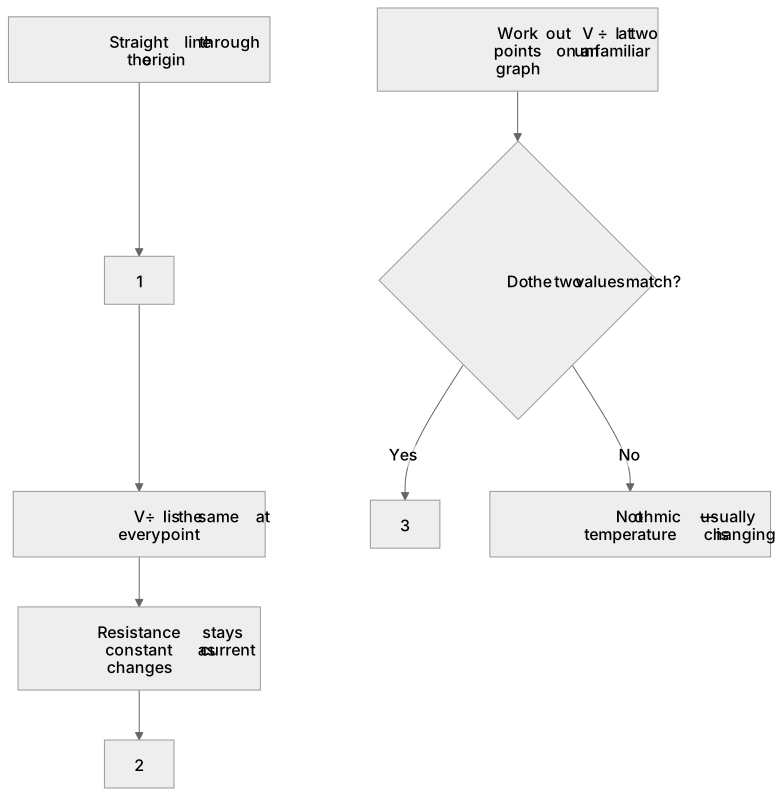
1Box 1
2Box 2
3Box 3
There is more to this lesson
The full lesson goes on to check your understanding and help you earn the marks. Create a free account to carry on, with your progress saved.
A week of Premium from your first lesson · Then the free plan continues · No card, no charge
Test your understanding of Resistors: This means that the resistance remains constant as the current changes.
Active recall beats re-reading. Take an instant quiz now to test what you’ve learned and lock it into long-term memory.
A week of Premium from your first lesson · Then the free plan continues · No card, no charge