AQA · GCSE · Physics
Course version: 8463 · Version from Sept 2016
The resistance of components such as lamps, diodes, thermistors and LDRs…
Full specification wording
Resistors: The resistance of components such as lamps, diodes, thermistors and LDRs is not constant; it changes with the current through the component.
Several common components have a resistance that shifts as conditions change.
Checked against the AQA 8463 specification (opens in a new tab) on .
- Point 4 of 13
- 4 key terms
Study notes
From the checked teaching notes for this specification point.
The idea
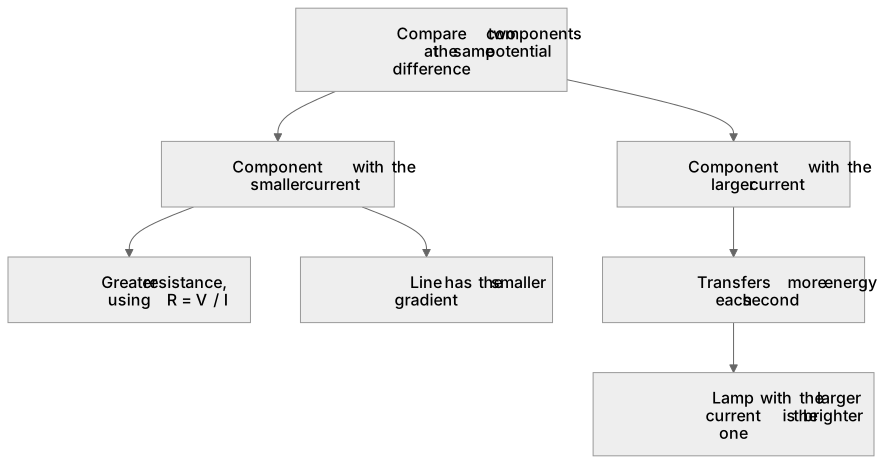
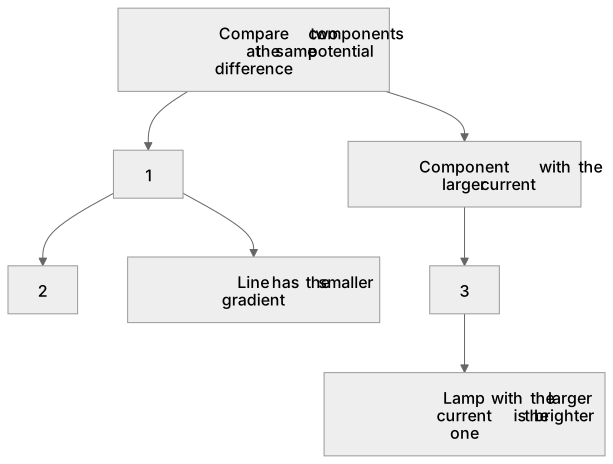
Several common components have a resistance that shifts as conditions change. A filament lamp resists more as the current through it heats the filament. A diode resists almost nothing in the forward direction and hugely in the reverse. A thermistor resists less when its surroundings are hotter, and a light dependent resistor resists less when the light on it is brighter. Their graphs are therefore curved, and you compare two such components at a chosen potential difference. At any given potential difference, the component carrying the smaller current has the larger resistance and its line has the smaller gradient; the one carrying the larger current transfers more energy each second, so a lamp with the larger current is the brighter one.
What earns the marks
- Identify which component carries the smaller current at the same potential difference when comparing graphs.
- Conclude that the component with the smaller current has the greater resistance, using the relationship R = V / I.
- Refer to the lower gradient of the line on the current-potential difference graph to indicate higher resistance.
- Link a larger current at the same potential difference to a greater power output and therefore a brighter lamp.
Common mistakes and how to put them right
Comparing two curved characteristics at different potential differences, which makes the comparison meaningless.
Put it right: Compare at a fixed potential difference.
Claiming the steeper line has the greater resistance.
Put it right: The steeper line has the greater current for a given pd and so the smaller resistance.
Stating a lamp is brighter because it has more resistance.
Put it right: Brightness should be linked to higher current and greater power output.
Treating the resistance of a filament lamp as fixed and quoting one value for the whole graph.
Put it right: Resistance increases as current increases.
Exam tips
- Draw a vertical line on the graph at one potential difference and compare the currents where it cuts each curve.
- Answers phrased in terms of R = V / I are accepted, so quote the equation when comparing resistance.
Try the lesson
The start of the Resistors: The resistance of components such as lamps, diodes, thermistors and LDRs is not constant; it changes with the current through the component. lesson, made from checked teaching notes for this specification point.
Have a go first
Which statement correctly describes the resistance of a filament lamp as the current through it changes?
Listen
Several common components have a resistance that shifts as conditions change. A filament lamp resists more as the current through it heats the filament. A diode resists almost nothing in the forward direction and hugely in the reverse. A thermistor resists less when its surroundings are hotter, and a light dependent resistor resists less when the light on it is brighter. Their graphs are therefore curved, and you compare two such components at a chosen potential difference. At any given potential difference, the component carrying the smaller current has the larger resistance and its line has the smaller gradient; the one carrying the larger current transfers more energy each second, so a lamp with the larger current is the brighter one. A strong answer earns marks for these points. Identify which component carries the smaller current at the same potential difference when comparing graphs. Conclude that the component with the smaller current has the greater resistance, using the relationship R = V / I. Refer to the lower gradient of the line on the current-potential difference graph to indicate higher resistance. Link a larger current at the same potential difference to a greater power output and therefore a brighter lamp. Exam tip: Draw a vertical line on the graph at one potential difference and compare the currents where it cuts each curve.
See it
Key words
Say what each word means before you turn the card.
non-ohmic components
Try answering aloud or in your head before turning the card.
curved characteristics
Try answering aloud or in your head before turning the card.
comparing at fixed pd
Try answering aloud or in your head before turning the card.
gradient and resistance
Try answering aloud or in your head before turning the card.
See every definition
- non-ohmic components
- Components such as lamps, diodes, thermistors and LDRs whose resistance is not constant but changes with the current through the component.
- curved characteristics
- The graphs of such components are curved rather than straight because their resistance changes as conditions change.
- comparing at fixed pd
- Two such components are compared at a chosen potential difference, since comparing them at different potential differences makes the comparison meaningless.
- gradient and resistance
- At any given potential difference the component carrying the smaller current has the larger resistance and its line has the smaller gradient.
Label the diagram
Some boxes have lost their names. Pick the right name for each number.
1Box 1
2Box 2
3Box 3
There is more to this lesson
The full lesson goes on to check your understanding and help you earn the marks. Create a free account to carry on, with your progress saved.
A week of Premium from your first lesson · Then the free plan continues · No card, no charge
Test your understanding of Resistors: The resistance of components such as lamps, diodes, thermistors and LDRs is not constant; it changes with the current through the component.
Active recall beats re-reading. Take an instant quiz now to test what you’ve learned and lock it into long-term memory.
A week of Premium from your first lesson · Then the free plan continues · No card, no charge