OCR · A-Level · Physics
Course version: H556 · Version from Sept 2015
Analysis: (c) appropriate use of significant figures
Significant figures communicate the precision of a measurement or calculation.
Checked against the OCR H556 specification (opens in a new tab) on .
- Point 2 of 5
Study notes
From the checked teaching notes for this specification point.
The idea
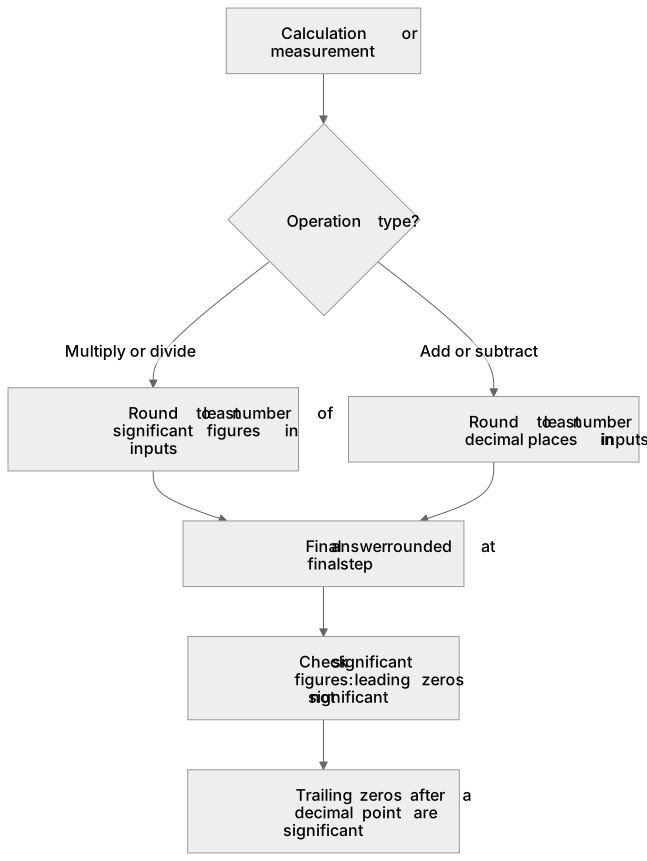
Significant figures communicate the precision of a measurement or calculation. In experimental work, the number of significant figures in a final answer should reflect the precision of the data used. For example, if a length is measured as 12.3 cm (3 s.f.) and a time as 4.56 s (3 s.f.), a calculated speed of 2.697368... cm/s should be rounded to 3 s.f., giving 2.70 cm/s. When adding or subtracting, the result should be rounded to the least number of decimal places in the inputs. When multiplying or dividing, round to the least number of significant figures in the inputs. Leading zeros are not significant; trailing zeros after a decimal point are significant.
What earns the marks
- Recognise that the number of significant figures in a final answer should be consistent with the precision of the input data.
- Apply the rule for multiplication and division: round the result to the least number of significant figures in any input.
- Apply the rule for addition and subtraction: round the result to the least number of decimal places in any input.
- Identify significant figures correctly, including that leading zeros are not significant and trailing zeros after a decimal point are significant.
- Round calculated values correctly to the required number of significant figures.
Common mistakes and how to put them right
Misunderstanding: all digits shown on a calculator should be written down.
Put it right: Round the answer to an appropriate number of significant figures based on the input data.
Misunderstanding: leading zeros in a decimal such as 0.00456 are significant.
Put it right: Leading zeros are placeholders and are not significant; 0.00456 has three significant figures.
Misunderstanding: when adding or subtracting, the number of significant figures determines the rounding.
Put it right: For addition and subtraction, round to the least number of decimal places in the inputs.
Misunderstanding: trailing zeros in a whole number such as 1200 are always significant.
Put it right: Without a decimal point, trailing zeros may be ambiguous; in such cases, scientific notation clarifies the intended precision.
Exam tips
- Read the question carefully to see whether it asks for a rounded value or the number of significant figures.
- Check each option by counting significant figures from the first non-zero digit.
- For calculations, perform the full calculation first, then round only at the final step to avoid rounding errors.
- Remember that in multiplication and division, the result should have the same number of significant figures as the least precise input.
Try the lesson
The start of the Analysis: (c) appropriate use of significant figures lesson, made from checked teaching notes for this specification point.
Listen
Significant figures communicate the precision of a measurement or calculation. In experimental work, the number of significant figures in a final answer should reflect the precision of the data used. For example, if a length is measured as 12.3 cm (3 s.f.) and a time as 4.56 s (3 s.f.), a calculated speed of 2.697368... cm/s should be rounded to 3 s.f., giving 2.70 cm/s. When adding or subtracting, the result should be rounded to the least number of decimal places in the inputs. When multiplying or dividing, round to the least number of significant figures in the inputs. Leading zeros are not significant; trailing zeros after a decimal point are significant. A strong answer earns marks for these points. Recognise that the number of significant figures in a final answer should be consistent with the precision of the input data. Apply the rule for multiplication and division: round the result to the least number of significant figures in any input. Apply the rule for addition and subtraction: round the result to the least number of decimal places in any input. Identify significant figures correctly, including that leading zeros are not significant and trailing zeros after a decimal point are significant. A common slip: Misunderstanding: all digits shown on a calculator should be written down. Instead, round the answer to an appropriate number of significant figures based on the input data. Exam tip: Read the question carefully to see whether it asks for a rounded value or the number of significant figures.
See it
There is more to this lesson
The full lesson goes on to check your understanding and help you earn the marks. Create a free account to carry on, with your progress saved.
A week of Premium from your first lesson · Then the free plan continues · No card, no charge
Test your understanding of Analysis: (c) appropriate use of significant figures
Active recall beats re-reading. Take an instant quiz now to test what you’ve learned and lock it into long-term memory.
A week of Premium from your first lesson · Then the free plan continues · No card, no charge