OCR · A-Level · Physics
Course version: H556 · Version from Sept 2015
Cosmology: (m) estimation for the age of the universe; t ≈ H 0 –1
The Hubble constant H₀ describes how fast the universe expands: recession speed v = H₀d, so H₀ has units of s⁻¹ (km s⁻¹ Mpc⁻¹).
Checked against the OCR H556 specification (opens in a new tab) on .
- Point 15 of 17
- 4 key terms
Study notes
From the checked teaching notes for this specification point.
The idea
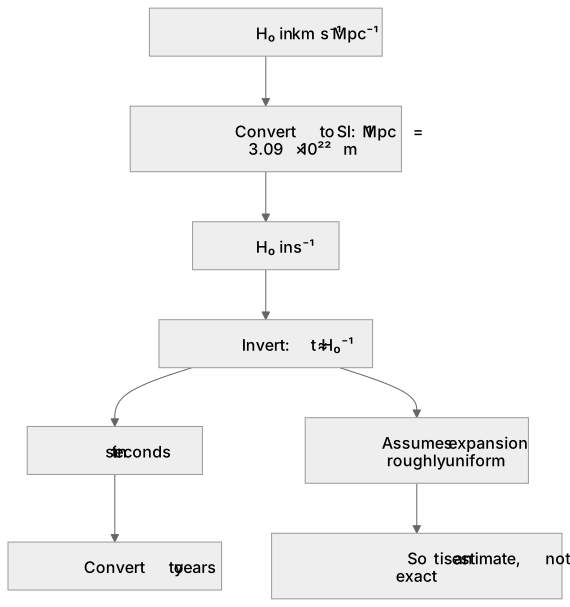
The Hubble constant H₀ describes how fast the universe expands: recession speed v = H₀d, so H₀ has units of s⁻¹ (km s⁻¹ Mpc⁻¹). If expansion has been roughly uniform, the time since galaxies were coincident is the distance divided by the speed, giving t ≈ H₀⁻¹. This is an estimate, not an exact age, because gravity and dark energy change the expansion rate over time. Worked method: convert H₀ to SI. For H₀ = 70 km s⁻¹ Mpc⁻¹, 1 Mpc = 3.09 × 10²² m, so H₀ = 70 000 m s⁻¹ ÷ 3.09 × 10²² m = 2.27 × 10⁻¹⁸ s⁻¹, and t ≈ 1 ÷ (2.27 × 10⁻¹⁸ s⁻¹) ≈ 4.4 × 10¹⁷ s ≈ 1.4 × 10¹⁰ years.
What earns the marks
- States that H₀ relates recession speed to distance: v = H₀d, so H₀ has units of inverse time (s⁻¹).
- Derives t ≈ H₀⁻¹ by assuming the recession speed has been approximately constant since the Big Bang.
- Converts H₀ from km s⁻¹ Mpc⁻¹ into SI before inverting, using 1 Mpc = 3.09 × 10²² m.
- Recognises that t ≈ H₀⁻¹ is an estimate because the expansion rate changes with time, so the true age differs from the simple reciprocal.
Common mistakes and how to put them right
Inverting H₀ while it is still in km s⁻¹ Mpc⁻¹, giving a meaningless time.
Put it right: The constant must first be converted to SI units of s⁻¹.
Treating t ≈ H₀⁻¹ as an exact age rather than an estimate that assumes constant expansion.
Using 1 Mpc = 3.09 × 10¹⁶ m (a parsec value) instead of 3.09 × 10²² m, which shifts the answer by a factor of about 10⁶.
Forgetting that H₀⁻¹ has units of seconds and reporting the raw number as years without converting.
Exam tips
- Always show the unit conversion of H₀ to s⁻¹ before calculating the reciprocal; method marks usually depend on it.
- Quote the final age in years as well as seconds, using 1 year ≈ 3.15 × 10⁷ s.
- If asked to comment on reliability, link the estimate to the assumption of constant expansion and to uncertainties in H₀.
Try the lesson
The start of the Cosmology: (m) estimation for the age of the universe; t ≈ H 0 –1 lesson, made from checked teaching notes for this specification point.
Listen
The Hubble constant H₀ describes how fast the universe expands: recession speed v = H₀d, so H₀ has units of s⁻¹ (km s⁻¹ Mpc⁻¹). If expansion has been roughly uniform, the time since galaxies were coincident is the distance divided by the speed, giving t ≈ H₀⁻¹. This is an estimate, not an exact age, because gravity and dark energy change the expansion rate over time. Worked method: convert H₀ to SI. For H₀ = 70 km s⁻¹ Mpc⁻¹, 1 Mpc = 3.09 × 10²² m, so H₀ = 70 000 m s⁻¹ ÷ 3.09 × 10²² m = 2.27 × 10⁻¹⁸ s⁻¹, and t ≈ 1 ÷ (2.27 × 10⁻¹⁸ s⁻¹) ≈ 4.4 × 10¹⁷ s ≈ 1.4 × 10¹⁰ years. A strong answer earns marks for these points. States that H₀ relates recession speed to distance: v = H₀d, so H₀ has units of inverse time (s⁻¹). Derives t ≈ H₀⁻¹ by assuming the recession speed has been approximately constant since the Big Bang. Converts H₀ from km s⁻¹ Mpc⁻¹ into SI before inverting, using 1 Mpc = 3.09 × 10²² m. Recognises that t ≈ H₀⁻¹ is an estimate because the expansion rate changes with time, so the true age differs from the simple reciprocal. Exam tip: Always show the unit conversion of H₀ to s⁻¹ before calculating the reciprocal; method marks usually depend on it.
See it
Key words
Say what each word means before you turn the card.
Hubble constant
Try answering aloud or in your head before turning the card.
Estimating the age of the universe
Try answering aloud or in your head before turning the card.
Units and unit conversion in cosmology
Try answering aloud or in your head before turning the card.
Limitations of simple cosmological models
Try answering aloud or in your head before turning the card.
See every definition
- Hubble constant
- Describes how fast the universe expands, relating recession speed to distance as v = H₀d, so it has units of s⁻¹.
- Estimating the age of the universe
- If expansion has been roughly uniform, the time since galaxies were coincident is the distance divided by the speed, giving t ≈ H₀⁻¹.
- Units and unit conversion in cosmology
- H₀ must be converted from km s⁻¹ Mpc⁻¹ into SI of s⁻¹ using 1 Mpc = 3.09 × 10²² m before inverting.
- Limitations of simple cosmological models
- The reciprocal is an estimate, not an exact age, because gravity and dark energy change the expansion rate over time.
Label the diagram
Some boxes have lost their names. Pick the right name for each number.
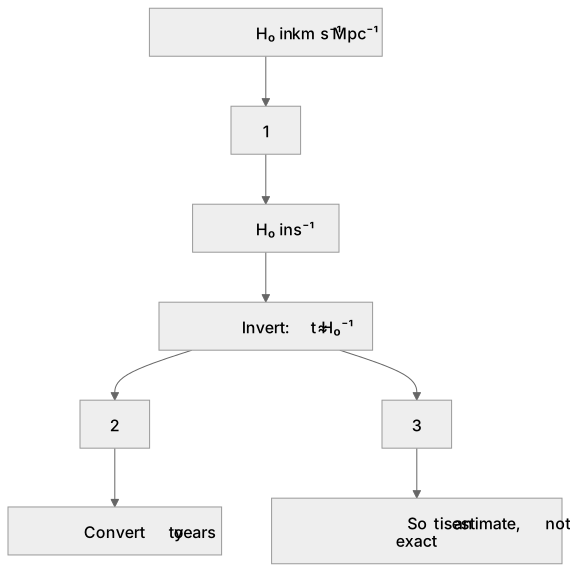
1Box 1
2Box 2
3Box 3
There is more to this lesson
The full lesson goes on to check your understanding and help you earn the marks. Create a free account to carry on, with your progress saved.
A week of Premium from your first lesson · Then the free plan continues · No card, no charge
Test your understanding of Cosmology: (m) estimation for the age of the universe; t ≈ H 0 –1
Active recall beats re-reading. Take an instant quiz now to test what you’ve learned and lock it into long-term memory.
A week of Premium from your first lesson · Then the free plan continues · No card, no charge