OCR · A-Level · Physics
Course version: H556 · Version from Sept 2015
Dynamics: (b) factors affecting drag for an object travelling through air
For an object moving through air, the size of the drag force depends on several factors.
Checked against the OCR H556 specification (opens in a new tab) on .
- Point 8 of 10
- 3 key terms
Study notes
From the checked teaching notes for this specification point.
The idea
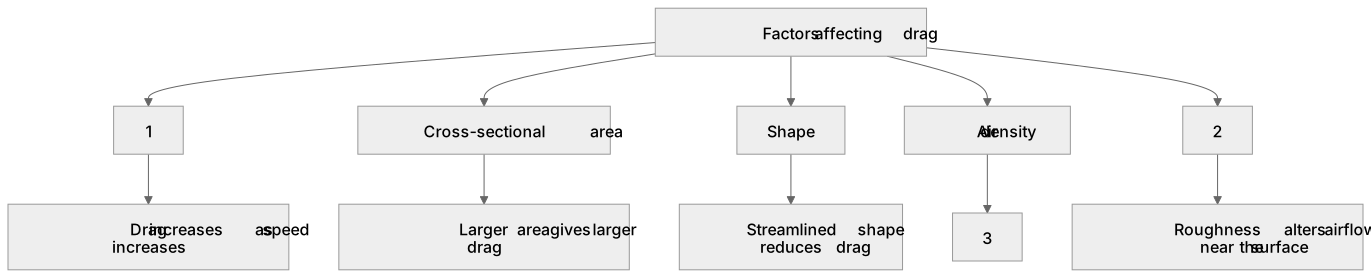
For an object moving through air, the size of the drag force depends on several factors. Speed is the most important: drag increases as speed increases, and at higher speeds drag grows roughly with the square of speed. The cross-sectional area of the object also matters, because a larger area pushes more air aside. The shape of the object affects how smoothly air flows around it, so a streamlined shape reduces drag compared with a blunt shape. The density of the air is another factor, since denser air provides more resistance. Surface roughness can also influence drag by changing the flow near the surface. In calculations you may be told which factors are held constant so that you can isolate the effect of one variable.
What earns the marks
- Drag on an object in air increases as the object's speed increases.
- A larger cross-sectional area produces a larger drag force.
- A streamlined shape reduces drag compared with a blunt or flat shape.
- Air density affects drag: denser air gives greater drag for the same object and speed.
- Surface roughness or texture can affect drag by altering the airflow near the surface.
Common mistakes and how to put them right
Assuming drag depends only on speed.
Put it right by recalling that area, shape and air density also matter.
Thinking a heavier object always has more drag.
Put it right by noting that drag depends on shape, area and speed, not directly on mass.
Believing a streamlined shape increases drag.
Put it right by stating that streamlining reduces drag by allowing smoother airflow.
Exam tips
- When comparing two objects, identify which factors are controlled and which are changed.
- Use the term 'cross-sectional area' rather than just 'size' for precision.
- Link shape to airflow: streamlined shapes allow air to flow smoothly, reducing drag.
Try the lesson
The start of the Dynamics: (b) factors affecting drag for an object travelling through air lesson, made from checked teaching notes for this specification point.
Listen
For an object moving through air, the size of the drag force depends on several factors. Speed is the most important: drag increases as speed increases, and at higher speeds drag grows roughly with the square of speed. The cross-sectional area of the object also matters, because a larger area pushes more air aside. The shape of the object affects how smoothly air flows around it, so a streamlined shape reduces drag compared with a blunt shape. The density of the air is another factor, since denser air provides more resistance. Surface roughness can also influence drag by changing the flow near the surface. In calculations you may be told which factors are held constant so that you can isolate the effect of one variable. A strong answer earns marks for these points. Drag on an object in air increases as the object's speed increases. A larger cross-sectional area produces a larger drag force. A streamlined shape reduces drag compared with a blunt or flat shape. Air density affects drag: denser air gives greater drag for the same object and speed. A common slip: Assuming drag depends only on speed. Instead, recalling that area, shape and air density also matter. Exam tip: When comparing two objects, identify which factors are controlled and which are changed.
See it

Key words
Say what each word means before you turn the card.
Drag in gases
Try answering aloud or in your head before turning the card.
Streamlining and shape
Try answering aloud or in your head before turning the card.
Variables and control
Try answering aloud or in your head before turning the card.
See every definition
- Drag in gases
- The drag force on an object moving through air depends on several factors, including speed, cross-sectional area, shape, air density and surface roughness.
- Streamlining and shape
- A streamlined shape reduces drag compared with a blunt shape because it affects how smoothly air flows around the object.
- Variables and control
- In calculations you may be told which factors are held constant so that you can isolate the effect of one variable.
Label the diagram
Some boxes have lost their names. Pick the right name for each number.
1Box 1
2Box 2
3Box 3
There is more to this lesson
The full lesson goes on to check your understanding and help you earn the marks. Create a free account to carry on, with your progress saved.
A week of Premium from your first lesson · Then the free plan continues · No card, no charge
Test your understanding of Dynamics: (b) factors affecting drag for an object travelling through air
Active recall beats re-reading. Take an instant quiz now to test what you’ve learned and lock it into long-term memory.
A week of Premium from your first lesson · Then the free plan continues · No card, no charge