OCR · A-Level · Physics
Course version: H556 · Version from Sept 2015
(a) drag as the frictional force experienced by an object travelling…
Full specification wording
Dynamics: (a) drag as the frictional force experienced by an object travelling through a fluid
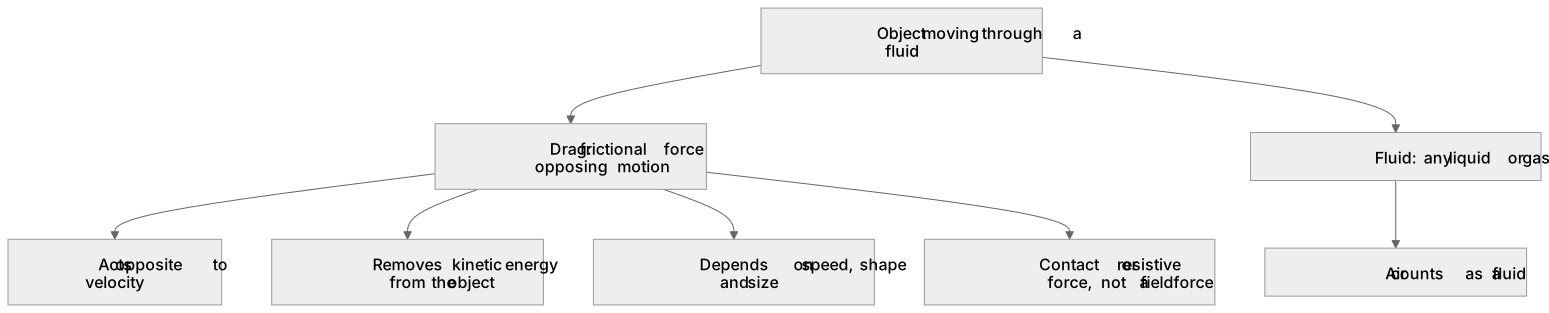
Drag is a contact force that opposes the motion of an object through a fluid, where a fluid is any liquid or gas.
Checked against the OCR H556 specification (opens in a new tab) on .
- Point 7 of 10
- 2 key terms
Study notes
From the checked teaching notes for this specification point.
The idea
Drag is a contact force that opposes the motion of an object through a fluid, where a fluid is any liquid or gas. It acts along the line of motion but in the opposite direction to velocity, so it always removes kinetic energy from the object. Unlike solid friction, drag depends strongly on speed and on the shape and size of the object. For example, a skydiver falling at 50 m s⁻¹ experiences far greater drag than the same skydiver moving at 5 m s⁻¹. Drag arises because the object must push fluid aside and because fluid layers slide past one another, producing viscous forces. In this section you treat drag as a resistive force to be included in free-body diagrams and in Newton's second law calculations.
What earns the marks
- Drag is a force that opposes the motion of an object through a fluid.
- A fluid includes both liquids and gases, so air counts as a fluid.
- Drag acts in the direction opposite to the object's velocity.
- Drag is a contact or resistive force, not a field force such as weight.
- Drag magnitude depends on speed, shape and size of the object, unlike simple solid friction.
Common mistakes and how to put them right
Thinking drag only acts in liquids.
Put it right by noting that gases such as air are fluids, so a falling object in air experiences drag.
Treating drag as a constant force like weight.
Put it right by recognising that drag changes with speed and can vary during motion.
Drawing drag in the same direction as velocity.
Put it right by drawing the drag arrow opposing the velocity vector.
Exam tips
- Read the stem carefully to check whether the object is in a liquid or a gas; both are fluids.
- When a free-body diagram is required, draw the drag arrow clearly opposite to the velocity arrow.
- Use the phrase 'opposes motion' rather than 'slows down' to show precise physical language.
Try the lesson
The start of the Dynamics: (a) drag as the frictional force experienced by an object travelling through a fluid lesson, made from checked teaching notes for this specification point.
Listen
Drag is a contact force that opposes the motion of an object through a fluid, where a fluid is any liquid or gas. It acts along the line of motion but in the opposite direction to velocity, so it always removes kinetic energy from the object. Unlike solid friction, drag depends strongly on speed and on the shape and size of the object. For example, a skydiver falling at 50 m s⁻¹ experiences far greater drag than the same skydiver moving at 5 m s⁻¹. Drag arises because the object must push fluid aside and because fluid layers slide past one another, producing viscous forces. In this section you treat drag as a resistive force to be included in free-body diagrams and in Newton's second law calculations. A strong answer earns marks for these points. Drag is a force that opposes the motion of an object through a fluid. A fluid includes both liquids and gases, so air counts as a fluid. Drag acts in the direction opposite to the object's velocity. Drag is a contact or resistive force, not a field force such as weight. A common slip: Thinking drag only acts in liquids. Instead, noting that gases such as air are fluids, so a falling object in air experiences drag. Exam tip: Read the stem carefully to check whether the object is in a liquid or a gas; both are fluids.
See it
Key words
Say what each word means before you turn the card.
Drag
Try answering aloud or in your head before turning the card.
Fluid
Try answering aloud or in your head before turning the card.
See every definition
- Drag
- The frictional force experienced by an object travelling through a fluid.
- Fluid
- Any liquid or gas, so air counts as a fluid.
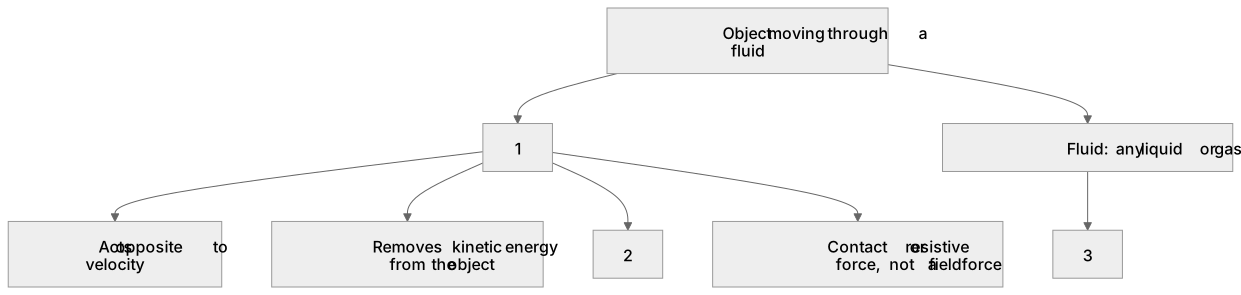
Label the diagram
Some boxes have lost their names. Pick the right name for each number.
1Box 1
2Box 2
3Box 3
There is more to this lesson
The full lesson goes on to check your understanding and help you earn the marks. Create a free account to carry on, with your progress saved.
A week of Premium from your first lesson · Then the free plan continues · No card, no charge
Test your understanding of Dynamics: (a) drag as the frictional force experienced by an object travelling through a fluid
Active recall beats re-reading. Take an instant quiz now to test what you’ve learned and lock it into long-term memory.
A week of Premium from your first lesson · Then the free plan continues · No card, no charge