OCR · A-Level · Physics
Course version: H556 · Version from Sept 2015
Nuclear fission and fusion: (absorption) coefficient
The attenuation (absorption) coefficient μ quantifies how strongly a material removes X-ray photons from a beam per unit thickness.
Checked against the OCR H556 specification (opens in a new tab) on .
- Point 16 of 18
Study notes
From the checked teaching notes for this specification point.
The idea
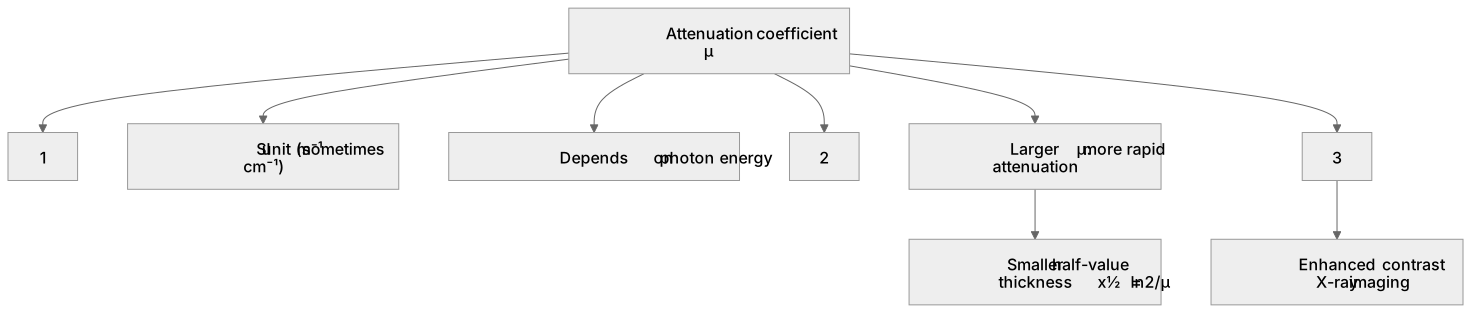
The attenuation (absorption) coefficient μ quantifies how strongly a material removes X-ray photons from a beam per unit thickness. It appears in I = I₀e^(−μx) and has SI unit m⁻¹, though cm⁻¹ is sometimes used. Its value depends on the photon energy and on the absorber's atomic number and density, because the underlying mechanisms (photoelectric absorption, Compton scattering, pair production) each vary differently with energy and Z. A larger μ means the beam is attenuated more rapidly, giving a smaller half-value thickness x½ = ln2/μ. In medical imaging, high-Z contrast media raise μ locally so those regions appear more strongly attenuating.
What earns the marks
- μ is the attenuation (absorption) coefficient in I = I₀e^(−μx), representing the probability of photon removal per unit thickness.
- The SI unit of μ is m⁻¹ (sometimes quoted in cm⁻¹), and it must be consistent with the thickness units used.
- μ depends on photon energy and on the atomic number and density of the absorber.
- A larger μ corresponds to more rapid attenuation and a smaller half-value thickness x½ = ln2/μ.
- High-Z contrast media increase μ locally, enhancing contrast in X-ray imaging.
- μ is not a fixed constant for a material; it changes with the X-ray photon energy.
Common mistakes and how to put them right
Treating μ as a constant for a given material regardless of photon energy.
Put it right: μ varies with photon energy as well as with Z and density.
Using inconsistent units for μ and x.
Put it right: If x is in metres, μ must be in m⁻¹, so convert cm⁻¹ values before substituting.
Confusing μ with half-value thickness.
Put it right: x½ = ln2/μ, so a larger μ gives a smaller x½.
Assuming μ is the same for all materials of equal thickness.
Put it right: μ depends on atomic number and density, so different materials attenuate differently.
Exam tips
- Always state the unit of μ and ensure it matches the thickness unit used in the calculation.
- When comparing materials, refer to differences in atomic number and density as well as photon energy.
- Link μ to half-value thickness using x½ = ln2/μ to show understanding of the relationship.
- Use contrast media (high-Z elements such as iodine or barium) as a concrete example of locally increased μ.
Try the lesson
The start of the Nuclear fission and fusion: (absorption) coefficient lesson, made from checked teaching notes for this specification point.
Listen
The attenuation (absorption) coefficient μ quantifies how strongly a material removes X-ray photons from a beam per unit thickness. It appears in I = I₀e^(−μx) and has SI unit m⁻¹, though cm⁻¹ is sometimes used. Its value depends on the photon energy and on the absorber's atomic number and density, because the underlying mechanisms (photoelectric absorption, Compton scattering, pair production) each vary differently with energy and Z. A larger μ means the beam is attenuated more rapidly, giving a smaller half-value thickness x½ = ln2/μ. In medical imaging, high-Z contrast media raise μ locally so those regions appear more strongly attenuating. A strong answer earns marks for these points. μ is the attenuation (absorption) coefficient in I = I₀e^(−μx), representing the probability of photon removal per unit thickness. The SI unit of μ is m⁻¹ (sometimes quoted in cm⁻¹), and it must be consistent with the thickness units used. μ depends on photon energy and on the atomic number and density of the absorber. A larger μ corresponds to more rapid attenuation and a smaller half-value thickness x½ = ln2/μ. A common slip: Treating μ as a constant for a given material regardless of photon energy. Instead, μ varies with photon energy as well as with Z and density. Exam tip: Always state the unit of μ and ensure it matches the thickness unit used in the calculation.
See it

Label the diagram
Some boxes have lost their names. Pick the right name for each number.
1Box 1
2Box 2
3Box 3
There is more to this lesson
The full lesson goes on to check your understanding and help you earn the marks. Create a free account to carry on, with your progress saved.
A week of Premium from your first lesson · Then the free plan continues · No card, no charge
Test your understanding of Nuclear fission and fusion: (absorption) coefficient
Active recall beats re-reading. Take an instant quiz now to test what you’ve learned and lock it into long-term memory.
A week of Premium from your first lesson · Then the free plan continues · No card, no charge