OCR · A-Level · Physics
Course version: H556 · Version from Sept 2015
(e) X-ray imaging with contrast media; barium and iodine
Full specification wording
Nuclear fission and fusion: (e) X-ray imaging with contrast media; barium and iodine
X-ray imaging relies on differential absorption: dense tissue such as bone absorbs more X-rays than soft tissue, so it casts a clearer shadow on the detector.
Checked against the OCR H556 specification (opens in a new tab) on .
- Point 17 of 18
- 4 key terms
Study notes
From the checked teaching notes for this specification point.
The idea
X-ray imaging relies on differential absorption: dense tissue such as bone absorbs more X-rays than soft tissue, so it casts a clearer shadow on the detector. Soft organs such as the gut or blood vessels absorb X-rays only weakly, so they produce little contrast. A contrast medium is a substance introduced into the body to increase absorption in the region of interest. Barium, usually swallowed as a suspension of barium sulfate, is used for the gastrointestinal tract because it is dense and effectively insoluble, so it coats the lining and outlines it. Iodine compounds, injected or infused into the bloodstream, are used for the urinary tract and blood vessels because iodine has a high atomic number and absorbs X-rays strongly. The medium must be safe, and its high attenuation relative to surrounding tissue is what makes the structure visible.
What earns the marks
- Contrast media increase the attenuation of X-rays in the region of interest so that soft tissue structures become visible.
- Barium is used for imaging the gastrointestinal tract, typically swallowed as a suspension of barium sulfate.
- Iodine compounds are used for imaging blood vessels and the urinary tract, usually introduced into the bloodstream.
- The medium must be safe for the patient, which is why barium is used as the insoluble sulfate rather than a soluble barium salt.
Common mistakes and how to put them right
Thinking contrast media emit X-rays.
Put it right: They do not; they absorb X-rays more strongly than surrounding tissue, increasing contrast.
Believing barium is used for blood vessels.
Put it right: Barium is used for the gastrointestinal tract, while iodine compounds are used for blood vessels and the urinary tract.
Assuming any barium compound is safe.
Put it right: Soluble barium salts are toxic, so barium sulfate, which is effectively insoluble, is used.
Confusing contrast media with radioactive tracers.
Put it right: Contrast media are not radioactive; they work by differential X-ray absorption.
Exam tips
- Link each medium to the body region it images: barium to the gut, iodine to blood vessels and the urinary tract.
- Explain contrast in terms of attenuation: the medium absorbs more X-rays than soft tissue, so the shadow it casts is clearer.
- If asked why barium sulfate is used, state that it is insoluble and therefore not absorbed as toxic barium ions.
Try the lesson
The start of the Nuclear fission and fusion: (e) X-ray imaging with contrast media; barium and iodine lesson, made from checked teaching notes for this specification point.
Listen
X-ray imaging relies on differential absorption: dense tissue such as bone absorbs more X-rays than soft tissue, so it casts a clearer shadow on the detector. Soft organs such as the gut or blood vessels absorb X-rays only weakly, so they produce little contrast. A contrast medium is a substance introduced into the body to increase absorption in the region of interest. Barium, usually swallowed as a suspension of barium sulfate, is used for the gastrointestinal tract because it is dense and effectively insoluble, so it coats the lining and outlines it. Iodine compounds, injected or infused into the bloodstream, are used for the urinary tract and blood vessels because iodine has a high atomic number and absorbs X-rays strongly. The medium must be safe, and its high attenuation relative to surrounding tissue is what makes the structure visible. A strong answer earns marks for these points. Contrast media increase the attenuation of X-rays in the region of interest so that soft tissue structures become visible. Barium is used for imaging the gastrointestinal tract, typically swallowed as a suspension of barium sulfate. Iodine compounds are used for imaging blood vessels and the urinary tract, usually introduced into the bloodstream. The medium must be safe for the patient, which is why barium is used as the insoluble sulfate rather than a soluble barium salt. Exam tip: Link each medium to the body region it images: barium to the gut, iodine to blood vessels and the urinary tract.
See it
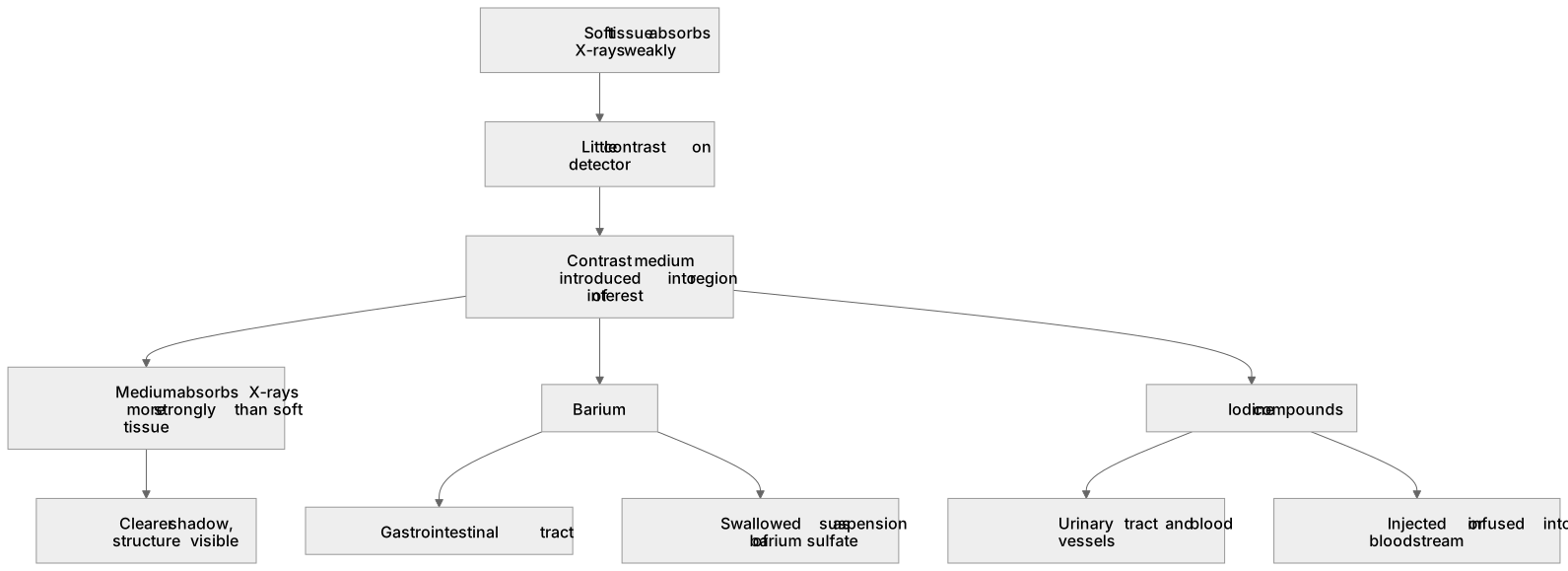
Key words
Say what each word means before you turn the card.
Differential absorption
Try answering aloud or in your head before turning the card.
Contrast medium
Try answering aloud or in your head before turning the card.
Barium
Try answering aloud or in your head before turning the card.
Iodine compounds
Try answering aloud or in your head before turning the card.
See every definition
- Differential absorption
- Dense tissue such as bone absorbs more X-rays than soft tissue, so it casts a clearer shadow on the detector.
- Contrast medium
- A substance introduced into the body to increase absorption in the region of interest.
- Barium
- Usually swallowed as a suspension of barium sulfate, it is used for the gastrointestinal tract because it is dense and effectively insoluble, so it coats the lining and outlines it.
- Iodine compounds
- Injected or infused into the bloodstream, these are used for the urinary tract and blood vessels because iodine has a high atomic number and absorbs X-rays strongly.
Label the diagram
Some boxes have lost their names. Pick the right name for each number.
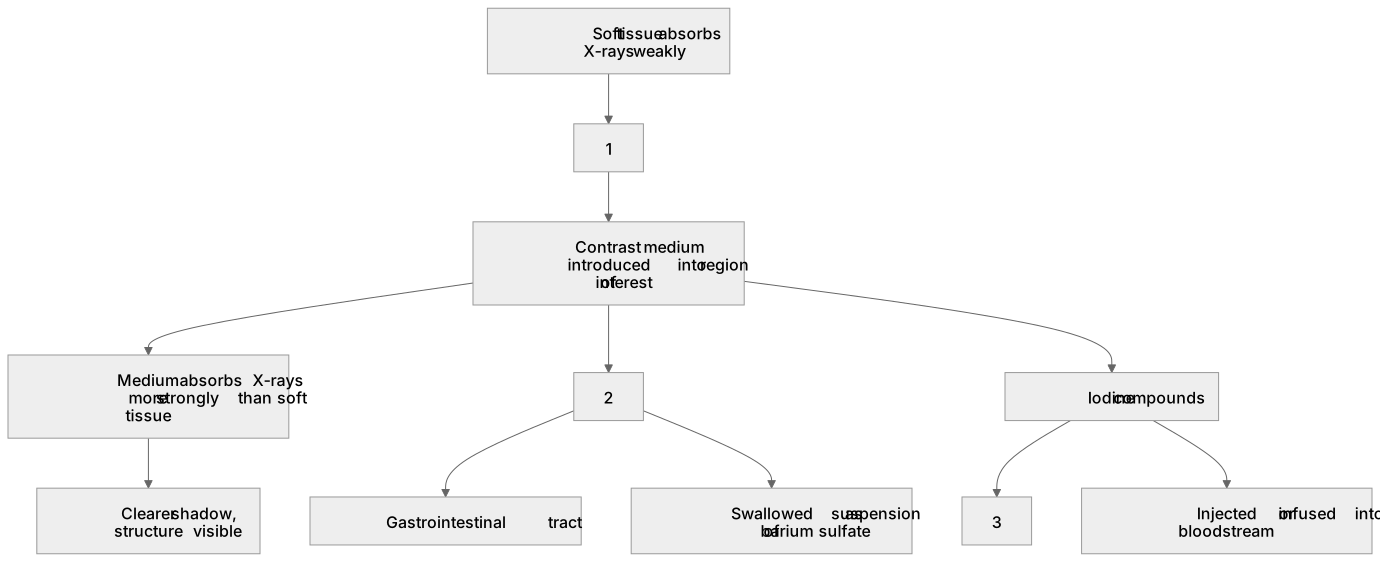
1Box 1
2Box 2
3Box 3
There is more to this lesson
The full lesson goes on to check your understanding and help you earn the marks. Create a free account to carry on, with your progress saved.
A week of Premium from your first lesson · Then the free plan continues · No card, no charge
Test your understanding of Nuclear fission and fusion: (e) X-ray imaging with contrast media; barium and iodine
Active recall beats re-reading. Take an instant quiz now to test what you’ve learned and lock it into long-term memory.
A week of Premium from your first lesson · Then the free plan continues · No card, no charge