OCR · A-Level · Physics
Course version: H556 · Version from Sept 2015
(h) use of a signal generator and oscilloscope, including volts/division…
Full specification wording
Practical skills: (h) use of a signal generator and oscilloscope, including volts/division and time-base
A signal generator produces an alternating voltage whose frequency and amplitude you can set.
Checked against the OCR H556 specification (opens in a new tab) on .
- Point 7 of 11
- 4 key terms
Study notes
From the checked teaching notes for this specification point.
The idea
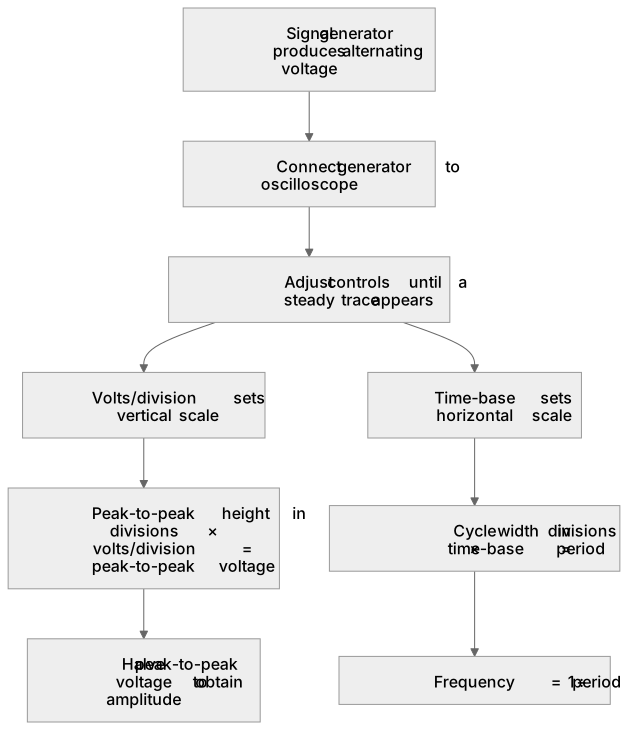
A signal generator produces an alternating voltage whose frequency and amplitude you can set. An oscilloscope displays that voltage against time. The volts/division control sets the vertical scale, so the peak-to-peak height in divisions multiplied by the volts/division gives the peak-to-peak voltage. The time-base sets the horizontal scale, so the horizontal width of one cycle in divisions multiplied by the time-base gives the period, and frequency is the reciprocal of the period. To use the instruments, connect the generator to the oscilloscope, adjust the controls until a steady trace appears, then read the scales.
What earns the marks
- Read the vertical scale using volts/division and convert a trace height in divisions into a voltage.
- Read the horizontal scale using the time-base and convert a cycle width in divisions into a period.
- Calculate frequency as the reciprocal of the period measured from the trace.
- Distinguish amplitude from peak-to-peak voltage when interpreting an oscilloscope trace.
- Select the correct control, volts/division or time-base, to change a stated feature of the display.
Common mistakes and how to put them right
Multiplying the full peak-to-peak height by volts/division and calling it the amplitude.
Put it right: Halve the peak-to-peak voltage to obtain the amplitude.
Using the time-base value as the period without counting the divisions for one cycle.
Put it right: Multiply the number of divisions per cycle by the time-base setting.
Forgetting to take the reciprocal when converting period to frequency.
Put it right: Calculate frequency as 1 divided by the period.
Exam tips
- Write down the volts/division and time-base settings before reading any values from the trace.
- Count divisions carefully for one complete cycle, and check whether the question asks for amplitude or peak-to-peak voltage.
- Keep units consistent, converting milliseconds to seconds before calculating frequency.
Try the lesson
The start of the Practical skills: (h) use of a signal generator and oscilloscope, including volts/division and time-base lesson, made from checked teaching notes for this specification point.
Listen
A signal generator produces an alternating voltage whose frequency and amplitude you can set. An oscilloscope displays that voltage against time. The volts/division control sets the vertical scale, so the peak-to-peak height in divisions multiplied by the volts/division gives the peak-to-peak voltage. The time-base sets the horizontal scale, so the horizontal width of one cycle in divisions multiplied by the time-base gives the period, and frequency is the reciprocal of the period. To use the instruments, connect the generator to the oscilloscope, adjust the controls until a steady trace appears, then read the scales. A strong answer earns marks for these points. Read the vertical scale using volts/division and convert a trace height in divisions into a voltage. Read the horizontal scale using the time-base and convert a cycle width in divisions into a period. Calculate frequency as the reciprocal of the period measured from the trace. Distinguish amplitude from peak-to-peak voltage when interpreting an oscilloscope trace. A common slip: Multiplying the full peak-to-peak height by volts/division and calling it the amplitude. Instead, halve the peak-to-peak voltage to obtain the amplitude. Exam tip: Write down the volts/division and time-base settings before reading any values from the trace.
See it
Key words
Say what each word means before you turn the card.
Volts/division
Try answering aloud or in your head before turning the card.
Time-base
Try answering aloud or in your head before turning the card.
Frequency
Try answering aloud or in your head before turning the card.
Amplitude
Try answering aloud or in your head before turning the card.
See every definition
- Volts/division
- The control that sets the vertical scale, so the peak-to-peak height in divisions multiplied by the volts/division gives the peak-to-peak voltage.
- Time-base
- The control that sets the horizontal scale, so the horizontal width of one cycle in divisions multiplied by the time-base gives the period.
- Frequency
- The reciprocal of the period measured from the trace.
- Amplitude
- Obtained by halving the peak-to-peak voltage, which must be distinguished from peak-to-peak voltage when interpreting an oscilloscope trace.
Label the diagram
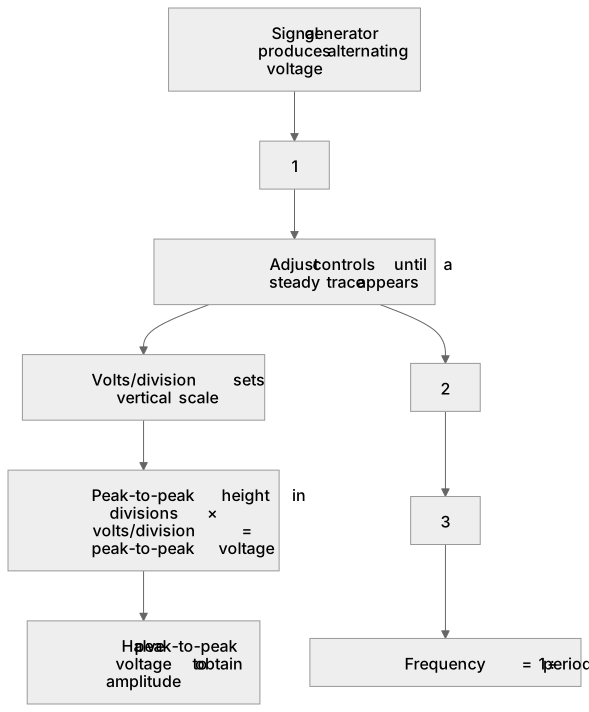
Some boxes have lost their names. Pick the right name for each number.
1Box 1
2Box 2
3Box 3
There is more to this lesson
The full lesson goes on to check your understanding and help you earn the marks. Create a free account to carry on, with your progress saved.
A week of Premium from your first lesson · Then the free plan continues · No card, no charge
Test your understanding of Practical skills: (h) use of a signal generator and oscilloscope, including volts/division and time-base
Active recall beats re-reading. Take an instant quiz now to test what you’ve learned and lock it into long-term memory.
A week of Premium from your first lesson · Then the free plan continues · No card, no charge