OCR · A-Level · Physics
Course version: H556 · Version from Sept 2015
(i) generating and measuring waves, using microphone and loudspeaker, or…
Full specification wording
Practical skills: (i) generating and measuring waves, using microphone and loudspeaker, or ripple tank, or vibration transducer, or microwave/radio wave source
This skill is about producing waves with a suitable source and measuring their properties.
Checked against the OCR H556 specification (opens in a new tab) on .
- Point 8 of 11
- 3 key terms
Study notes
From the checked teaching notes for this specification point.
The idea
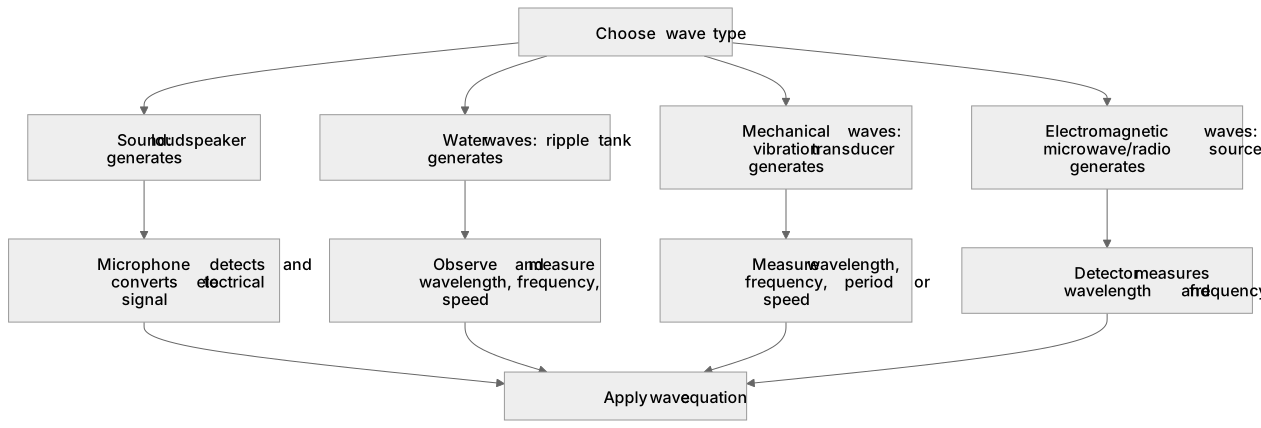
This skill is about producing waves with a suitable source and measuring their properties. A loudspeaker driven by a signal generator generates sound, which a microphone detects and converts to an electrical signal for display or measurement. A ripple tank generates water waves whose wavelength, frequency and speed can be observed and measured. A vibration transducer generates mechanical vibrations, for example on a string or a rod. A microwave or radio wave source generates electromagnetic waves that can be detected and used to measure wavelength and frequency. In each case you control the source, measure quantities such as wavelength, frequency, period or speed, and relate them using the wave equation.
What earns the marks
- Match a wave type to a suitable source, such as loudspeaker for sound, ripple tank for water waves, vibration transducer for mechanical waves, or microwave/radio source for electromagnetic waves.
- Describe how a detector, such as a microphone, is used to convert a wave into a measurable signal.
- Measure wavelength, frequency, period or speed using an appropriate method for the chosen source.
- Apply the wave equation relating speed, frequency and wavelength to measurements taken.
- Explain how changing a source setting, such as generator frequency, affects the generated wave.
Common mistakes and how to put them right
Using a microphone to generate sound rather than detect it.
Put it right: Use a loudspeaker or similar source to generate the sound and a microphone to detect it.
Measuring the distance between a node and an adjacent node and calling it the wavelength.
Put it right: Measure across a full repeating pattern, since adjacent nodes are half a wavelength apart.
Mixing up frequency and period when substituting into the wave equation.
Put it right: Use frequency in hertz and check the units before calculating.
Exam tips
- Identify the wave type first, then choose the source and detector that suit it.
- State the quantity being measured and the instrument or method used, including how the scale is read.
- Check units and use the wave equation with frequency in hertz and wavelength in metres.
Try the lesson
The start of the Practical skills: (i) generating and measuring waves, using microphone and loudspeaker, or ripple tank, or vibration transducer, or microwave/radio wave source lesson, made from checked teaching notes for this specification point.
Listen
This skill is about producing waves with a suitable source and measuring their properties. A loudspeaker driven by a signal generator generates sound, which a microphone detects and converts to an electrical signal for display or measurement. A ripple tank generates water waves whose wavelength, frequency and speed can be observed and measured. A vibration transducer generates mechanical vibrations, for example on a string or a rod. A microwave or radio wave source generates electromagnetic waves that can be detected and used to measure wavelength and frequency. In each case you control the source, measure quantities such as wavelength, frequency, period or speed, and relate them using the wave equation. A strong answer earns marks for these points. Match a wave type to a suitable source, such as loudspeaker for sound, ripple tank for water waves, vibration transducer for mechanical waves, or microwave/radio source for electromagnetic waves. Describe how a detector, such as a microphone, is used to convert a wave into a measurable signal. Measure wavelength, frequency, period or speed using an appropriate method for the chosen source. Apply the wave equation relating speed, frequency and wavelength to measurements taken. A common slip: Using a microphone to generate sound rather than detect it. Instead, use a loudspeaker or similar source to generate the sound and a microphone to detect it. Exam tip: Identify the wave type first, then choose the source and detector that suit it.
See it
Key words
Say what each word means before you turn the card.
Detection and conversion of waves to measurable signals
Try answering aloud or in your head before turning the card.
Measurement of wavelength, frequency, period and speed
Try answering aloud or in your head before turning the card.
The wave equation linking speed, frequency and wavelength
Try answering aloud or in your head before turning the card.
See every definition
- Detection and conversion of waves to measurable signals
- A microphone detects sound and converts it to an electrical signal for display or measurement.
- Measurement of wavelength, frequency, period and speed
- Quantities such as wavelength, frequency, period or speed are measured using an appropriate method for the chosen source.
- The wave equation linking speed, frequency and wavelength
- Measured wave quantities are related using the wave equation, with frequency in hertz and wavelength in metres.
Label the diagram
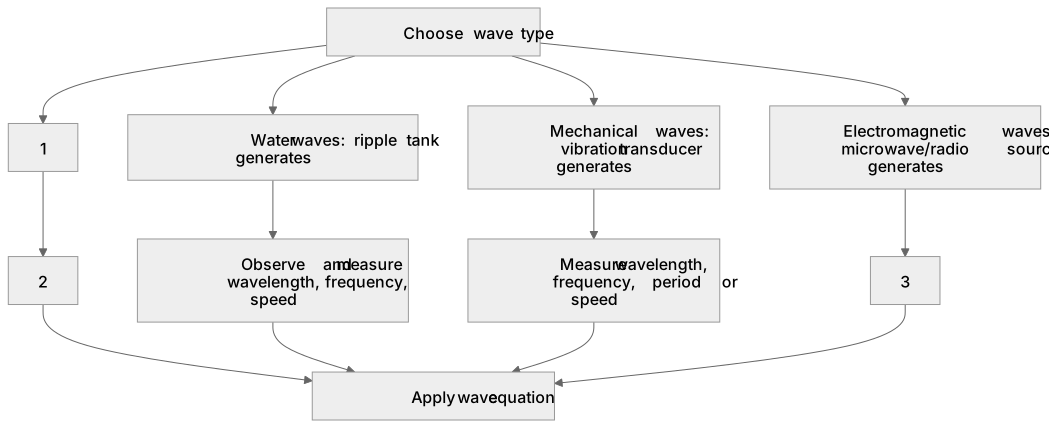
Some boxes have lost their names. Pick the right name for each number.
1Box 1
2Box 2
3Box 3
There is more to this lesson
The full lesson goes on to check your understanding and help you earn the marks. Create a free account to carry on, with your progress saved.
A week of Premium from your first lesson · Then the free plan continues · No card, no charge
Test your understanding of Practical skills: (i) generating and measuring waves, using microphone and loudspeaker, or ripple tank, or vibration transducer, or microwave/radio wave source
Active recall beats re-reading. Take an instant quiz now to test what you’ve learned and lock it into long-term memory.
A week of Premium from your first lesson · Then the free plan continues · No card, no charge