OCR · A-Level · Physics
Course version: H556 · Version from Sept 2015
(j) use of a laser or light source to investigate characteristics of…
Full specification wording
Practical skills: (j) use of a laser or light source to investigate characteristics of light, including interference and diffraction
This practical skill requires you to set up a laser or other light source and use it to investigate the wave characteristics of light, specifically interference and diffraction.
Checked against the OCR H556 specification (opens in a new tab) on .
- Point 9 of 11
- 4 key terms
Study notes
From the checked teaching notes for this specification point.
The idea
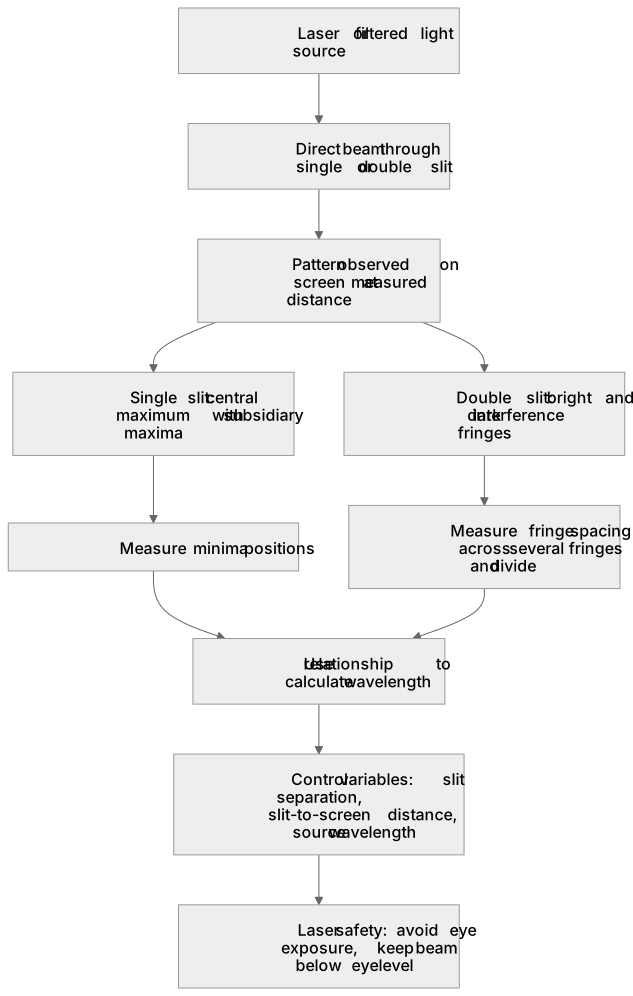
This practical skill requires you to set up a laser or other light source and use it to investigate the wave characteristics of light, specifically interference and diffraction. A typical method uses a laser directed at a single slit to produce a diffraction pattern, or at a double slit to produce interference fringes, with the pattern observed on a screen at a measured distance. You measure fringe spacing or minima positions and use the appropriate relationship, such as λ = ax/D for double-slit interference, to determine wavelength. You must control variables: slit separation, slit-to-screen distance and source wavelength. Safety matters: laser light must never be directed towards eyes, and beams should be kept below eye level.
What earns the marks
- Selects a monochromatic laser or filtered light source and directs the beam through a single or double slit onto a screen.
- Identifies and measures the relevant quantities, such as slit separation a, slit-to-screen distance D, and fringe spacing x or angular positions of minima.
- Uses the correct relationship, for example λ = ax/D for double-slit interference, or the diffraction grating equation d sin θ = nλ, to calculate wavelength.
- Describes the observed pattern: bright and dark fringes for interference, or a central maximum with subsidiary maxima for single-slit diffraction.
- Applies laser safety measures, such as avoiding direct eye exposure and keeping the beam path below eye level.
Common mistakes and how to put them right
Confusing interference with diffraction.
Put it right: Interference arises from superposition of waves from two or more coherent sources, while diffraction is the spreading of waves passing through an aperture or around an obstacle.
Measuring fringe spacing across a single fringe rather than across many fringes and dividing, which increases percentage uncertainty.
Put it right: Measure across several fringes and divide by the number of intervals.
Forgetting to convert measurements to SI units, for example using millimetres for slit separation without converting to metres, which gives an incorrect wavelength.
Exam tips
- Always state the safety precaution explicitly when describing a laser experiment, as this is a standard assessed point.
- Show the rearrangement of the equation before substituting values, so the examiner can award method marks even if the final answer is wrong.
- When describing the pattern, use precise terms such as 'central maximum' and 'first-order minimum' rather than vague descriptions.
Try the lesson
The start of the Practical skills: (j) use of a laser or light source to investigate characteristics of light, including interference and diffraction lesson, made from checked teaching notes for this specification point.
Listen
This practical skill requires you to set up a laser or other light source and use it to investigate the wave characteristics of light, specifically interference and diffraction. A typical method uses a laser directed at a single slit to produce a diffraction pattern, or at a double slit to produce interference fringes, with the pattern observed on a screen at a measured distance. You measure fringe spacing or minima positions and use the appropriate relationship, such as λ = ax/D for double-slit interference, to determine wavelength. You must control variables: slit separation, slit-to-screen distance and source wavelength. Safety matters: laser light must never be directed towards eyes, and beams should be kept below eye level. A strong answer earns marks for these points. Selects a monochromatic laser or filtered light source and directs the beam through a single or double slit onto a screen. Identifies and measures the relevant quantities, such as slit separation a, slit-to-screen distance D, and fringe spacing x or angular positions of minima. Uses the correct relationship, for example λ = ax/D for double-slit interference, or the diffraction grating equation d sin θ = nλ, to calculate wavelength. Describes the observed pattern: bright and dark fringes for interference, or a central maximum with subsidiary maxima for single-slit diffraction. A common slip: Measuring fringe spacing across a single fringe rather than across many fringes and dividing, which increases percentage uncertainty. Instead, measure across several fringes and divide by the number of intervals. Exam tip: Always state the safety precaution explicitly when describing a laser experiment, as this is a standard assessed point.
See it
Key words
Say what each word means before you turn the card.
Interference
Try answering aloud or in your head before turning the card.
Diffraction
Try answering aloud or in your head before turning the card.
Fringe spacing
Try answering aloud or in your head before turning the card.
Laser safety
Try answering aloud or in your head before turning the card.
See every definition
- Interference
- Arising from superposition of waves from two or more coherent sources, producing bright and dark fringes.
- Diffraction
- The spreading of waves passing through an aperture or around an obstacle, producing a central maximum with subsidiary maxima for a single slit.
- Fringe spacing
- A quantity measured across several fringes and divided by the number of intervals, used with slit separation and slit-to-screen distance in the relationship λ = ax/D.
- Laser safety
- Laser light must never be directed towards eyes, and beams should be kept below eye level.
Label the diagram
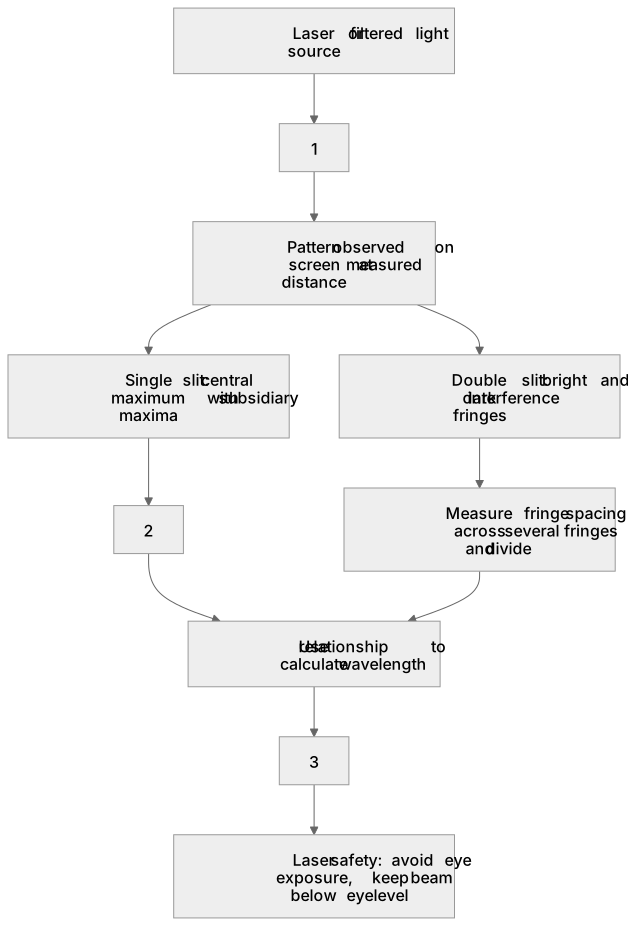
Some boxes have lost their names. Pick the right name for each number.
1Box 1
2Box 2
3Box 3
There is more to this lesson
The full lesson goes on to check your understanding and help you earn the marks. Create a free account to carry on, with your progress saved.
A week of Premium from your first lesson · Then the free plan continues · No card, no charge
Test your understanding of Practical skills: (j) use of a laser or light source to investigate characteristics of light, including interference and diffraction
Active recall beats re-reading. Take an instant quiz now to test what you’ve learned and lock it into long-term memory.
A week of Premium from your first lesson · Then the free plan continues · No card, no charge