OCR · A-Level · Physics
Course version: H556 · Version from Sept 2015
(a) ultrasound; longitudinal wave with frequency greater than 20 kHz
Full specification wording
Using ultrasound: (a) ultrasound; longitudinal wave with frequency greater than 20 kHz
Ultrasound is a longitudinal wave with a frequency above 20 kHz, the upper limit of normal human hearing.
Checked against the OCR H556 specification (opens in a new tab) on .
- Point 1 of 8
- 3 key terms
Study notes
From the checked teaching notes for this specification point.
The idea
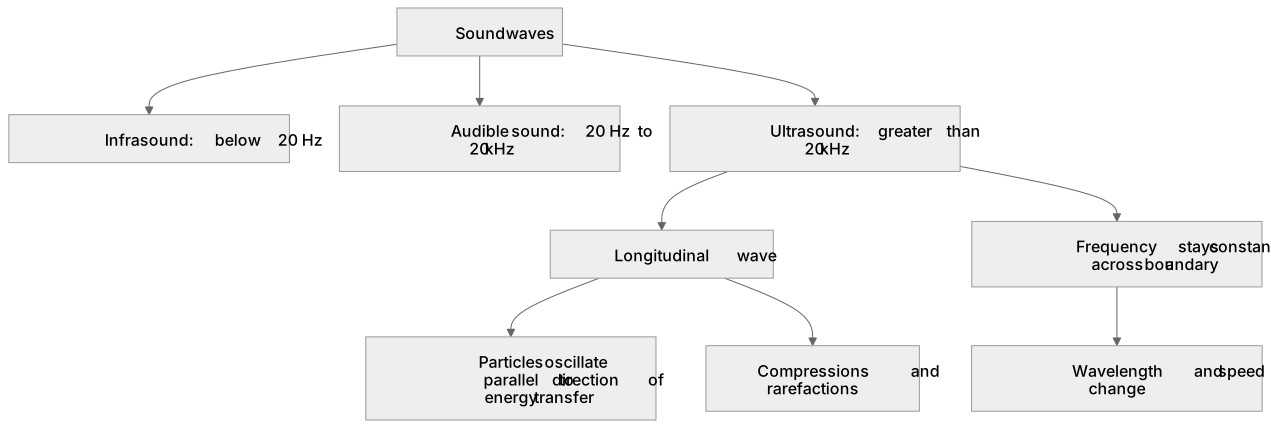
Ultrasound is a longitudinal wave with a frequency above 20 kHz, the upper limit of normal human hearing. In a longitudinal wave, particles oscillate parallel to the direction of energy transfer, producing compressions and rarefactions. For example, a 2.5 MHz ultrasound pulse used in medical imaging has a frequency of 2.5 × 10⁶ Hz, far above 20 kHz. The wave travels through a medium at a speed determined by the medium's properties, and its frequency remains constant when crossing boundaries, while wavelength changes.
What earns the marks
- Ultrasound is a longitudinal wave.
- Its frequency is greater than 20 kHz.
- In a longitudinal wave, particle oscillations are parallel to the direction of energy transfer.
- Audible sound for humans typically spans 20 Hz to 20 kHz, so ultrasound lies above this range.
- Frequency remains constant when a wave crosses a boundary; wavelength and speed may change.
Common mistakes and how to put them right
Describing ultrasound as a transverse wave.
Put it right by stating that ultrasound is longitudinal, with compressions and rarefactions.
Confusing the 20 kHz threshold with 20 Hz.
Put it right by remembering that ultrasound is above 20 kHz, while infrasound is below 20 Hz.
Thinking frequency changes when ultrasound enters a different medium.
Put it right by stating that frequency is set by the source and stays constant; speed and wavelength change.
Exam tips
- Underline the words 'longitudinal' and 'greater than 20 kHz' in the question before choosing an option.
- If a period is given, calculate f = 1/T and compare the result with 20 kHz.
- Eliminate options that describe ultrasound as electromagnetic or transverse.
Try the lesson
The start of the Using ultrasound: (a) ultrasound; longitudinal wave with frequency greater than 20 kHz lesson, made from checked teaching notes for this specification point.
Listen
Ultrasound is a longitudinal wave with a frequency above 20 kHz, the upper limit of normal human hearing. In a longitudinal wave, particles oscillate parallel to the direction of energy transfer, producing compressions and rarefactions. For example, a 2.5 MHz ultrasound pulse used in medical imaging has a frequency of 2.5 × 10⁶ Hz, far above 20 kHz. The wave travels through a medium at a speed determined by the medium's properties, and its frequency remains constant when crossing boundaries, while wavelength changes. A strong answer earns marks for these points. Ultrasound is a longitudinal wave. Its frequency is greater than 20 kHz. In a longitudinal wave, particle oscillations are parallel to the direction of energy transfer. Audible sound for humans typically spans 20 Hz to 20 kHz, so ultrasound lies above this range. A common slip: Describing ultrasound as a transverse wave. Instead, stating that ultrasound is longitudinal, with compressions and rarefactions. Exam tip: Underline the words 'longitudinal' and 'greater than 20 kHz' in the question before choosing an option.
See it
Key words
Say what each word means before you turn the card.
Ultrasound
Try answering aloud or in your head before turning the card.
Longitudinal wave
Try answering aloud or in your head before turning the card.
Audible sound
Try answering aloud or in your head before turning the card.
See every definition
- Ultrasound
- A longitudinal wave with a frequency greater than 20 kHz, the upper limit of normal human hearing.
- Longitudinal wave
- A wave in which particles oscillate parallel to the direction of energy transfer, producing compressions and rarefactions.
- Audible sound
- Sound for humans that typically spans 20 Hz to 20 kHz, so ultrasound lies above this range.
Label the diagram
Some boxes have lost their names. Pick the right name for each number.
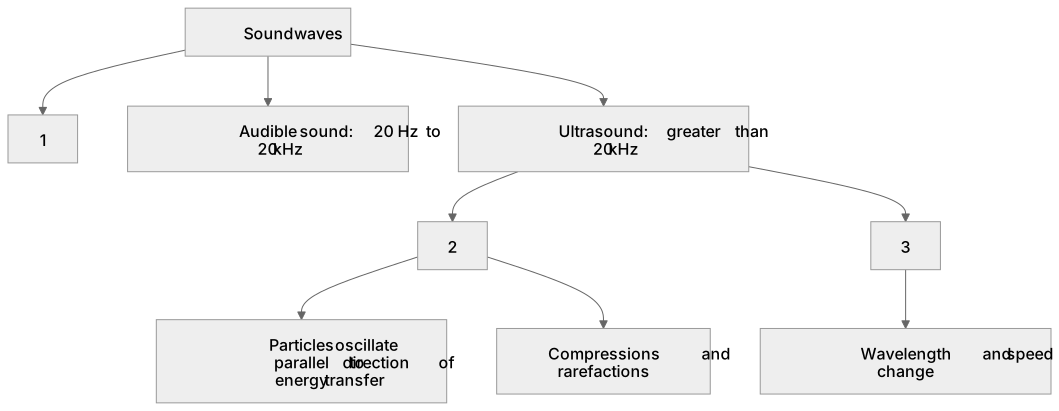
1Box 1
2Box 2
3Box 3
There is more to this lesson
The full lesson goes on to check your understanding and help you earn the marks. Create a free account to carry on, with your progress saved.
A week of Premium from your first lesson · Then the free plan continues · No card, no charge
Test your understanding of Using ultrasound: (a) ultrasound; longitudinal wave with frequency greater than 20 kHz
Active recall beats re-reading. Take an instant quiz now to test what you’ve learned and lock it into long-term memory.
A week of Premium from your first lesson · Then the free plan continues · No card, no charge