OCR · A-Level · Physics
Course version: H556 · Version from Sept 2015
(b) piezoelectric effect; ultrasound transducer as a device that emits and…
Full specification wording
Using ultrasound: (b) piezoelectric effect; ultrasound transducer as a device that emits and receives ultrasound
The piezoelectric effect is the production of a potential difference across certain crystals when they are mechanically deformed, and the reverse effect where an applied potential difference…
Checked against the OCR H556 specification (opens in a new tab) on .
- Point 2 of 8
- 4 key terms
Study notes
From the checked teaching notes for this specification point.
The idea
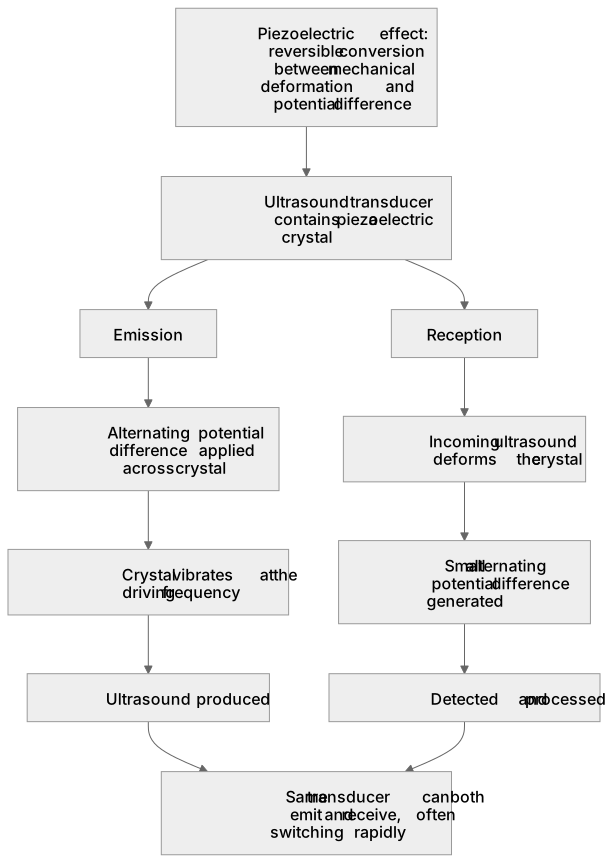
The piezoelectric effect is the production of a potential difference across certain crystals when they are mechanically deformed, and the reverse effect where an applied potential difference causes the crystal to change shape. An ultrasound transducer uses a piezoelectric crystal, such as quartz or lead zirconate titanate, to emit and receive ultrasound. In emission, an alternating potential difference is applied across the crystal, causing it to vibrate at the driving frequency and produce ultrasound. In reception, incoming ultrasound waves deform the crystal, generating a small alternating potential difference that can be detected and processed. Remember that the same transducer can perform both functions, often switching rapidly between them.
What earns the marks
- The piezoelectric effect involves converting between mechanical deformation and potential difference in a crystal.
- An ultrasound transducer contains a piezoelectric crystal.
- In emission, an alternating potential difference is applied, causing the crystal to vibrate and produce ultrasound.
- In reception, incident ultrasound deforms the crystal, producing a potential difference.
- The same transducer can both emit and receive ultrasound.
Common mistakes and how to put them right
Stating that the piezoelectric effect only converts sound to electricity.
Put it right by explaining that it is reversible and can convert electrical energy to mechanical vibration and vice versa.
Believing that the transducer only emits or only receives.
Put it right by noting that a single transducer can do both, often alternating roles.
Confusing the piezoelectric effect with the photoelectric effect.
Put it right by linking piezoelectricity to mechanical stress and crystal deformation, not to light.
Exam tips
- Link each stage to the correct energy transfer: electrical to mechanical for emission, mechanical to electrical for reception.
- Use the phrase 'alternating potential difference' when describing emission.
- Check whether the question asks about emission, reception, or both before selecting an option.
Try the lesson
The start of the Using ultrasound: (b) piezoelectric effect; ultrasound transducer as a device that emits and receives ultrasound lesson, made from checked teaching notes for this specification point.
Listen
The piezoelectric effect is the production of a potential difference across certain crystals when they are mechanically deformed, and the reverse effect where an applied potential difference causes the crystal to change shape. An ultrasound transducer uses a piezoelectric crystal, such as quartz or lead zirconate titanate, to emit and receive ultrasound. In emission, an alternating potential difference is applied across the crystal, causing it to vibrate at the driving frequency and produce ultrasound. In reception, incoming ultrasound waves deform the crystal, generating a small alternating potential difference that can be detected and processed. Remember that the same transducer can perform both functions, often switching rapidly between them. A strong answer earns marks for these points. The piezoelectric effect involves converting between mechanical deformation and potential difference in a crystal. An ultrasound transducer contains a piezoelectric crystal. In emission, an alternating potential difference is applied, causing the crystal to vibrate and produce ultrasound. In reception, incident ultrasound deforms the crystal, producing a potential difference. A common slip: Stating that the piezoelectric effect only converts sound to electricity. Instead, explaining that it is reversible and can convert electrical energy to mechanical vibration and vice versa. Exam tip: Link each stage to the correct energy transfer: electrical to mechanical for emission, mechanical to electrical for reception.
See it
Key words
Say what each word means before you turn the card.
Piezoelectric effect
Try answering aloud or in your head before turning the card.
Ultrasound transducer
Try answering aloud or in your head before turning the card.
Emission
Try answering aloud or in your head before turning the card.
Reception
Try answering aloud or in your head before turning the card.
See every definition
- Piezoelectric effect
- The production of a potential difference across certain crystals when they are mechanically deformed, and the reverse effect where an applied potential difference causes the crystal to change shape.
- Ultrasound transducer
- A device that emits and receives ultrasound, containing a piezoelectric crystal such as quartz or lead zirconate titanate.
- Emission
- An alternating potential difference is applied across the crystal, causing it to vibrate at the driving frequency and produce ultrasound.
- Reception
- Incoming ultrasound waves deform the crystal, generating a small alternating potential difference that can be detected and processed.
Label the diagram
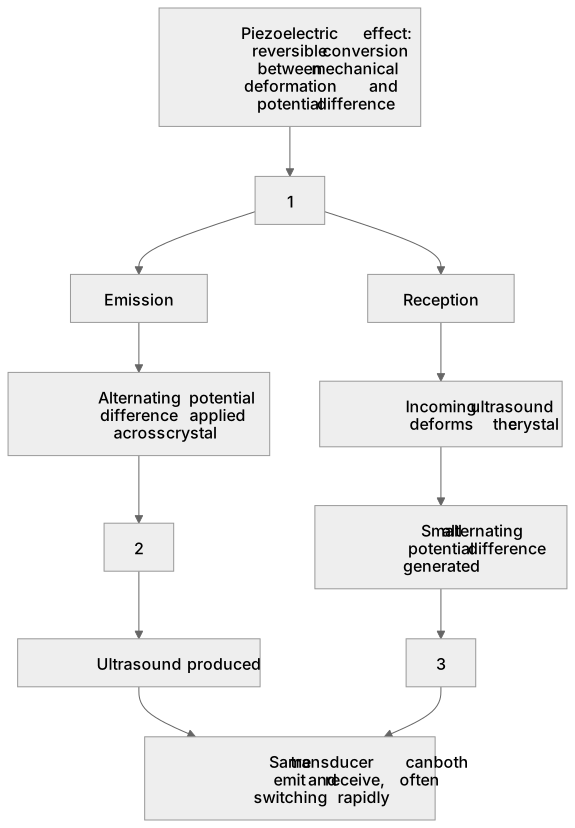
Some boxes have lost their names. Pick the right name for each number.
1Box 1
2Box 2
3Box 3
There is more to this lesson
The full lesson goes on to check your understanding and help you earn the marks. Create a free account to carry on, with your progress saved.
A week of Premium from your first lesson · Then the free plan continues · No card, no charge
Test your understanding of Using ultrasound: (b) piezoelectric effect; ultrasound transducer as a device that emits and receives ultrasound
Active recall beats re-reading. Take an instant quiz now to test what you’ve learned and lock it into long-term memory.
A week of Premium from your first lesson · Then the free plan continues · No card, no charge