OCR · A-Level · Physics
Course version: H556 · Version from Sept 2015
Using ultrasound: (d) acoustic impedance of a medium; Z = ρc
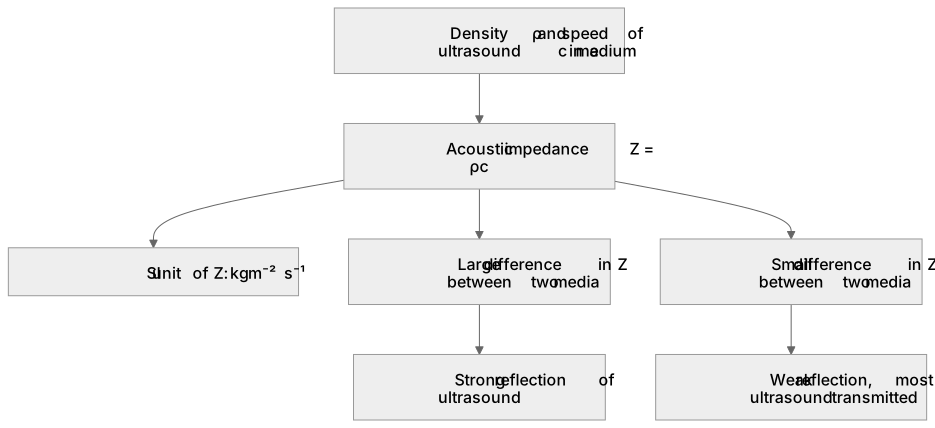
Acoustic impedance Z of a medium is the product of its density ρ and the speed of ultrasound c in that medium, given by Z = ρc.
Checked against the OCR H556 specification (opens in a new tab) on .
- Point 4 of 8
Study notes
From the checked teaching notes for this specification point.
The idea
Acoustic impedance Z of a medium is the product of its density ρ and the speed of ultrasound c in that medium, given by Z = ρc. The SI unit of Z is kg m⁻² s⁻¹, which is equivalent to Pa s m⁻¹. Acoustic impedance determines how much ultrasound is reflected at a boundary between two media: a large difference in Z produces a strong reflection, while a small difference produces weak reflection. For example, the acoustic impedance of soft tissue is about 1.6 × 10⁶ kg m⁻² s⁻¹, and that of air is much lower, so ultrasound is almost totally reflected at a tissue–air boundary. Ensure you use consistent SI units: density in kg m⁻³ and speed in m s⁻¹.
What earns the marks
- Acoustic impedance Z is defined as Z = ρc, where ρ is density and c is the speed of ultrasound in the medium.
- The SI unit of Z is kg m⁻² s⁻¹.
- A large difference in acoustic impedance between two media causes a large proportion of ultrasound to be reflected.
- A small difference in acoustic impedance causes little reflection and most ultrasound to be transmitted.
- Acoustic impedance depends on both the density of the medium and the speed of ultrasound in it.
Common mistakes and how to put them right
Using density in g cm⁻³ without converting to kg m⁻³.
Put it right by converting to SI units before calculating Z.
Thinking that a large impedance difference means most ultrasound is transmitted.
Put it right by stating that a large difference causes strong reflection.
Confusing acoustic impedance with electrical impedance.
Put it right by defining Z as the product of density and ultrasound speed, with units kg m⁻² s⁻¹.
Exam tips
- Write down Z = ρc and substitute values with units before calculating.
- Check that density is in kg m⁻³ and speed is in m s⁻¹ to obtain Z in kg m⁻² s⁻¹.
- When comparing boundaries, calculate the difference in Z or the ratio to judge reflection strength.
Try the lesson
The start of the Using ultrasound: (d) acoustic impedance of a medium; Z = ρc lesson, made from checked teaching notes for this specification point.
Listen
Acoustic impedance Z of a medium is the product of its density ρ and the speed of ultrasound c in that medium, given by Z = ρc. The SI unit of Z is kg m⁻² s⁻¹, which is equivalent to Pa s m⁻¹. Acoustic impedance determines how much ultrasound is reflected at a boundary between two media: a large difference in Z produces a strong reflection, while a small difference produces weak reflection. For example, the acoustic impedance of soft tissue is about 1.6 × 10⁶ kg m⁻² s⁻¹, and that of air is much lower, so ultrasound is almost totally reflected at a tissue–air boundary. Ensure you use consistent SI units: density in kg m⁻³ and speed in m s⁻¹. A strong answer earns marks for these points. Acoustic impedance Z is defined as Z = ρc, where ρ is density and c is the speed of ultrasound in the medium. The SI unit of Z is kg m⁻² s⁻¹. A large difference in acoustic impedance between two media causes a large proportion of ultrasound to be reflected. A small difference in acoustic impedance causes little reflection and most ultrasound to be transmitted. A common slip: Using density in g cm⁻³ without converting to kg m⁻³. Instead, converting to SI units before calculating Z. Exam tip: Write down Z = ρc and substitute values with units before calculating.
See it
Label the diagram
Some boxes have lost their names. Pick the right name for each number.
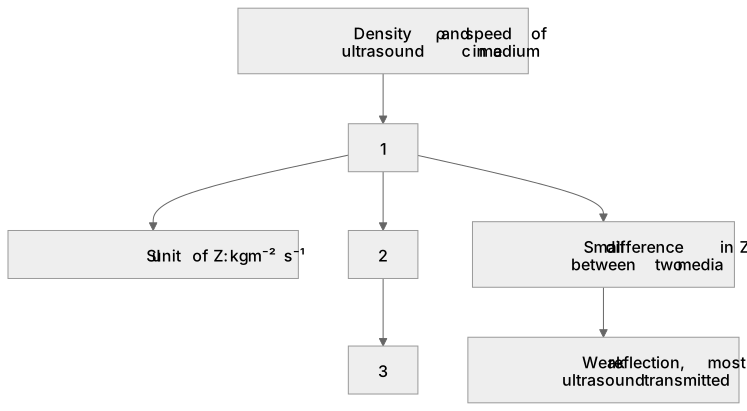
1Box 1
2Box 2
3Box 3
There is more to this lesson
The full lesson goes on to check your understanding and help you earn the marks. Create a free account to carry on, with your progress saved.
A week of Premium from your first lesson · Then the free plan continues · No card, no charge
Test your understanding of Using ultrasound: (d) acoustic impedance of a medium; Z = ρc
Active recall beats re-reading. Take an instant quiz now to test what you’ve learned and lock it into long-term memory.
A week of Premium from your first lesson · Then the free plan continues · No card, no charge