OCR · GCSE · Physics
Course version: J249 · Version from Sept 2018
Explain how, for a stable orbit, the radius must change if this speed…
Full specification wording
Beyond Earth: explain how, for a stable orbit, the radius must change if this speed changes (qualitative only) (content found only in the physics separate science qualification) (Higher tier only)
A satellite stays in a stable circular orbit when gravity supplies exactly the centripetal force it needs.
Checked against the OCR J249 specification (opens in a new tab) on .
- Point 7 of 8
- 4 key terms
Study notes
From the checked teaching notes for this specification point.
The idea
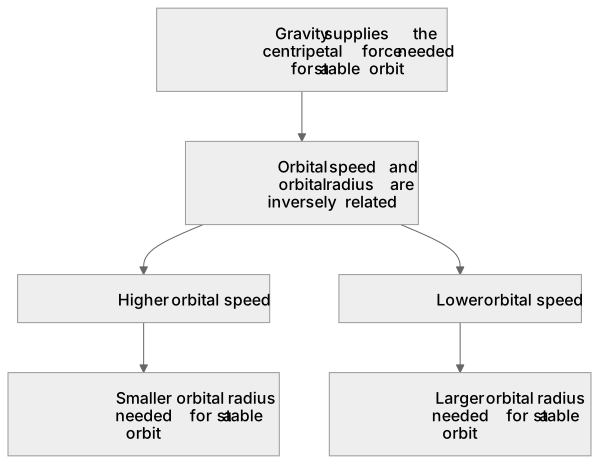
A satellite stays in a stable circular orbit when gravity supplies exactly the centripetal force it needs. For a given central body, the orbital speed and the orbital radius are inversely related: a faster stable orbit must have a smaller radius, and a slower stable orbit must have a larger radius. So if a satellite's speed is increased and it is to settle into a new stable orbit, its radius must decrease; if its speed is reduced, its radius must increase. This is qualitative only at Higher tier: you reason about the direction of the change, not a numerical calculation. A useful check is that a satellite close to a planet orbits quickly, while a distant satellite orbits slowly.
What earns the marks
- States that for a stable orbit a higher orbital speed requires a smaller orbital radius.
- States that for a stable orbit a lower orbital speed requires a larger orbital radius.
- Explains that gravity provides the centripetal force needed to keep the satellite in a stable orbit.
- Applies the inverse relationship to a described change, for example concluding that increasing a satellite's speed means its stable-orbit radius must decrease.
Common mistakes and how to put them right
Claims that a faster stable orbit needs a larger radius.
Put it right by stating that a higher speed corresponds to a smaller radius.
Claims that a slower stable orbit needs a smaller radius.
Put it right by stating that a lower speed corresponds to a larger radius.
Treats the relationship as direct rather than inverse.
Put it right by checking that speed and radius change in opposite directions for a stable orbit.
Exam tips
- Read the question carefully to see whether speed is being increased or decreased, then state the opposite change in radius.
- Use the words 'stable orbit' in your answer so the examiner sees you are applying the orbital relationship, not a general motion rule.
- Keep the answer qualitative: describe the direction of the radius change rather than attempting a calculation.
Try the lesson
The start of the Beyond Earth: explain how, for a stable orbit, the radius must change if this speed changes (qualitative only) (content found only in the physics separate science qualification) (Higher tier only) lesson, made from checked teaching notes for this specification point.
Have a go first
A satellite is in a stable circular orbit around the Earth. If the satellite's orbital speed is increased and it then settles into a new stable circular orbit, how must the orbital radius change?
Listen
A satellite stays in a stable circular orbit when gravity supplies exactly the centripetal force it needs. For a given central body, the orbital speed and the orbital radius are inversely related: a faster stable orbit must have a smaller radius, and a slower stable orbit must have a larger radius. So if a satellite's speed is increased and it is to settle into a new stable orbit, its radius must decrease; if its speed is reduced, its radius must increase. This is qualitative only at Higher tier: you reason about the direction of the change, not a numerical calculation. A useful check is that a satellite close to a planet orbits quickly, while a distant satellite orbits slowly. A strong answer earns marks for these points. States that for a stable orbit a higher orbital speed requires a smaller orbital radius. States that for a stable orbit a lower orbital speed requires a larger orbital radius. Explains that gravity provides the centripetal force needed to keep the satellite in a stable orbit. Applies the inverse relationship to a described change, for example concluding that increasing a satellite's speed means its stable-orbit radius must decrease. A common slip: Claims that a faster stable orbit needs a larger radius. Instead, stating that a higher speed corresponds to a smaller radius. Exam tip: Read the question carefully to see whether speed is being increased or decreased, then state the opposite change in radius.
See it
Key words
Say what each word means before you turn the card.
Stable orbit
Try answering aloud or in your head before turning the card.
Inverse relationship between orbital speed and radius
Try answering aloud or in your head before turning the card.
Gravity as the force maintaining orbits
Try answering aloud or in your head before turning the card.
Qualitative reasoning about change
Try answering aloud or in your head before turning the card.
See every definition
- Stable orbit
- A satellite stays in a stable circular orbit when gravity supplies exactly the centripetal force it needs.
- Inverse relationship between orbital speed and radius
- For a given central body, a faster stable orbit must have a smaller radius, and a slower stable orbit must have a larger radius.
- Gravity as the force maintaining orbits
- Gravity provides the centripetal force needed to keep the satellite in a stable orbit.
- Qualitative reasoning about change
- You reason about the direction of the change, not a numerical calculation.
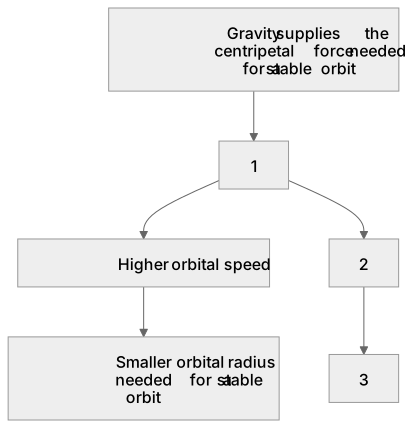
Label the diagram
Some boxes have lost their names. Pick the right name for each number.
1Box 1
2Box 2
3Box 3
There is more to this lesson
The full lesson goes on to check your understanding and help you earn the marks. Create a free account to carry on, with your progress saved.
A week of Premium from your first lesson · Then the free plan continues · No card, no charge
Test your understanding of Beyond Earth: explain how, for a stable orbit, the radius must change if this speed changes (qualitative only) (content found only in the physics separate science qualification) (Higher tier only)
Active recall beats re-reading. Take an instant quiz now to test what you’ve learned and lock it into long-term memory.
A week of Premium from your first lesson · Then the free plan continues · No card, no charge