OCR · GCSE · Physics
Course version: J249 · Version from Sept 2018
Explain how the temperature of a body is related to the balance between…
Full specification wording
Beyond Earth: explain how the temperature of a body is related to the balance between incoming radiation absorbed and radiation emitted; illustrate this balance using everyday examples and the example of the factors which determine the temperature of the Earth (to include: an understanding that Earth’s atmosphere affects the electromagnetic radiation from the Sun that passes through it) (content found only in the physics separate science qualification) (Higher tier only)
A body's temperature depends on the balance between the radiation it absorbs and the radiation it emits.
Checked against the OCR J249 specification (opens in a new tab) on .
- Point 8 of 8
- 4 key terms
Study notes
From the checked teaching notes for this specification point.
The idea
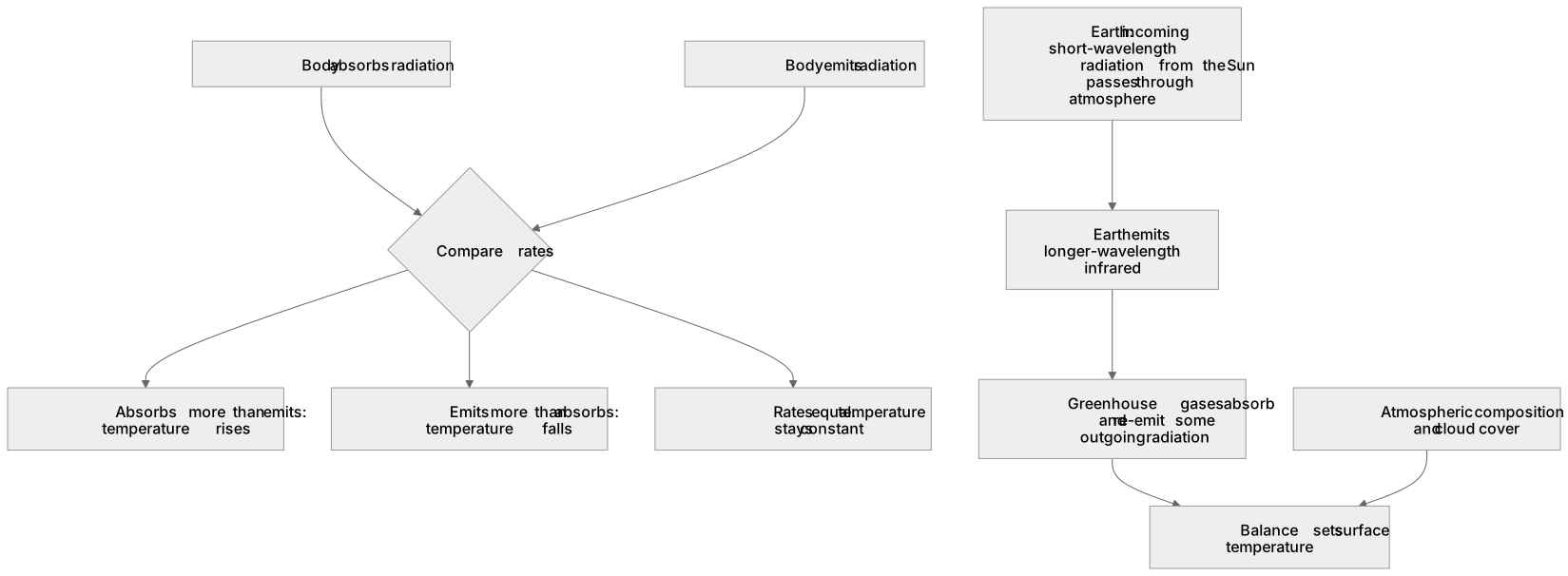
A body's temperature depends on the balance between the radiation it absorbs and the radiation it emits. If it absorbs more than it emits, its temperature rises; if it emits more than it absorbs, its temperature falls; when the two rates are equal, its temperature stays constant. Everyday examples include a cup of hot drink cooling because it emits more infrared than it absorbs, and a car left in sunshine warming because it absorbs more than it emits. For the Earth, incoming short-wavelength radiation from the Sun passes through the atmosphere, while the Earth emits longer-wavelength infrared; greenhouse gases absorb and re-emit some of this outgoing radiation, so the balance sets the surface temperature. Factors such as the atmosphere's composition and cloud cover therefore affect how much solar radiation reaches the surface and how much escapes.
What earns the marks
- States that a body's temperature rises when it absorbs more radiation than it emits and falls when it emits more than it absorbs.
- States that temperature stays constant when the rates of absorption and emission are equal.
- Illustrates the balance with an everyday example such as a cooling hot drink or a warming object in sunlight.
- Explains that the Earth's atmosphere affects how much of the Sun's electromagnetic radiation reaches the surface and how much outgoing radiation escapes.
- Identifies factors such as atmospheric composition or cloud cover that determine the Earth's temperature through this balance.
Common mistakes and how to put them right
Claims temperature depends only on absorption.
Put it right by including the emitted radiation and comparing the two rates.
Says the atmosphere blocks all solar radiation.
Put it right by noting that some electromagnetic radiation from the Sun passes through.
Ignores the outgoing radiation from the Earth.
Put it right by describing emission of longer-wavelength infrared and its partial absorption by the atmosphere.
Gives an everyday example without linking it to the absorption-emission balance.
Put it right by stating which rate is greater.
Exam tips
- Always compare the rate of absorption with the rate of emission to decide the temperature change.
- Use a named everyday example and state which rate is larger.
- For the Earth, mention that the atmosphere affects both incoming solar radiation and outgoing radiation.
Try the lesson
The start of the Beyond Earth: explain how the temperature of a body is related to the balance between incoming radiation absorbed and radiation emitted; illustrate this balance using everyday examples and the example of the factors which determine the temperature of the Earth (to include: an understanding that Earth’s atmosphere affects the electromagnetic radiation from the Sun that passes through it) (content found only in the physics separate science qualification) (Higher tier only) lesson, made from checked teaching notes for this specification point.
Have a go first
A cup of hot tea cools down in a room. Which statement about the radiation balance is correct?
Listen
A body's temperature depends on the balance between the radiation it absorbs and the radiation it emits. If it absorbs more than it emits, its temperature rises; if it emits more than it absorbs, its temperature falls; when the two rates are equal, its temperature stays constant. Everyday examples include a cup of hot drink cooling because it emits more infrared than it absorbs, and a car left in sunshine warming because it absorbs more than it emits. For the Earth, incoming short-wavelength radiation from the Sun passes through the atmosphere, while the Earth emits longer-wavelength infrared; greenhouse gases absorb and re-emit some of this outgoing radiation, so the balance sets the surface temperature. Factors such as the atmosphere's composition and cloud cover therefore affect how much solar radiation reaches the surface and how much escapes. A strong answer earns marks for these points. States that a body's temperature rises when it absorbs more radiation than it emits and falls when it emits more than it absorbs. States that temperature stays constant when the rates of absorption and emission are equal. Illustrates the balance with an everyday example such as a cooling hot drink or a warming object in sunlight. Explains that the Earth's atmosphere affects how much of the Sun's electromagnetic radiation reaches the surface and how much outgoing radiation escapes. A common slip: Claims temperature depends only on absorption. Instead, including the emitted radiation and comparing the two rates. Exam tip: Always compare the rate of absorption with the rate of emission to decide the temperature change.
See it
Key words
Say what each word means before you turn the card.
Absorption and emission of radiation
Try answering aloud or in your head before turning the card.
Thermal equilibrium and temperature change
Try answering aloud or in your head before turning the card.
Greenhouse effect and Earth's temperature
Try answering aloud or in your head before turning the card.
Effect of the atmosphere on electromagnetic radiation
Try answering aloud or in your head before turning the card.
See every definition
- Absorption and emission of radiation
- A body's temperature rises when it absorbs more radiation than it emits, falls when it emits more than it absorbs, and stays constant when the rates are equal.
- Thermal equilibrium and temperature change
- When the rates of absorption and emission are equal, the temperature stays constant; otherwise the temperature rises or falls.
- Greenhouse effect and Earth's temperature
- Greenhouse gases absorb and re-emit some of the Earth's outgoing longer-wavelength infrared, so the balance sets the surface temperature.
- Effect of the atmosphere on electromagnetic radiation
- Incoming short-wavelength radiation from the Sun passes through the atmosphere, while the Earth emits longer-wavelength infrared, some of which the atmosphere absorbs and re-emits.
There is more to this lesson
The full lesson goes on to check your understanding and help you earn the marks. Create a free account to carry on, with your progress saved.
A week of Premium from your first lesson · Then the free plan continues · No card, no charge
Test your understanding of Beyond Earth: explain how the temperature of a body is related to the balance between incoming radiation absorbed and radiation emitted; illustrate this balance using everyday examples and the example of the factors which determine the temperature of the Earth (to include: an understanding that Earth’s atmosphere affects the electromagnetic radiation from the Sun that passes through it) (content found only in the physics separate science qualification) (Higher tier only)
Active recall beats re-reading. Take an instant quiz now to test what you’ve learned and lock it into long-term memory.
A week of Premium from your first lesson · Then the free plan continues · No card, no charge