OCR · GCSE · Physics
Course version: J249 · Version from Sept 2018
Explain that all bodies emit radiation, and that the intensity and…
Full specification wording
Beyond Earth: explain that all bodies emit radiation, and that the intensity and wavelength distribution of any emission depends on their temperatures (to include: an understanding that hot objects can emit a continuous range of electromagnetic radiation at different energy values and therefore frequencies and wavelengths) (content found only in the physics separate science qualification)
Every object with a temperature above absolute zero emits electromagnetic radiation.
Checked against the OCR J249 specification (opens in a new tab) on .
- Point 4 of 8
- 4 key terms
Study notes
From the checked teaching notes for this specification point.
The idea
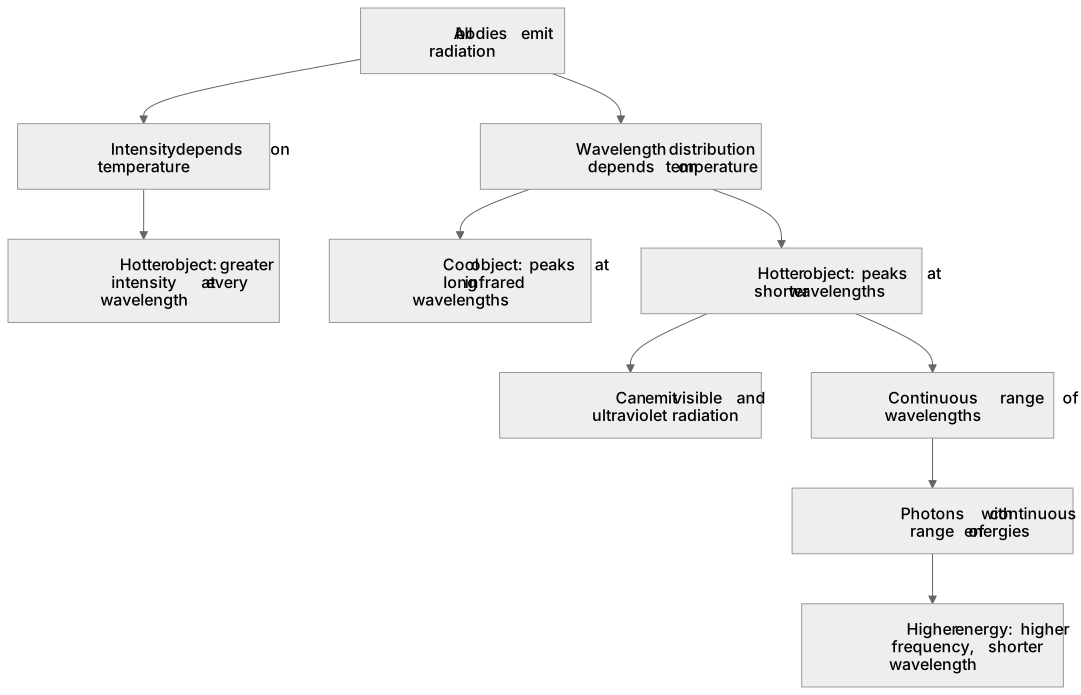
Every object with a temperature above absolute zero emits electromagnetic radiation. The hotter the object, the greater the intensity of radiation it emits at every wavelength. Temperature also changes the wavelength distribution: a cool object emits most strongly at long infrared wavelengths, while a hotter object peaks at shorter wavelengths and can emit visible and ultraviolet radiation. Because a hot object emits a continuous range of wavelengths, it emits photons with a continuous range of energies; since energy is proportional to frequency (E = hf) and frequency is inversely proportional to wavelength, higher-energy photons correspond to shorter wavelengths.
What earns the marks
- States that all bodies emit radiation and that intensity increases with temperature.
- Explains that the wavelength at which emission peaks becomes shorter as temperature rises.
- Describes a hot object emitting a continuous range of electromagnetic radiation with different energies, frequencies and wavelengths.
- Links photon energy to frequency and wavelength, noting that higher energy corresponds to higher frequency and shorter wavelength.
Common mistakes and how to put them right
States that only hot objects emit radiation.
Put it right by noting that all bodies above absolute zero emit radiation.
Claims that a hotter object emits only shorter wavelengths.
Put it right by stating that it emits a continuous range but peaks at shorter wavelengths.
Treats wavelength and frequency as directly proportional.
Put it right by stating that they are inversely proportional.
Exam tips
- Use the phrase continuous range when describing emission from a hot object.
- State the direction of change: hotter means higher intensity and shorter peak wavelength.
- Recall that photon energy increases with frequency and decreases with wavelength.
Try the lesson
The start of the Beyond Earth: explain that all bodies emit radiation, and that the intensity and wavelength distribution of any emission depends on their temperatures (to include: an understanding that hot objects can emit a continuous range of electromagnetic radiation at different energy values and therefore frequencies and wavelengths) (content found only in the physics separate science qualification) lesson, made from checked teaching notes for this specification point.
Have a go first
A student says that a cold metal block at 5 °C gives off no radiation at all. Which statement is correct?
Listen
Every object with a temperature above absolute zero emits electromagnetic radiation. The hotter the object, the greater the intensity of radiation it emits at every wavelength. Temperature also changes the wavelength distribution: a cool object emits most strongly at long infrared wavelengths, while a hotter object peaks at shorter wavelengths and can emit visible and ultraviolet radiation. Because a hot object emits a continuous range of wavelengths, it emits photons with a continuous range of energies; since energy is proportional to frequency (E = hf) and frequency is inversely proportional to wavelength, higher-energy photons correspond to shorter wavelengths. A strong answer earns marks for these points. States that all bodies emit radiation and that intensity increases with temperature. Explains that the wavelength at which emission peaks becomes shorter as temperature rises. Describes a hot object emitting a continuous range of electromagnetic radiation with different energies, frequencies and wavelengths. Links photon energy to frequency and wavelength, noting that higher energy corresponds to higher frequency and shorter wavelength. A common slip: States that only hot objects emit radiation. Instead, noting that all bodies above absolute zero emit radiation. Exam tip: Use the phrase continuous range when describing emission from a hot object.
See it
Key words
Say what each word means before you turn the card.
All bodies emit radiation
Try answering aloud or in your head before turning the card.
Intensity depends on temperature
Try answering aloud or in your head before turning the card.
Wavelength distribution depends on temperature
Try answering aloud or in your head before turning the card.
Continuous range of electromagnetic radiation
Try answering aloud or in your head before turning the card.
See every definition
- All bodies emit radiation
- Every object with a temperature above absolute zero emits electromagnetic radiation.
- Intensity depends on temperature
- The hotter the object, the greater the intensity of radiation it emits at every wavelength.
- Wavelength distribution depends on temperature
- A cool object emits most strongly at long infrared wavelengths, while a hotter object peaks at shorter wavelengths.
- Continuous range of electromagnetic radiation
- A hot object emits a continuous range of wavelengths, so it emits photons with a continuous range of energies.
Label the diagram
Some boxes have lost their names. Pick the right name for each number.
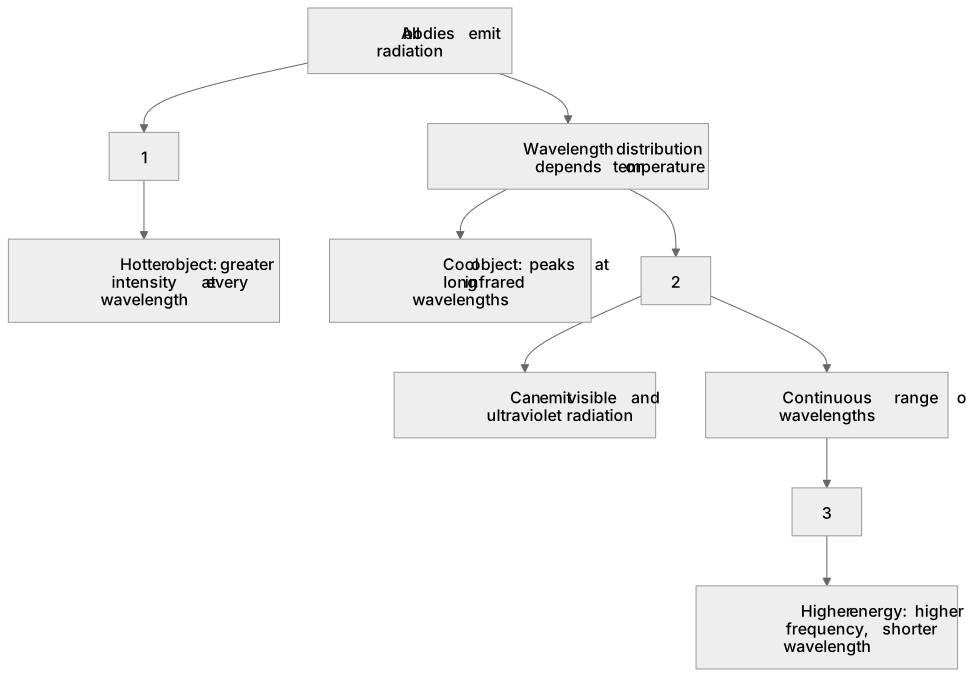
1Box 1
2Box 2
3Box 3
There is more to this lesson
The full lesson goes on to check your understanding and help you earn the marks. Create a free account to carry on, with your progress saved.
A week of Premium from your first lesson · Then the free plan continues · No card, no charge
Test your understanding of Beyond Earth: explain that all bodies emit radiation, and that the intensity and wavelength distribution of any emission depends on their temperatures (to include: an understanding that hot objects can emit a continuous range of electromagnetic radiation at different energy values and therefore frequencies and wavelengths) (content found only in the physics separate science qualification)
Active recall beats re-reading. Take an instant quiz now to test what you’ve learned and lock it into long-term memory.
A week of Premium from your first lesson · Then the free plan continues · No card, no charge