OCR · GCSE · Physics
Course version: J249 · Version from Sept 2018
Recall the main features of our solar system, including the similarities…
Full specification wording
Beyond Earth: recall the main features of our solar system, including the similarities and distinctions between the planets, their moons, and artificial satellites (to include: the 8 planets and knowledge of minor planets, geostationary and polar orbits for artificial satellites and how these may be similar to or differ from natural satellites) (content found only in the physics separate science qualification)
Our solar system contains the Sun and eight planets in order from the Sun: Mercury, Venus, Earth, Mars, Jupiter, Saturn, Uranus and Neptune.
Checked against the OCR J249 specification (opens in a new tab) on .
- Point 5 of 8
- 4 key terms
Study notes
From the checked teaching notes for this specification point.
The idea
Our solar system contains the Sun and eight planets in order from the Sun: Mercury, Venus, Earth, Mars, Jupiter, Saturn, Uranus and Neptune. Minor planets, such as asteroids in the asteroid belt and dwarf planets beyond Neptune, also orbit the Sun but are much smaller than planets. Most planets have natural satellites (moons) that orbit them, for example the Moon orbiting Earth. Artificial satellites are human-made objects placed in orbit, often around Earth. A geostationary satellite orbits above the equator with a period of 24 hours, so it stays above the same point on Earth's surface; a polar satellite passes over the poles in a lower orbit and scans the whole surface as Earth rotates beneath it. Both kinds of artificial satellite are held in orbit by gravity, just as natural satellites are, but they differ in origin, orbit and purpose.
What earns the marks
- Lists the eight planets in order from the Sun as Mercury, Venus, Earth, Mars, Jupiter, Saturn, Uranus and Neptune.
- Identifies minor planets such as asteroids and dwarf planets as small bodies orbiting the Sun.
- States that natural satellites are moons orbiting planets, whereas artificial satellites are human-made objects placed in orbit.
- Describes a geostationary satellite as orbiting above the equator with a 24-hour period so it stays above one point on Earth.
- Describes a polar satellite as passing over the poles in a low orbit and scanning the whole surface as Earth rotates.
- Explains that gravity keeps both natural and artificial satellites in orbit.
Common mistakes and how to put them right
Places the planets in the wrong order.
Put it right: Learn the sequence outwards from the Sun as Mercury, Venus, Earth, Mars, Jupiter, Saturn, Uranus and Neptune.
Treats the Moon as a planet.
Put it right: Classify it as a natural satellite of Earth.
Confuses geostationary and polar orbits.
Put it right: Link geostationary to a 24-hour equatorial orbit and polar to a low orbit over the poles.
Claims artificial satellites are not held by gravity.
Put it right: State that gravity keeps both natural and artificial satellites in orbit.
Exam tips
- Learn the eight planets in order from the Sun so you can pick the correct option quickly.
- Link each orbit type to its purpose: geostationary for continuous coverage of one region, polar for scanning the whole surface.
- Check whether a question asks about similarities or differences before choosing an option.
- Remember that moons and artificial satellites are both satellites held in orbit by gravity.
Try the lesson
The start of the Beyond Earth: recall the main features of our solar system, including the similarities and distinctions between the planets, their moons, and artificial satellites (to include: the 8 planets and knowledge of minor planets, geostationary and polar orbits for artificial satellites and how these may be similar to or differ from natural satellites) (content found only in the physics separate science qualification) lesson, made from checked teaching notes for this specification point.
Have a go first
How many planets are there in our solar system?
Listen
Our solar system contains the Sun and eight planets in order from the Sun: Mercury, Venus, Earth, Mars, Jupiter, Saturn, Uranus and Neptune. Minor planets, such as asteroids in the asteroid belt and dwarf planets beyond Neptune, also orbit the Sun but are much smaller than planets. Most planets have natural satellites (moons) that orbit them, for example the Moon orbiting Earth. Artificial satellites are human-made objects placed in orbit, often around Earth. A geostationary satellite orbits above the equator with a period of 24 hours, so it stays above the same point on Earth's surface; a polar satellite passes over the poles in a lower orbit and scans the whole surface as Earth rotates beneath it. Both kinds of artificial satellite are held in orbit by gravity, just as natural satellites are, but they differ in origin, orbit and purpose. A strong answer earns marks for these points. Lists the eight planets in order from the Sun as Mercury, Venus, Earth, Mars, Jupiter, Saturn, Uranus and Neptune. Identifies minor planets such as asteroids and dwarf planets as small bodies orbiting the Sun. States that natural satellites are moons orbiting planets, whereas artificial satellites are human-made objects placed in orbit. Describes a geostationary satellite as orbiting above the equator with a 24-hour period so it stays above one point on Earth. Exam tip: Learn the eight planets in order from the Sun so you can pick the correct option quickly.
See it
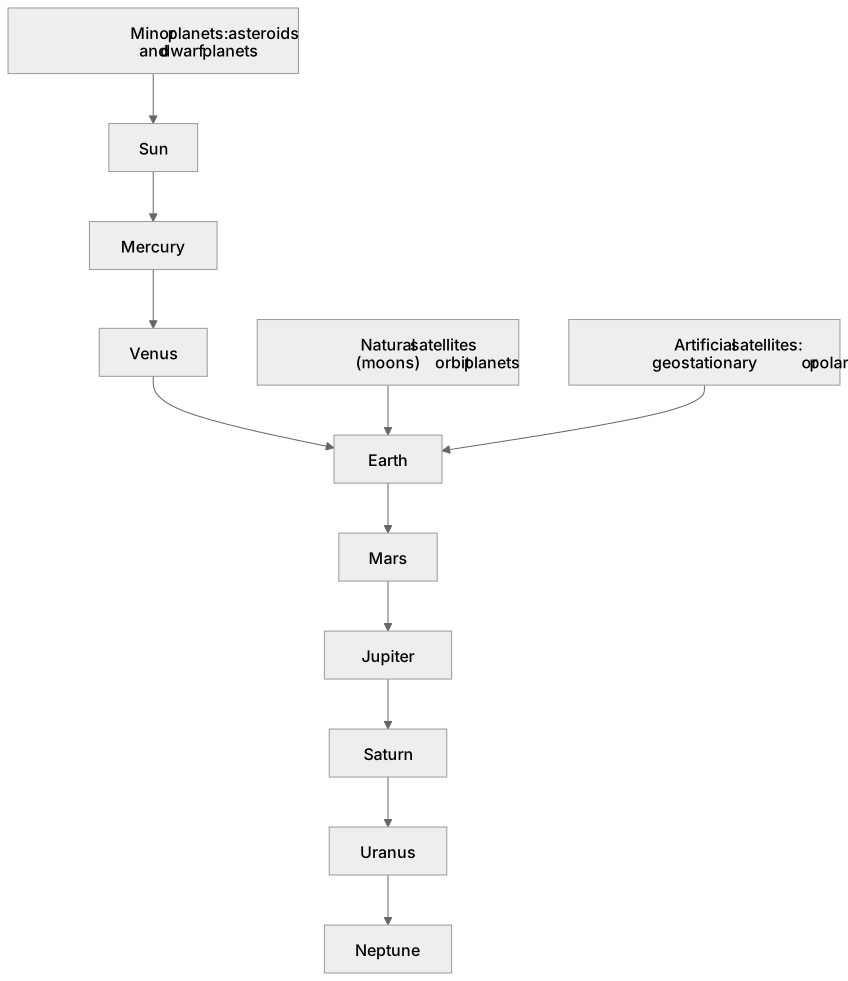
Key words
Say what each word means before you turn the card.
The eight planets and minor planets
Try answering aloud or in your head before turning the card.
Natural satellites (moons)
Try answering aloud or in your head before turning the card.
Artificial satellites: geostationary and polar orbits
Try answering aloud or in your head before turning the card.
Structure of the solar system
Try answering aloud or in your head before turning the card.
See every definition
- The eight planets and minor planets
- Our solar system contains the Sun and eight planets in order from the Sun, while minor planets also orbit the Sun but are much smaller than planets.
- Natural satellites (moons)
- Most planets have moons that orbit them, for example the Moon orbiting Earth.
- Artificial satellites: geostationary and polar orbits
- Human-made objects placed in orbit, often around Earth; a geostationary satellite orbits above the equator with a period of 24 hours, and a polar satellite passes over the poles in a lower orbit.
- Structure of the solar system
- The Sun and eight planets in order from the Sun, with minor planets also orbiting the Sun and most planets having moons that orbit them.
Label the diagram
Some boxes have lost their names. Pick the right name for each number.
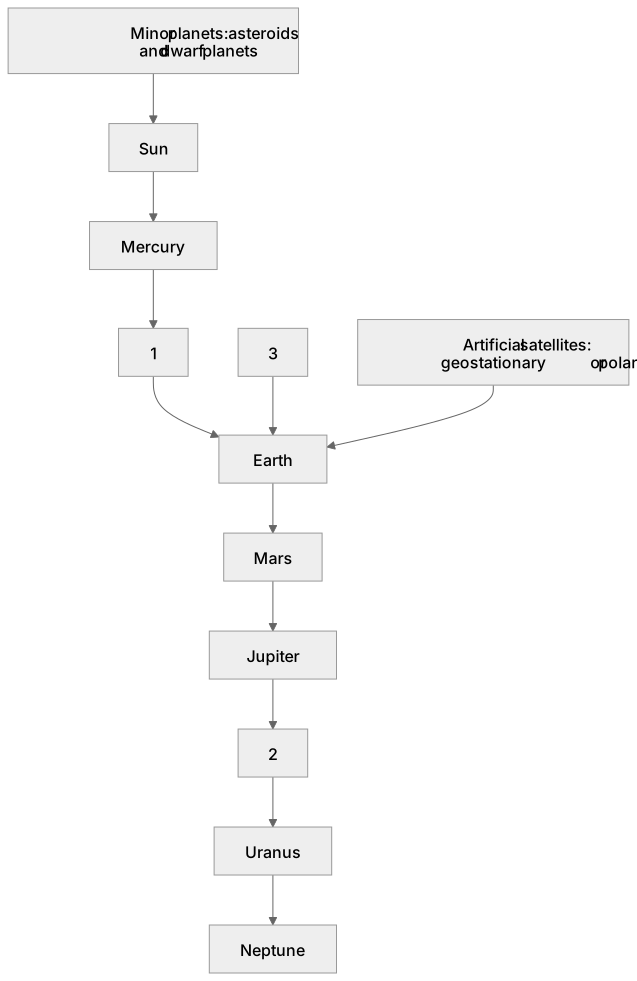
1Box 1
2Box 2
3Box 3
There is more to this lesson
The full lesson goes on to check your understanding and help you earn the marks. Create a free account to carry on, with your progress saved.
A week of Premium from your first lesson · Then the free plan continues · No card, no charge
Test your understanding of Beyond Earth: recall the main features of our solar system, including the similarities and distinctions between the planets, their moons, and artificial satellites (to include: the 8 planets and knowledge of minor planets, geostationary and polar orbits for artificial satellites and how these may be similar to or differ from natural satellites) (content found only in the physics separate science qualification)
Active recall beats re-reading. Take an instant quiz now to test what you’ve learned and lock it into long-term memory.
A week of Premium from your first lesson · Then the free plan continues · No card, no charge